Colorado Elk Field Judging Tips
There's nothing quite like the heart-pounding rush of spotting a magnificent bull elk, especially in the rugged, breathtaking country of Colorado. In that split second, with adrenaline surging and time feeling like it's slipping away, you're faced with a critical decision: is he the one? Field judging an elk in those fleeting moments is one of the toughest challenges a hunter faces, often leading to hurried decisions or, worse, passed opportunities. This guide is here to strip away some of that uncertainty, providing you with practical, realistic tips to confidently assess an elk's rack in the wild.
The Pressure of the Moment: Why Field Judging is So Tricky
Let's be honest, standing there, rifle shouldered or bow drawn, with a bull elk in your sights, isn't exactly the ideal scenario for calm, calculated analysis. It's a high-stakes, high-emotion situation, and it's completely natural to feel overwhelmed. Many hunters, even seasoned ones, find themselves second-guessing their initial judgments once the moment has passed. Understanding why it's so hard is the first step in preparing to do it better.
The Adrenaline Dump and Fleeting Opportunities
Picture this: you've been grinding for days in the Colorado Backcountry Hunting Guide terrain of the Flat Tops Wilderness, maybe even called in a few cows with your best attempts at How to Cow Call Colorado Elk, but no bull has committed. Then, suddenly, through a break in the timber, he appears. A big body, darker antlers, a glint of ivory tips. Your heart leaps into your throat, your hands might even tremble a bit. This physiological response, the "fight or flight" mechanism, is fantastic for survival but terrible for intricate antler estimation. Your focus narrows, peripheral vision blurs, and the clock seems to speed up. The elk might only offer a clear view for seconds before disappearing into a draw or behind a patch of aspens. You have to make a call, and quickly. This intense pressure makes it incredibly difficult to recall all the mental checklists you studied back home.
The Deceptive Dance of Distance and Terrain
Elk, bless their massive hearts, are masters of camouflage and illusion. A bull that looks enormous at 100 yards can shrink dramatically when you close the distance, and conversely, a bull appearing mediocre far off might reveal impressive size when he steps into the open. Uneven terrain in places like the San Juan Mountains, with their steep inclines and deep canyons, plays tricks on your eyes, distorting perceptions of height and width. A main beam sweeping uphill can look longer, while one dipping downhill might seem shorter. Shadows, fog, or the dappled light filtering through a dense canopy in the White River National Forest can further obscure details, making points disappear or enhancing the appearance of mass. Judging a bull against a backdrop of varying textures and colors is a far cry from looking at a taxidermy mount in a brightly lit room. This is why having Best Optics for Colorado Big Game and knowing How to Glass Big Colorado Basins are absolutely crucial, giving you every advantage to mitigate these optical illusions.
Dissecting the Rack: Key Antler Anatomy for Scoring
Before you can estimate a score, you need to understand what you're actually looking at and how Boone and Crockett (B&C) or Pope and Young (P&Y) scores are calculated. It's not just about the number of points; it's a complex equation involving length, mass, and symmetry. Getting familiar with the terminology will help you break down a bull's rack into manageable assessment components, even under pressure.
Main Beam, Points, and Mass: The Big Three
When you first lay eyes on a bull, your brain probably registers "big" or "small" based on the overall impression. But to field judge effectively, you need to mentally dissect the rack.
-
Main Beam: This is the primary antler shaft that sweeps back and then forward, typically forming the largest curve. Its length is a huge factor in the overall score. Visualize how far it extends past the animal's ear or nose. A long, graceful main beam that curls forward is a significant contributor to score. Think about it like this: if the beam doesn't extend much past the back of the ear when the elk's head is upright, it's likely a shorter beam. If it reaches past the eye or even the nose, you've got a seriously long main beam. The sweep and symmetry of the main beams are also important. Are they evenly matched? Do they have a good, wide arc?
-
Points (Tines): These are the individual projections coming off the main beam. For B&C/P&Y scoring, only "typical" points are counted (those growing off the main beam in a generally upward direction, at least one inch long). Elk typically have a brow tine (G1), a bez tine (G2), a trez tine (G3), a royal tine (G4), and then often a fifth and sometimes a sixth point (G5, G6). The length of these tines, particularly the G3 and G4, adds substantial inches to the score. Don't just count; estimate their length relative to the main beam or the animal's ear. Are they long and slender, or shorter and stubby? A G3 that's as long as or longer than the G2 is often a sign of a good bull, as is a royal tine (G4) that really reaches.
-
Mass (Circumference): This is often overlooked but is a critical component of a good score. Mass refers to the thickness of the main beam at various points. B&C measures four circumference points between the burr (the base of the antler) and the tip of the G4. A bull with heavy, thick beams will score much higher than a bull with long, slender antlers. Look for a bull whose antlers look "ropey" or "corky" all the way out, maintaining their thickness rather than tapering quickly. Compare the thickness of the beam to the diameter of the elk's eye or muzzle. A main beam that's consistently as thick as its eye or thicker, especially past the G2, is a good indicator of solid mass.
Tines: Counting and Length
Counting points might seem straightforward, but in the field, it can be anything but. Elk are famous for their brow tines, bez, trez, and royals. A "six-point" (or "6×6") is the holy grail for many, meaning six typical points on each side. But what if one side is a 5×6 or a 6×7? Symmetry is favored in scoring, but an asymmetrical bull can still be magnificent and score well on gross inches.
When counting, pay special attention to the G1 and G2 tines (brow and bez). They're often shorter and can be hidden by foliage or the animal's head position. The G3 and G4 are usually the longest and most impressive. Look for kicker points, stickers, or cheaters – these are non-typical points that might add to the gross score but are deductions in typical scoring. For a quick estimate, focus on the overall length of the tines. Are they reaching upwards, past the main beam, or do they seem short? A bull with long, dagger-like tines on his G3s and G4s immediately stands out as having greater scoring potential.
Metrics That Matter: Estimating Gross Score on the Fly
Now that you've got the anatomy down, let's talk about how to quickly translate that into a rough score estimate. This isn't an exact science in the field; it's about making educated comparisons and using visual benchmarks.
Main Beam Length and Curvature
The main beams are like the foundation of the score. A bull with beams that extend roughly to the tip of his nose or beyond, when viewed from the side, is generally sporting main beams in the 48-55 inch range per side. If they seem to fall short of his nose, they're probably closer to 40-45 inches. A good way to gauge this is to use the elk's own body as a ruler.
Consider a mature bull elk from an archery perspective, like those often sought during Colorado Archery Elk Hunting Guide. If his main beam extends forward and out from his head, forming a wide, sweeping arc, it adds significant length. A tighter, more upright beam will be shorter. Visualize measuring a string along the curve of the beam. Does it seem to stretch a considerable distance? This takes practice.
Here’s a simplified visual guide for main beam length estimation:
| Visual Cue (Bull's Head Upright) | Estimated Main Beam Length (per side) | Scoring Impact |
|---|---|---|
| Barely past ear / top of head | 35-42 inches | Moderate |
| Extends to eye / middle of face | 42-48 inches | Good |
| Reaches nose / slightly past | 48-55 inches | Very Good |
| Well past nose / significant forward sweep | 55+ inches | Excellent |
Measuring Mass and Circumference
Mass is the "girth" of the antlers and is crucial for adding inches. A bull with consistently thick main beams throughout their length is a gem. A good rule of thumb is to compare the thickness of the main beam to the animal's ear or eye. If the beam looks as thick or thicker than his eye all the way up to his G4, that's a heavily massed bull. If it tapers quickly, becoming thin past the G2, the mass measurements will be lower.
Think about the gap between the points. Is the main beam thick and robust even in those sections? Or does it look spindly? Heavy mass gives the antlers a powerful, dominant appearance. For those interested in Colorado Mule Deer Hunting Guide as well, the principle for mass is similar, though mule deer antlers have different growth patterns. This aspect of field judging takes a lot of mental training, as mass is notoriously difficult to judge accurately, especially at a distance or in low light.
Spread: Inside vs. Outside
Spread refers to how wide the antlers are. While impressive, spread actually contributes fewer inches to the score than length and mass. There's "inside spread" (the widest point between the main beams) and "greatest spread" (the widest point including any tines). B&C/P&Y scoring only uses the inside spread measurement.
A typical mature bull often has an inside spread equal to or slightly wider than his ears. An elk's ears are roughly 24-28 inches wide when alert. So, if a bull's antlers are significantly wider than his ears, you're likely looking at an inside spread of 35 inches or more. If they look very narrow, well within his ear tips, you might be closer to 25-30 inches. A bull with antlers that appear much wider than his body (say, extending well past his shoulders when viewed from the front) could have an inside spread in the 40-50+ inch range, a truly exceptional characteristic. Remember, a wide bull is impressive, but it's not the primary driver of a high score.
Sharpening Your Eye: Practice and Tools for Better Judging
Field judging isn't something you master overnight. It takes conscious effort, consistent practice, and the right tools. The more you put in, the better you'll become at making those critical, split-second decisions when a trophy bull steps into view.
Using Body Cues and Proportions as a Ruler
One of the most effective ways to field judge is to use the elk itself as your measuring tape. This is where truly knowing Colorado Elk: Where to Find Them and their typical size comes into play. A mature bull elk, especially an older one, will have a larger body than a younger bull, which can sometimes make its antlers appear smaller by comparison. Look for other age indicators like a swayed back, thick neck, or a sag in the belly.
- Ear Length: An elk's ear is roughly 10-12 inches long. If a point looks like two ear lengths, you're likely looking at a 20-24 inch tine.
- Head Length: From nose to the back of the skull, an elk's head is usually around 24-30 inches. This can help estimate beam length.
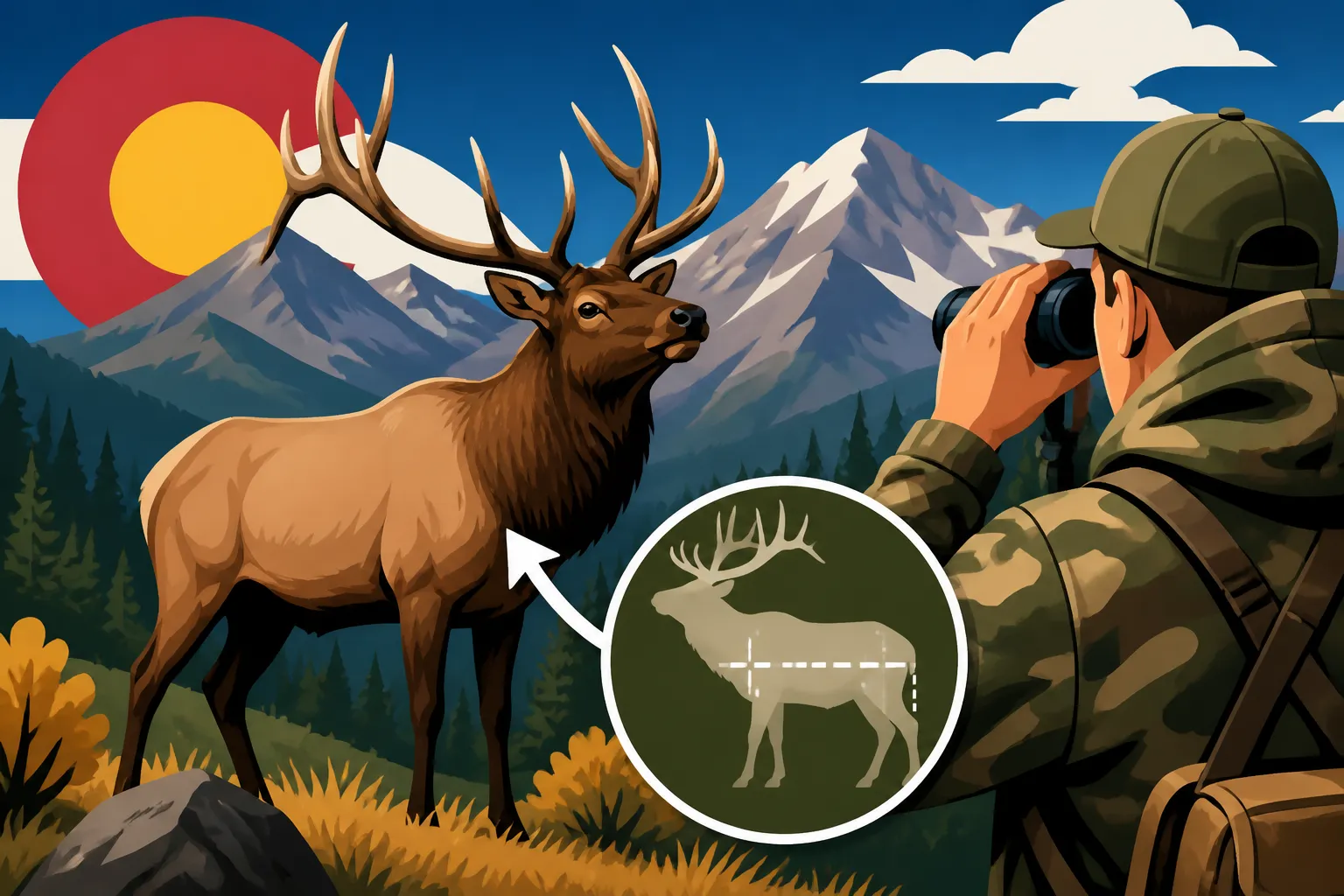
- Body Depth: The depth of the body from back to brisket is approximately 30-36 inches. This can be used to estimate overall antler height if the bull is broadside.
These aren't exact, but they provide a consistent, organic ruler in the field. Practice doing this with photos of elk before your hunt. Look at numerous images online and try to estimate point lengths, main beam length, and spread using these body comparisons, then compare your estimate to any provided scores or measurements. This mental exercise is invaluable.
Leveraging Optics and Digital Tools
Your optics are your best friend when it comes to field judging. High-quality binoculars (10×42 or 12×50 are popular choices for Colorado Elk Hunting Guide) and a spotting scope are essential, especially when glassing expansive areas like those found in the How to Hunt Colorado Alpine Basins. A good pair of binos will allow you to count points and assess mass, while a spotting scope will give you the magnification needed to pick out finer details, estimate tine lengths more accurately, and truly dissect the main beams.
Many modern rangefinders now come with built-in angle compensation, which is crucial for How to Judge Distance in the Mountains and understanding how a shot might play out on varied terrain. Additionally, mapping and scouting apps like GoHunt have revolutionized pre-season preparation. You can use GoHunt to study terrain, identify potential bedding and feeding areas, and even get an idea of the habitat where larger bulls might reside. While GoHunt won't judge your bull for you in the moment, understanding game movements, often mapped out on platforms like GoHunt, and scouting from afar with its tools, gives you more time and better angles for detailed assessment. Some hunters even take a picture or video through their scope or phone and then quickly review it to confirm details, though this isn't always feasible in fast-moving situations.
Practice, Practice, Practice
The absolute best way to improve your field judging skills is consistent practice. It's not just about looking at antlers; it's about actively estimating and comparing.
- Post-Season Scouting: After the hunt, when you're no longer under pressure, observe elk. Practice judging them as they move through the landscape.
- Online Resources: Study photos and videos of scored elk. Sites dedicated to B&C or P&Y records are fantastic. Try to estimate the score before looking at the official measurement.
- Hunting Shows and Videos: Watch hunting programs and pause the action when an elk is on screen. Make your judgment, then listen to what the hosts say.
- Shed Hunting: If you're out How to Bugle-Locate a Colorado Bull in the spring, picking up sheds is fantastic practice. You can hold them, feel the mass, and truly understand the measurements firsthand. This hands-on experience is invaluable.
Remember that field judging is a skill, and like any skill, it improves with dedication. Embrace the challenge, learn from every encounter, and you'll find yourself making more confident and accurate decisions when that bull of a lifetime finally steps out. Whether you're planning for Colorado Muzzleloader Hunting Guide or Colorado Rifle Elk Hunting Guide, this practice is critical.
Disclaimer
The information provided in this article is for general guidance and informational purposes only. Hunting regulations, seasons, and requirements can change frequently. Always consult the official Colorado Parks and Wildlife (CPW) regulations before planning any hunt. We do not guarantee hunting success, and all hunting activities carry inherent risks.