Best Optics for Colorado Big Game
There’s nothing quite as frustrating as being out in the vast, beautiful expanse of Colorado’s backcountry, seeing a faint speck in the distance that might be the bull you’ve been chasing, only to realize your optics aren't clear enough to confirm. Whether you're chasing elk through dark timber or spotting mule deer across an open basin, having the right optics isn't a luxury; it's an absolute necessity. This comprehensive guide will walk you through everything you need to know about choosing the best optics for your Colorado big game hunts, helping you turn those distant blurs into clear opportunities.
Why Quality Optics Are Non-Negotiable in Colorado
Hunting in Colorado isn't like hunting whitetails in dense eastern woods where most shots are under 100 yards. Here, the landscape itself demands clarity and reach. From the expansive peaks of the San Juan Mountains to the rolling sagebrush hills of the Western Slope, your eyes can only take you so far. This is where quality optics become your best friend, extending your vision and greatly increasing your chances of success.
The Vastness of Western Landscapes
Imagine standing on a ridge in the Flat Tops Wilderness, looking out over miles of rugged terrain, broken only by distant timber lines and alpine meadows. You know elk are out there, but trying to pick them out with the naked eye is like finding a needle in a haystack. This immense scale is why your optics need to be top-notch. You'll spend hours, sometimes days, glassing distant slopes, trying to locate game. Poor glass will lead to eye strain, headaches, and ultimately, missed opportunities because you simply couldn't see what was there.
The ability to effectively survey large areas from a vantage point is often the key to finding animals that are otherwise invisible. This is especially true when you're trying to cover ground efficiently without busting game. A good pair of binoculars or a spotting scope allows you to systematically break down a mountain face or a river bottom, piece by piece, identifying potential bedding areas, feeding zones, or travel corridors without having to put boots on the ground in every single spot. It's about working smarter, not harder, in a country that will already test your physical limits.
Identifying Game and Judging Trophy Potential
Once you spot something moving in the distance, the next challenge is figuring out what it is. Is it a cow elk or a bull? If it’s a bull, is it a legal animal for the unit you're hunting? And if you're a trophy hunter, is it the kind of animal you're willing to burn your tag on after years of building preference points? These questions can only be answered definitively with clear, high-resolution optics. Trying to field judge a bull elk at 800 yards with blurry glass is an exercise in futility and frustration.
High-quality glass reveals the subtle details that separate a raghorn from a true monarch. You'll be able to count points, assess main beam length, and judge mass and symmetry—all crucial factors in making an informed decision before you even consider making a move. This detailed assessment from afar also helps you avoid chasing after animals that don't meet your criteria, saving you precious time and energy that can be redirected to more promising prospects. For serious hunters, the investment in superior optics pays dividends in the form of confident decision-making and preventing "ground shrinkage" disappointments.
Spotting Critical Details
Beyond simply locating and identifying game, quality optics help you pick up on other critical details that can make or break a hunt. Perhaps you notice a distinct rub line on a tree at the edge of a timber patch, or a fresh set of tracks leading into a secluded basin. Maybe you see a subtle flick of an ear or the shine of an antler tip amidst dense cover. These are the small, often overlooked clues that truly experienced hunters rely on, and they are almost impossible to detect without excellent magnification and light-gathering capabilities.
Consider, for instance, a situation where an elk herd has gone quiet after the rut. They might be bedded down in thick timber, almost invisible. With exceptional glass, you might catch the glint of an eye, a patch of hide through the branches, or even the subtle steam of breath on a cold morning. These nuanced observations, made possible by superior optics, can provide the exact intelligence you need to plan your stalk or adjust your strategy. It’s not just about seeing an animal; it’s about understanding its behavior and environment from a distance, which is fundamental to a successful Colorado Elk Hunting Guide or a Colorado Mule Deer Hunting Guide.
Essential Optics for Every Colorado Hunter's Pack
When you're packing for a Colorado big game hunt, space and weight are always a concern. However, there are a few core optical tools that simply cannot be left behind. These aren't interchangeable; each serves a distinct, vital purpose in the field.
Binoculars: Your Primary Scouting Tool
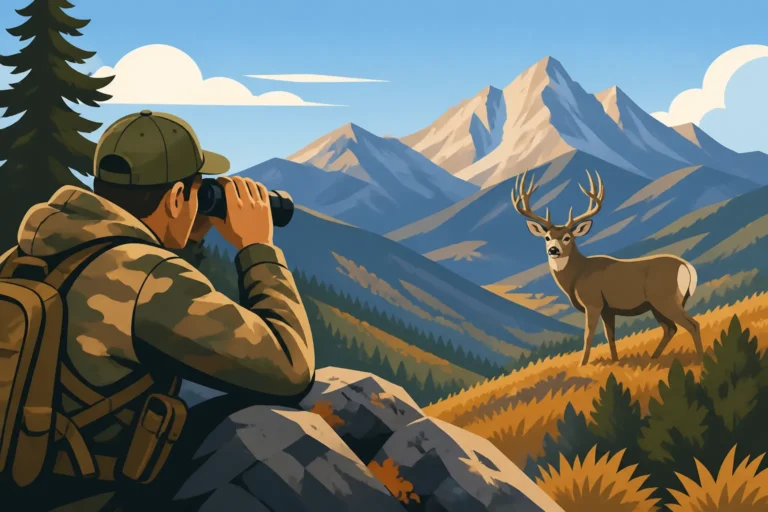
Your binoculars are the workhorses of your optical setup. They'll be around your neck or in an easily accessible chest harness for 90% of your waking hours in the field. They're what you'll grab first to scan a ridge line, check a distant shadow, or confirm movement. For Colorado hunting, I highly recommend a 10×42 or 12×50 magnification. The 10×42 offers a great balance of magnification, field of view, and brightness, making it versatile for timber, open country, and even low light conditions. If you spend a lot of time in wide-open country and have a steady hand, a 12×50 can offer that extra reach without needing to pull out a spotting scope every time.
When choosing binoculars, pay attention to the glass quality. Brands like Vortex, Leupold, and Maven offer excellent performance for the price, providing clear, bright images that reduce eye fatigue during long glassing sessions. For truly discerning hunters, higher-end brands like Swarovski, Zeiss, and Leica deliver unparalleled optical clarity, especially in challenging light conditions. Remember, you're going to be staring through these for hours, so comfort and clarity are paramount. Think about how they feel in your hands, the smoothness of the focus wheel, and how well they transmit light in those critical first and last minutes of the day.
Spotting Scopes: Reaching Out Across Valleys
For those truly distant observations—the kind where you need to pick apart a mountainside mile away—a spotting scope is indispensable. While binoculars are great for general scanning and closer confirmation, a spotting scope (typically 15-60x or 20-70x magnification) lets you zoom in on specific areas to really scrutinize details, judge antlers, and confirm bedded animals. If you're hunting trophy mule deer or a specific bull elk in a unit like GMU 76, a spotting scope isn't just nice to have, it’s a necessity for field judging.
Spotting scopes can be heavy, so consider an angled eyepiece for comfort during prolonged viewing, especially if you're glassing from a tripod set up while seated. Look for scopes with interchangeable eyepieces or versatile zoom ranges. A compact, lightweight model, perhaps with an objective lens around 65mm, offers a good compromise between portability and performance for backcountry hunters. Paired with a sturdy, lightweight tripod, a spotting scope becomes your long-range reconnaissance station. You'll find it invaluable when trying to decipher if that tiny brown speck is a rock, a stump, or the back of a bedded mule deer, ultimately helping you decide if you need to plan a Spot-and-Stalk Hunting in Colorado approach.
Rangefinders: Precision When It Matters Most
Gone are the days of guessing distances. A reliable laser rangefinder is an absolute must-have for any big game hunter in Colorado, regardless of whether you're carrying a bow or a rifle. The varied terrain, steep angles, and open spaces of the Rocky Mountains can make judging distance incredibly deceptive. What looks like 300 yards might be 450, and that 50-yard difference can mean a clean kill or a devastating miss.
Many modern rangefinders offer angle compensation, which is critical for mountain hunting. A shot uphill or downhill is effectively a shorter horizontal distance than the actual line-of-sight distance, and without proper compensation, your shot will likely go high. Look for a rangefinder that is fast, accurate, and easy to use with one hand. Brands like Sig Sauer, Leupold, and Vortex offer excellent options with varying ranges and features. Some even integrate ballistic data. Before heading out on your Colorado DIY Elk Hunting Guide adventure, practice with your rangefinder on various terrains and angles so you can confidently range animals quickly when the moment of truth arrives.
| Optic Type | Primary Use Case | Typical Magnification Range | Key Advantages | Potential Drawbacks |
|---|---|---|---|---|
| Binoculars | General scanning, closer range ID | 8x-12x | Fast target acquisition, wide field of view, portable | Limited reach for distant objects |
| Spotting Scope | Long-range observation, trophy ID | 15x-70x | Extreme magnification, precise detail assessment | Bulky, requires tripod, narrow field of view, slow to deploy |
| Rangefinder | Distance measurement, angle comp. | N/A (laser based) | Pinpoint accuracy, critical for ethical shots | Battery dependent, short-range focus can be tricky |
Factors to Consider When Choosing Your Optics
Picking out optics isn't a one-size-fits-all endeavor. What works for one hunter might not be ideal for another, largely depending on their hunting style, target species, and the specific terrain they'll be covering.
Magnification and Objective Lens Size
This is often the first thing people look at. Magnification (the first number, e.g., 10x) tells you how many times closer an object appears. Objective lens size (the second number, e.g., 42mm) indicates the diameter of the front lens, which directly impacts how much light the optic can gather. For binoculars, 10×42 is a fantastic all-around choice. It provides ample magnification for most glassing scenarios and gathers enough light for effective use in early morning and late evening. Some hunters prefer 8x for wider fields of view in dense timber or 12x for more open country.
For spotting scopes, you'll typically see variable magnifications like 20-60x. This versatility is crucial, allowing you to scan at lower power and then zoom in for detailed inspection. The objective lens for spotting scopes usually ranges from 60mm to 85mm. Larger objective lenses mean more light and a brighter image, which is paramount in dim conditions, but they also mean more weight and bulk. It’s a constant trade-off in the mountains, so consider your physical capabilities and how far you plan to pack it in when planning your Colorado Backcountry Hunting Guide.
Glass Quality and Coatings
This is where the real difference between budget optics and high-end models becomes apparent. "Glass quality" refers to the purity and grinding precision of the lenses. Better glass transmits light more efficiently and renders sharper, truer-to-life images. This is particularly important for discerning subtle details and color differences in low light or at extreme distances.
Lens coatings are equally vital. Manufacturers apply multiple layers of anti-reflective coatings to lens surfaces to reduce glare and maximize light transmission. Fully multi-coated lenses are the gold standard, ensuring that every lens surface has multiple layers of coating. This translates to a brighter, clearer, and higher-contrast image. Don't underestimate the value of good coatings; they can literally add precious minutes to your usable hunting light at dawn and dusk, which are often the most productive times to encounter big game.
Durability and Weatherproofing
Colorado weather is notoriously unpredictable. One minute it's sunny and calm, the next you're in a driving snowstorm or a sudden downpour. Your optics need to be able to withstand these harsh conditions without failing. Look for optics that are fully sealed and purged with inert gas (like nitrogen or argon) to prevent internal fogging and waterproof. Rubber armor provides excellent shock absorption, protecting your expensive glass from inevitable bumps and drops against rocks and trees.
Ensure that any moving parts, like focus wheels and diopter adjustments, feel robust and operate smoothly even when wet or cold. A flimsy focus wheel can be a nightmare with numb fingers. Investing in durable optics from reputable brands like GoHunt's recommended options or others such as Kowa or Bushnell, means they'll perform reliably season after season, rather than letting you down when you need them most. After all, what good is a perfect shot if your optics fogged up right before you took it?
Ergonomics and Weight
When you're climbing thousands of feet of elevation and covering miles of rugged terrain, every ounce in your pack matters. While a giant, bright spotting scope might sound appealing, if it's too heavy and you leave it in camp, it's useless. Consider the overall weight and bulk of your entire optical system—binoculars, spotting scope, tripod, and rangefinder. Can you comfortably carry it all day, every day?
Ergonomics play a huge role in user comfort, especially during extended glassing sessions. Do the binoculars fit comfortably in your hands? Is the focus knob easy to reach? Is the eye relief sufficient if you wear glasses? An angled eyepiece on a spotting scope can make a world of difference for comfortable viewing from a sitting position, which is often how you'll spend hours picking apart a distant basin. Test out different models if you can, as personal preference for fit and feel is significant. A comfortable optic is one you’ll actually use.
Tailoring Optics to Your Hunting Style and Species
The "best" optics setup isn't universal; it truly depends on what and how you're hunting. A solo elk hunter packing into the wilderness for 10 days will have different needs than someone hunting pronghorn on the Eastern Plains from a truck.
Elk Hunting Specifics
Elk hunting in Colorado typically involves vast, steep, and often timbered terrain. You’ll be doing a lot of hiking, sometimes busting through dense lodgepole pine, other times glassing huge open parks and alpine basins. For this, a versatile binocular like a 10×42 is almost universally recommended. It offers a great balance of field of view for quick scanning and enough magnification to pick out movement in the trees.
A compact, lightweight spotting scope (e.g., 15-45x65mm) is also invaluable, especially if you plan to How to Glass Big Colorado Basins. Elk can disappear into dark timber in an instant, and being able to quickly zoom in on a distant group of trees can confirm if they are still there or have moved off. Given the rigorous nature of elk hunting, prioritizing durability and weatherproofing is crucial. Your optics will get knocked around, rained on, and snowed on. Focus on ruggedness and reliability over marginal gains in optical performance if it means a significant increase in weight or fragility.
Mule Deer and Pronghorn Considerations
Mule deer hunting often takes place in more open, high-country terrain compared to elk, where long-range glassing is even more critical. Here, many hunters opt for 12x binoculars for their primary glassing tool, or even a higher-magnification binocular mounted on a tripod for stability during extended glassing sessions. When hunting big country for mule deer, a high-quality spotting scope with a larger objective lens (e.g., 20-60x85mm) really shines. The extra light gathering and magnification allow you to pick apart distant dark timber or rock slides, where mule deer love to bed.
Pronghorn hunting on the Eastern Plains is almost entirely a long-range glassing game. The terrain is flat and open, offering little cover, so you’ll spend most of your time spotting animals from afar and planning your stalk. A 15x or even 18x binocular on a tripod is extremely effective for covering vast expanses. Pair that with a powerful spotting scope to confirm horn length and plan your approach, and you're well-equipped. A rangefinder is also absolutely non-negotiable for pronghorn, as judging distance in flat, featureless terrain is incredibly difficult. Remember, when you're focusing on hunting specific species, the advice from a Colorado Pronghorn Hunting Guide will stress the importance of quality long-range glass.
Archery vs. Rifle Hunting
Your choice of weapon can also subtly influence your optical needs. Archery hunting typically involves getting much closer to the animal, often within 20-60 yards. While long-range glassing is still vital for locating and stalking, the precision needed for a shot is more about close-range accuracy. For archery, a high-quality rangefinder with angle compensation is paramount, as steep angles are common in bowhunting situations, and slight errors in distance estimation can lead to a miss. Binoculars around 10x are perfect for scouting and scanning, and a spotting scope might be less critical than for rifle hunting, depending on how much you need to evaluate animals from a mile away.
Rifle hunting, on the other hand, often involves longer shots, sometimes out to several hundred yards, especially in open Colorado terrain. A rifle scope with good light transmission and clear resolution is critical, but so are your spotting scope and binoculars. For rifle hunters, precision at long range is everything. This means ensuring your rangefinder is accurate to your maximum ethical shooting distance, and that your spotting scope allows you to see if your bullet made a clean hit or if a follow-up shot is needed. Also, consider Colorado Long-Range Shooting Considerations when pairing your rifle and optics for maximum effectiveness.
Disclaimer
The information provided in this article is for general guidance and educational purposes only. Hunting regulations, seasons, and requirements in Colorado can change. Always consult the most current Colorado Parks and Wildlife (CPW) regulations and official sources before planning any hunting trip. Safety should always be your top priority in the field.