Colorado Long-Range Shooting Considerations
Hitting those distant targets in Colorado's high country is a monumental challenge, and it's easy to feel overwhelmed by all the factors at play: the thin air, the swirling winds, and those steep angles. Many hunters struggle to confidently extend their effective range, fearing an unethical shot or a missed opportunity. This comprehensive guide will meticulously break down the critical considerations for long-range shooting in Colorado, helping you understand the variables, choose the right gear, and develop the skills to make ethical, confident shots when the moment arrives.
Navigating Colorado's Unique Ballistic Challenges
Colorado's stunning mountain landscapes offer incredible hunting opportunities, but they also present a unique set of challenges for long-range shooters. It's not just about pointing and shooting; the environment itself actively works to alter your bullet's trajectory. Understanding these forces is the first step toward mastering precision at extended distances.
The Thin Air Effect on Bullet Flight
One of the most significant factors hunters encounter in Colorado is the high altitude. Whether you're hunting elk near timberline at 10,000 feet or pursuing mule deer in a basin at 12,000 feet, the air is considerably thinner than at sea level. This reduced air density has a direct impact on your bullet's flight path.
Simply put, less air means less drag. While this might sound like a benefit, leading to less bullet drop over distance, it also means your bullet will fly faster and retain more energy at further ranges than it would in denser air. Ignoring this difference can lead to shots flying high above your intended point of impact, especially on longer engagements. Your familiar ballistic charts or range dope might be significantly off if they're calibrated for lower elevations.
This phenomenon requires meticulous attention to detail. Instead of just dialing for a given distance, you need to account for the actual air density, which varies not only with altitude but also with temperature and barometric pressure. Many experienced long-range hunters use tools that integrate atmospheric data to provide accurate adjustments, ensuring their shot lands precisely where intended even in the rarefied mountain air.
Thinking of your typical range session back home at 2,000 feet compared to a hunt in the Flat Tops Wilderness at 11,000 feet really puts it into perspective. The same bullet, fired from the same rifle, will perform differently. This isn't just a slight variance; it can be the difference between a clean kill and a frustrating miss, or worse, a wounded animal. It's why practicing in conditions that mimic your hunting environment is so vital.
Mastering Mountain Wind Drift
If there's one factor that can humble even the most experienced long-range shooter in Colorado, it's mountain wind. The terrain creates highly unpredictable wind currents that can shift direction and speed within seconds, even across a relatively short distance between you and your target. You might feel a gentle breeze on your face, while the bullet is contending with a gale in the canyon below.
Understanding how to read mountain wind is an art form that takes years to develop. Thermals, for instance, play a huge role. In the mornings, cooler air sinks, often funneling down valleys and draws. As the sun warms the slopes, the thermals reverse, carrying warmer air uphill. These shifting patterns can cause significant lateral bullet displacement, even if you’ve accounted for range and elevation.
Beyond thermals, topographical features like ridges, saddles, and canyons act as funnels or deflectors, creating micro-climates of wind. A steady crosswind at your shooting position might turn into a headwind or tailwind closer to your target, only to pick up speed again as it exits a narrow chute. Having a reliable method for judging wind, whether it’s through flags, mirage, or even observing vegetation, is crucial. For more insights on this complex topic, make sure to read up on How to Use the Wind Hunting Colorado Elk.
This complexity is why many seasoned hunters set a conservative maximum range when hunting in windy conditions, even if their rifle is capable of reaching further. It's not about the rifle's capability, but about the human's ability to accurately compensate for an invisible, constantly changing force. A small error in wind estimation can result in a wide shot, well outside the vital zone of an animal, making a clean kill impossible.
Steep Angles and Gravity's Influence
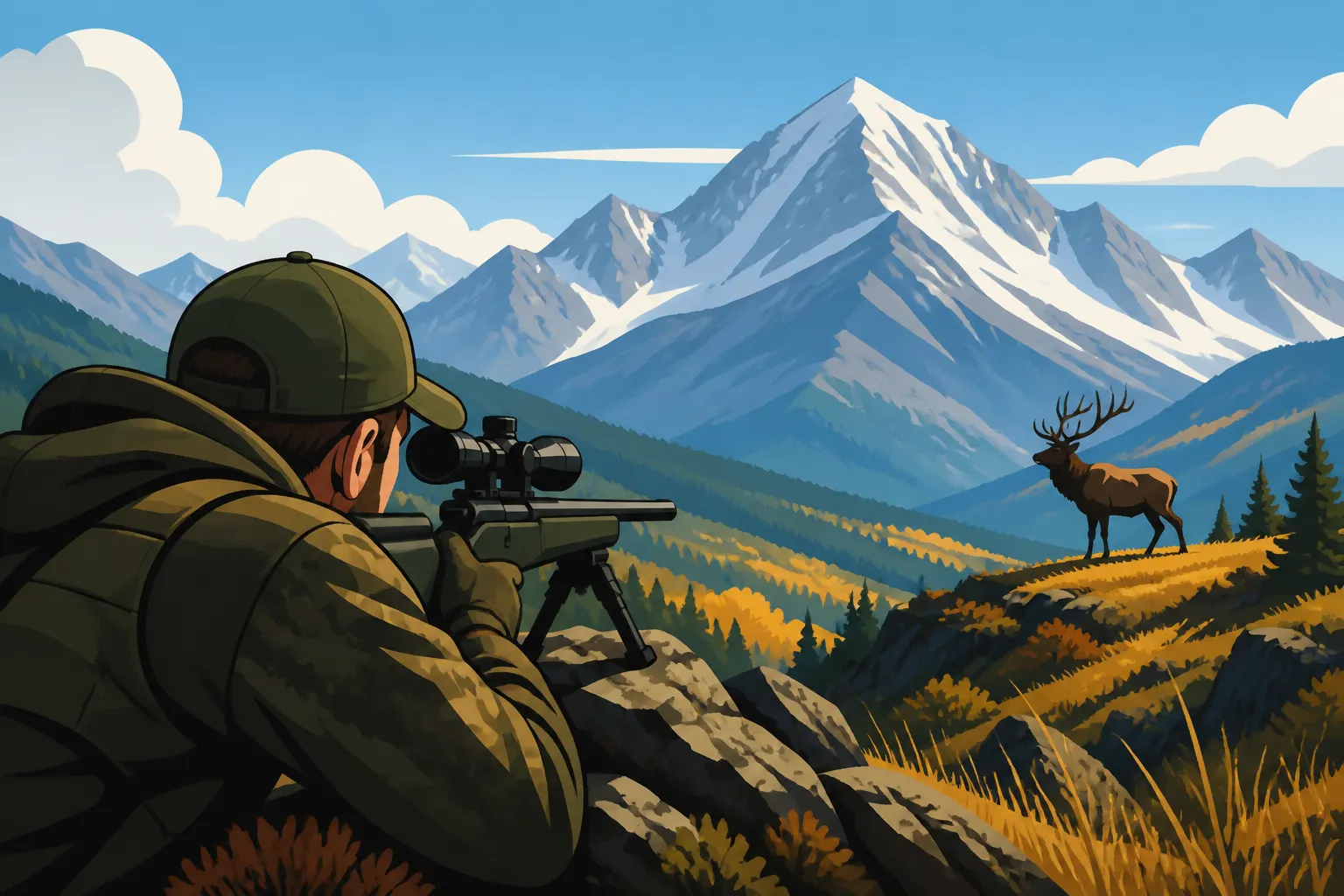
Hunting in Colorado often means shooting at game that is significantly above or below your position. Whether you're looking down a canyon at an elk grazing below or aiming up at a mule deer on a distant ridge, these steep angles drastically alter the effective distance your bullet travels and, therefore, its drop.
When shooting uphill or downhill, gravity acts on the bullet for a shorter "effective horizontal distance" than the actual line-of-sight distance. This means your bullet will impact higher than it would on flat ground if you only dial for the line-of-sight range. It's a common misconception that shooting downhill requires holding low and shooting uphill requires holding high. In reality, both scenarios require you to adjust for a reduced effective distance, meaning less drop than anticipated.
Modern rangefinders often include an angle compensation feature that calculates this ballistic equivalent horizontal distance for you, which is an absolute game-changer in mountain terrain. If your rangefinder doesn't have this, learning to use a ballistic calculator or a simple formula to determine the angle-adjusted range is essential. For a deeper dive into this, check out our guide on How to Shoot Uphill and Downhill at Elk.
Ignoring angle compensation is a recipe for disaster. Imagine you've ranged an elk at 400 yards, but it's 30 degrees downhill. Your bullet won't drop as much as it would over a flat 400-yard shot. If you dial for the full 400, your shot will likely sail over the animal's back. This specific challenge is why practicing from various inclined positions is just as important as practicing on flat ground; it helps you build muscle memory and trust your equipment's compensations.
The Ethical Imperative of Long-Range Hunting
While the thrill of making a precise long-range shot is undeniable, the conversation around long-range hunting in Colorado must always prioritize ethics. Our responsibility as hunters is to ensure a clean, humane kill, and extending our range amplifies the importance of self-imposed limitations and thorough preparation.
Defining Your Personal Ethical Maximum Range
Every hunter has a "maximum effective range," but for long-range hunting, it's crucial to define your personal ethical maximum range. This isn't what your rifle can do, or what a professional shooter could do; it's what you can consistently and reliably do under real-world hunting conditions, where adrenaline, fatigue, and environmental factors are all at play.
This range should be determined not just by hitting a target at the shooting range, but by consistently hitting the vital zone of an animal-sized target in varying conditions (wind, angle, awkward positions) with a high degree of confidence. For some, this might be 300 yards, for others 500, and for a very select few, perhaps further. It's a deeply personal decision that should be based on honest self-assessment, not aspiration. The vital zone of a Colorado elk, for instance, is roughly an 8-10 inch circle. Can you consistently put your bullet in that circle, every single time, from a hunting position, at your chosen maximum range?
Pushing beyond this ethical limit significantly increases the risk of a wounded animal that suffers or is never recovered. Even with advanced equipment, unforeseen variables like a sudden gust of wind, an animal taking a step, or a slight miscalculation can turn a potential clean kill into a tragic outcome. Respecting the animal and the hunt means only taking shots within your proven, comfortable, and ethical maximum range.
Shot Placement and Terminal Performance at Distance
At extended ranges, ensuring proper shot placement and understanding the terminal performance of your bullet become even more critical. A bullet might fly straight, but if it doesn't expand reliably or retain enough energy to penetrate sufficiently, it won't achieve a quick, humane kill. This is a vital consideration when selecting your ammunition and caliber.
Heavy-for-caliber, bonded, or monolithic bullets are often preferred for long-range hunting. These designs are engineered to retain mass and energy over longer distances, ensuring deep penetration and consistent expansion upon impact, even if velocities have dropped considerably. Understanding your bullet's ballistic coefficient and how it performs at lower velocities is key. A bullet that performs wonderfully at 100 yards might fragment or fail to expand at 600 yards if its impact velocity falls below its minimum design threshold.
When you're aiming at an animal that's hundreds of yards away, the margin for error is incredibly thin. A shot that's an inch or two off at 100 yards is a clean kill. That same error at 500 yards could mean hitting a gut, a leg, or missing entirely. Therefore, your commitment to shot placement must be absolute. Using a quality spotting scope to watch bullet impact and having a follow-up plan are also part of this ethical equation. For discussions on what calibers are best suited for this, consider reading Best Rifle Calibers for Colorado Elk.
The Role of Practice and Self-Assessment
True proficiency in long-range shooting for hunting isn't gained by a single trip to the range. It's built through consistent, deliberate practice and honest self-assessment. You need to shoot from hunting-specific positions – prone, kneeling, sitting, using your backpack as a rest – not just from a bench.
Practicing in varying environmental conditions is also crucial. If you plan to hunt in the wind, practice in the wind. If you anticipate steep angles, find a suitable location to practice uphill and downhill shots, like those you might find on a typical hunting trip into the San Juan Mountains. This kind of dynamic practice is what builds true confidence and competency. A great resource like GoHunt offers insights into different unit types and terrain, which can help inform your practice scenarios.
Beyond simply hitting the target, analyze your misses. Why did the shot go high? Was it wind? Did you flinch? Was your scope canted? Keeping a detailed log of your shots, including distance, conditions, and adjustments, will provide invaluable data for improving your skills. This relentless pursuit of perfection, coupled with the humility to acknowledge when a shot is beyond your current skill level, is the cornerstone of ethical long-range hunting. It's about knowing your limits and respecting the animal enough not to exceed them.
Essential Equipment for Precision Mountain Shooting
Successfully making a long-range shot in the Colorado mountains demands not just skill, but also reliable, precision equipment. Each component of your shooting system, from the rifle itself to the smallest environmental sensor, plays a crucial role in delivering accuracy downrange.
Choosing the Right Rifle and Ammunition System
Your rifle is the foundation of your long-range setup. For hunting in Colorado, you’ll want a rifle that is accurate, reliable, and durable enough to withstand the rigors of mountain travel. While heavier rifles often provide superior stability for precision shooting, you also need to consider weight for packing miles into the backcountry. Many hunters opt for a balance, choosing a rifle with a robust action and a quality barrel, but perhaps a lighter stock or fluted barrel to shave off precious ounces.
The caliber you choose is paramount. For elk, popular choices like 7mm Rem Mag, .300 Win Mag, .300 PRC, and .300 WSM offer a good blend of ballistic performance, energy retention, and bullet options suitable for long-range. These calibers can push heavy, high-ballistic coefficient (BC) bullets at respectable velocities, helping them resist wind drift and retain energy. For mule deer or pronghorn, slightly lighter recoiling calibers like 6.5 PRC, 7mm-08, or .308 Winchester can also be effective if paired with the right bullets and within appropriate ethical range limits. Your ammunition choice should complement your caliber, focusing on quality, consistency, and a bullet designed for terminal performance at the velocities you expect at extended ranges. For help zeroing in your setup, check out our guide on How to Sight In for a Colorado Elk Hunt.
When selecting your rifle, pay attention to the barrel's twist rate, which must match the bullet weight and length you intend to shoot. A rifle with a faster twist rate (e.g., 1:8 or 1:9 for a .30 caliber) is often necessary to stabilize the heavier, longer, high-BC bullets favored by long-range shooters. Furthermore, consider a quality scope base and rings that will hold zero under recoil and field abuse. Brands like Leupold, Vortex, and Nightforce offer rugged options that are trusted by serious hunters for their reliability in harsh conditions.
| Component | Key Considerations | Recommended Features |
|---|---|---|
| Rifle | Accuracy, Durability, Weight Balance, Caliber | Sub-MOA guarantee, Carbon fiber stock, Fluted barrel |
| Optics | Clarity, Magnification, Durability, Turrets, Reticle | First Focal Plane (FFP), Zero stop, Illuminated reticle |
| Ammunition | Bullet Type, Ballistic Coefficient, Consistency | Bonded, monolithic, or controlled expansion; High BC |
| Rangefinder | Range, Angle Compensation, Speed, Durability | >1000 yd range, Angle Compensating (AC), Scan mode |
| Kestrel/Weather | Accuracy of sensors, Integration with Ballistic Solvers | Bluetooth connectivity, Wind, Temp, Pressure, Humidity |
Critical Optics and Ranging Devices
Your optics are arguably as important as your rifle for long-range success. A high-quality riflescope designed for precision shooting is non-negotiable. Look for scopes with clear, sharp glass across the entire magnification range, robust and repeatable turrets with positive clicks (and ideally a zero stop), and a reticle that offers precise holdovers or windage references. First Focal Plane (FFP) reticles are often preferred for long-range hunting, as the reticle subtensions remain true at all magnification settings, simplifying holdover and windage adjustments.
Beyond the riflescope, a reliable rangefinder is your best friend. For Colorado's varied terrain, a rangefinder with angle compensation is essential, as discussed earlier. Many modern rangefinders can accurately range out to 1,000 yards or more, providing critical data for your shot solutions. Brands like Leica, Sig Sauer, and Vortex offer rangefinders with excellent optics and fast, accurate ranging capabilities. When planning a hunt and scouting new areas, tools from GoHunt can help you assess terrain and potential shot opportunities, which then informs the specific ranging capabilities you'll need.
Don't forget a good set of binoculars and, if your budget allows, a spotting scope. These tools are crucial for glassing vast expanses of the backcountry, locating game, and observing wind conditions or mirage near your target. A spotting scope also allows you to watch for bullet impact, which is vital for making corrections on follow-up shots or for confirming a hit. Our guide on How to Use Optics for Colorado Mule Deer and Best Optics for Colorado Big Game provide additional details on selecting the right glass.
Ballistic Solvers and Environmental Sensors
To truly master long-range shooting in Colorado, you need to move beyond simple ballistic charts. Environmental conditions change rapidly in the mountains, and these changes significantly impact bullet trajectory. This is where modern ballistic solvers and environmental sensors come into play.
A ballistic solver, whether it's an app on your smartphone (like Applied Ballistics, Kestrel Ballistics, or Hornady 4DOF) or integrated into a device like a Kestrel weather meter, takes into account a host of variables: your specific bullet's ballistic coefficient, muzzle velocity, twist rate, and crucially, real-time atmospheric data. It then calculates precise adjustments for elevation and windage for any given distance.
Pairing a ballistic solver with a handheld weather meter (often called a Kestrel) that measures temperature, barometric pressure, humidity, and wind speed is the ultimate setup. The Kestrel provides the accurate, real-time environmental data that your ballistic solver needs to make precise calculations. Some advanced Kestrel models even have integrated ballistic solvers, giving you an all-in-one solution for accurate shot dope in the field. This capability is especially important when you're preparing for a Colorado DIY Elk Hunting Guide type of hunt where every piece of information counts.
Investing in these tools and learning how to use them effectively is a game-changer. It allows you to generate highly accurate firing solutions on the fly, compensating for the thin air, shifting winds, and steep angles that characterize Colorado hunting. While they might seem complex at first, the confidence and precision they provide are invaluable when a trophy animal presents a fleeting long-range opportunity.
Training and Mental Preparation for the Moment of Truth
Having the right gear is only half the battle. Without dedicated training and mental fortitude, even the most expensive rifle and scope combination won't guarantee success. Preparing yourself physically and mentally for the demands of long-range shooting in the mountains is just as important as perfecting your gear.
Foundational Marksmanship and Positional Shooting
Before you can confidently stretch your range, you absolutely must master the fundamentals of marksmanship. This includes trigger control, sight picture, breath control, and follow-through. These basics are the bedrock of accurate shooting at any distance, and any deficiency will be magnified exponentially at longer ranges. Don't skip these foundational steps; they are the most critical component of consistent accuracy.
For hunting in Colorado, you'll rarely find a perfectly flat bench rest in the field. Therefore, practicing positional shooting is crucial. This means practicing from prone (your most stable position), kneeling, sitting, and even standing with support. Get comfortable using your backpack, trekking poles, or natural terrain features as improvised rests. The ability to quickly and stably get into a solid shooting position under pressure is a skill that must be honed repeatedly. Many a hunter has missed an opportunity because they fumbled with their shooting sticks or couldn't get stable quickly enough.
Regular dry-fire practice at home can significantly improve your trigger control and consistency without ever firing a live round. Then, take those skills to the range and gradually extend your distance, always focusing on maintaining perfect form. This meticulous approach to practice is what differentiates a lucky shot from a confident, repeatable one. For more ideas on how to specifically prepare for the hunting season, you might find our article How to Physically Prepare for Colorado Elk helpful.
Simulating Real-World Hunting Scenarios
Range practice, while essential, can only get you so far. To truly prepare for long-range hunting in Colorado, you need to simulate real-world scenarios as much as possible. This means practicing with the same gear you'll carry into the field – your hunting pack, bipod, shooting sticks, and layered clothing. Fatigue and adrenaline can severely impact your shooting ability, so incorporating these elements into your practice regime is vital.
Consider setting up targets at unknown distances and then ranging them, calculating your dope, and taking a shot within a limited timeframe, mimicking the pressure of a real hunting encounter. Practice shooting uphill and downhill on varied terrain if possible, using your rangefinder's angle compensation feature as you would in the field. Even incorporating light physical exertion before a shooting drill can simulate the elevated heart rate you'll experience after a climb.
One effective technique is to set up a small target, roughly the size of an animal's vital zone (e.g., an 8-inch plate), at varying distances, perhaps from 200 to 600 yards. Don't just shoot from a single position. Move between shooting positions, incorporating quick ranging and wind calls. This kind of dynamic practice builds confidence in your equipment and your ability to execute under pressure. Remember, it's about building proficiency for when it matters most, and you can't truly test that until you approximate the conditions you'll face. For practical exercises, review How to Practice for a Colorado Elk Shot.
Mental Toughness and Decision-Making Under Pressure
Finally, long-range shooting success in Colorado hinges on mental toughness and solid decision-making. The high stakes of a hunting situation, combined with physical exertion and environmental stressors, can easily lead to "buck fever" or target panic. Being able to remain calm, focused, and analytical when a trophy animal steps out hundreds of yards away is a skill developed through experience and deliberate mental preparation.
Before you even pull the trigger, you need to make critical decisions: Is the shot ethical? Can I confidently make this shot given the wind, angle, and my skill level? Is there a safe backstop? What's my follow-up plan? Having a personal checklist and adhering to your predetermined ethical maximum range, regardless of the trophy potential, is crucial. It takes immense discipline to pass on a shot, even a legal one, if you're not 100% confident in a clean kill. This is especially true when hunting pressured areas, as outlined in our guide How to Hunt Elk on Public Land Pressure, where opportunities can be rare.
Visualize successful shots. Walk through the entire process in your mind: ranging, dialing, wind call, breathing, trigger squeeze, follow-through, and watching for impact. This mental rehearsal can significantly improve your performance when the actual moment arrives. Trust your preparation, trust your equipment, and most importantly, trust your judgment. The goal is to walk away from every hunting encounter knowing you made the most ethical and responsible decision possible, regardless of the outcome.
Disclaimer
Please remember that hunting regulations and seasons in Colorado can change. Always consult the official Colorado Parks and Wildlife (CPW) website or their current regulations brochure for the most up-to-date and accurate information before planning any hunting trip. This guide is for informational purposes only and does not supersede official regulations.