Colorado Black Bear Habitat by Elevation
Understanding where Colorado black bears live can feel like solving a mountain puzzle, especially when their movements are so tied to elevation and seasonal food sources. It's frustrating to scout an area only to find bears have moved on, leaving you wondering if you're even in the right country. This guide dives deep into Colorado black bear habitat across different elevations, helping you decipher their patterns and improve your odds.
Understanding Colorado's Diverse Bear Habitats Across Elevations
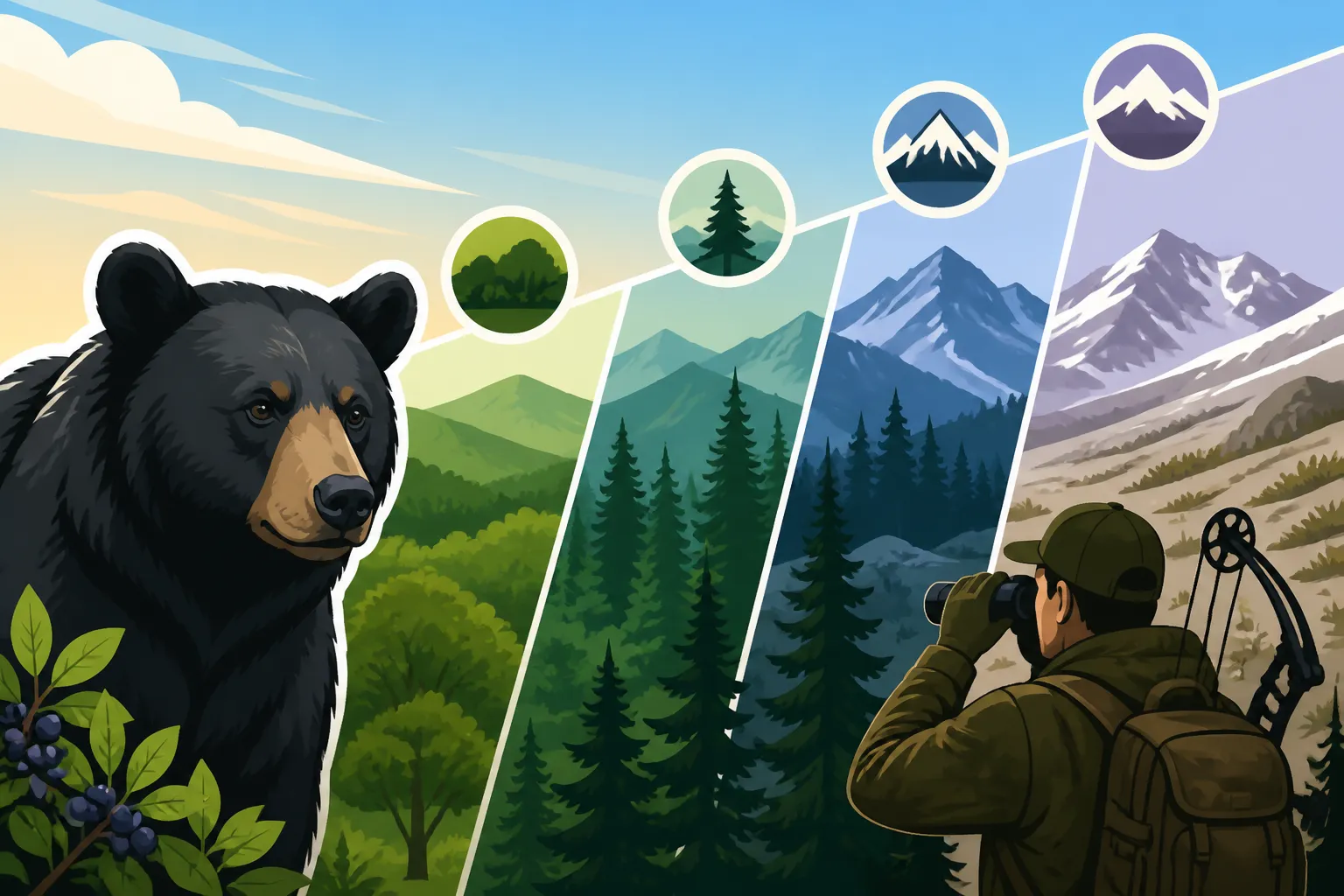
Colorado is a state of dramatic elevation changes, from the eastern plains to the towering 14,000-foot peaks, and black bears have learned to call a vast range of this landscape home. It’s not simply a matter of "bears live in the mountains"; it's a dynamic interplay of food availability, cover, and human disturbance that shifts with every thousand feet of ascent or descent. For hunters, grasping this nuanced relationship between elevation and bear presence is absolutely critical. Without it, you're essentially walking around in the dark, hoping to stumble upon a bear, which is rarely a productive strategy.
The General Range and Adaptability of Black Bears
Colorado's black bear population is quite robust, thriving in a variety of environments, but they primarily inhabit the forested, mountainous, and foothill regions of the state. While most of us picture bears deep in the high country, their range actually extends much further than many realize, from the pinyon-juniper zones of the lower canyons to the subalpine forests, and even occasionally into higher alpine tundra areas. What makes them so adaptable is their opportunistic diet; they are omnivores, meaning they'll eat just about anything – berries, nuts, insects, grasses, carrion, and even agricultural crops. This flexibility allows them to exploit food sources at different elevations as they become available throughout the year. Knowing Colorado Black Bear Behavior is key to understanding their adaptability.
The vast majority of Colorado's black bears are concentrated in the western half of the state, particularly in the national forests and wilderness areas that offer extensive cover and diverse forage. Areas like the White River National Forest, the San Juan National Forest, and parts of the Gunnison National Forest are prime examples where black bears thrive due to their varied terrain and rich food sources. However, their increasing presence in suburban foothills and even agricultural areas reminds us that they are master opportunists, always looking for an easy meal, which often draws them to lower elevations.
Key Factors Influencing Bear Distribution
Several interconnected factors dictate where black bears choose to live at any given elevation. Understanding these elements is paramount for anyone hoping to successfully locate and hunt these intelligent animals. It’s not enough to just know the season dates; you need to understand why bears are where they are.
Firstly, food availability is the ultimate driver. Bears are constantly on the move, tracking the ripening of berries, the emergence of new grasses, the fall of acorns, or the presence of winter-killed carcasses. This means their preferred elevation can change dramatically from spring to summer to fall. In spring, they might be in lower, sun-exposed slopes where green-up happens earliest. By late summer, they're often gorging on berries in mid-elevation shrub fields, and come fall, they could be moving to oak or aspen groves for mast crops.
Secondly, cover is essential for security, bedding, and denning. Bears need dense timber, thick brush, or rocky areas where they can feel safe from predators (including humans) and find refuge from harsh weather. This is why you'll often find them utilizing north-facing slopes with dark timber during hotter parts of the day, even if their primary food source is on a nearby south-facing slope. The ability to quickly escape into thickets is a huge factor in their habitat selection.
Finally, water sources are always important, especially during dry periods. While bears can get some moisture from their food, they still need access to creeks, springs, or wallows. Identifying areas with reliable water can be a critical puzzle piece, particularly in arid parts of Colorado where water is not as abundant. When you're using tools like GoHunt to e-scout, paying attention to hydrological features alongside vegetation types can give you a significant advantage.
Black Bear Presence in Lower Elevations and Foothills
When many hunters think of bear habitat, they often picture remote wilderness. However, Colorado's black bears are increasingly found at surprisingly low elevations, especially in the foothills and even encroaching on human development. This isn't necessarily a sign of overpopulation but rather an indication of their opportunistic nature and a response to expanding human presence. It presents unique challenges for both bears and people.
Riparian Zones and Agricultural Interfaces
In the lower elevations, particularly along the Front Range and in river valleys, black bears frequently utilize riparian corridors. These areas, characterized by lush vegetation along rivers and streams, offer not only water but also a rich diversity of food sources. Berries, chokecherries, plums, and other succulent plants thrive here, providing a consistent buffet for bears throughout the warmer months. These linear features also offer natural travel corridors, allowing bears to move through developed areas with some degree of cover.
Furthermore, the interface with agricultural lands can be a significant draw. While bears generally prefer natural forage, the sheer abundance of calories in orchards, cornfields, and even certain hayfields can be irresistible. Bears might descend from higher elevation forests into agricultural valleys under the cover of darkness to feed, retreating to more secluded timbered areas during the day. This behavior can make them challenging to hunt, as they might only be present in accessible areas for short, unpredictable periods. Hunting these areas requires intimate knowledge of local patterns and often good relationships with landowners.
The Urban-Wildland Interface Challenges
Perhaps the most common frustration for both residents and wildlife managers is the increasing presence of bears in the urban-wildland interface. As Colorado's population grows and development pushes further into traditional bear habitat, encounters become inevitable. Bears are attracted to human settlements by easy access to calories: trash, pet food, bird feeders, fruit trees, and even compost piles. While this is problematic for human-bear conflict management, it also means that bears can be found at very low elevations, often below what hunters might consider "traditional" bear country.
These bears, however, are often habituated to humans and can be extremely wary of hunters, moving mostly at night or sticking to thick, inaccessible pockets of private land. While hunting bears close to towns and cities is often restricted or heavily managed, it's a stark reminder that bear habitat is not solely about pristine wilderness. Understanding this dynamic can inform broader strategies for Colorado Black Bear Population and Range management and help prevent conflicts. It also underscores why focusing on natural food sources and undisturbed areas is usually a more fruitful hunting strategy.
Mid-Elevation Habitats: The Prime Bear Zones
When you talk to experienced Colorado bear hunters, the conversation often gravitates towards the mid-elevations. This is where, for much of the year, conditions converge to create ideal living and feeding grounds for black bears. Think of elevations generally ranging from about 6,000 to 9,500 feet – a sweet spot where food is abundant, and security cover is extensive.
Aspen Groves and Oak Brush: The Food Factories
Aspen groves, with their characteristic white bark and shimmering leaves, are absolute magnets for black bears. In late summer and early fall, these groves provide a critical food source: the understory is often rich with berries like serviceberry, chokecherry, and raspberry. The aspen trees themselves can also be a food source, as bears will strip bark to get to the sweet cambium layer, especially during periods of scarce forage. Look for scarred aspen trees as a sign of bear activity, which can indicate current or past feeding. These groves also provide excellent escape cover, particularly where they grow thick and intermingled with conifers.
Even more significant in many areas are the vast tracts of oak brush, primarily gambel oak, found across the Colorado landscape. From late summer through fall, the acorns produced by these oak stands are a super-food for bears. Acorns are packed with fat and protein, essential calories for bears to put on weight for hibernation. When the acorn crop is good, bears will gorge themselves, sometimes spending weeks in concentrated oak brush areas. Hunters often focus their efforts on these "oak flats" or hillsides, especially in years of good mast production. This is where Best Time to Hunt Black Bear in Colorado often aligns with the ripening of these vital food sources. These areas are not just about food; the dense, tangled nature of oak brush also provides unparalleled bedding and security cover.
Dense Conifer Forests and Security Cover
While aspen and oak brush offer food, the dense conifer forests – comprising ponderosa pine, Douglas fir, Engelmann spruce, and lodgepole pine – provide the necessary security blanket. Bears rely on these dark timber stands for bedding, especially during the heat of the day or when seeking refuge from hunting pressure. North-facing slopes, in particular, often hold thicker, cooler timber stands that bears prefer for bedding and escaping detection.
These conifer forests aren't just for cover; they also offer food, albeit sometimes more subtle. Bears will overturn rocks and logs looking for insects like ants and grubs. They might also feed on certain conifer needles or bark. More importantly, these forests are where bears establish their dens for winter hibernation. Scouting for den sites in the fall can be an effective tactic, as bears will often choose secluded, undisturbed areas within these dense timber blocks, often utilizing rock crevices, blowdowns, or excavated earth beneath large root systems. Areas that combine dense conifer cover with nearby aspen or oak brush are truly prime bear habitat.
High-Elevation Forays: When Bears Venture Up
While the mid-elevations might be the primary domain for black bears, these resilient animals are not afraid to climb. Many hunters are surprised to find bear sign, or even bears themselves, at elevations exceeding 10,000 feet, sometimes even nearing treeline. These high-elevation forays are almost always driven by specific seasonal food sources or denning preferences.
Alpine Basins and Early Fall Food Sources
As summer transitions into early fall, the high country above 10,000 feet, particularly in vast alpine basins and subalpine meadows, can become a temporary but critical feeding ground for bears. Here, certain berry crops like huckleberries, blueberries, and currants ripen later than their lower-elevation counterparts due to the cooler temperatures. For bears trying to pack on maximum fat before hibernation, these late-season, high-calorie sources are invaluable.
You might find bears diligently working these berry patches, often in areas that look more like elk country. This is especially true in units with extensive wilderness areas like the Flat Tops Wilderness Area or portions of the Weminuche Wilderness. Hunters pursuing elk in these high basins during early archery seasons will occasionally encounter bears feeding alongside. It's a testament to the bear's drive for calories that they will expend the energy to climb to these elevations. When these high-country berry crops are abundant, bears can concentrate heavily, making these areas worth exploring, especially if other food sources lower down have been picked over or are sparse.
Denning Behavior and High-Country Preferences
Interestingly, many black bears prefer to den at higher elevations, even if they spend much of the summer and early fall feeding lower down. There are several theories for this, but chief among them is security and stability. Higher elevations often offer more consistent snow cover, which insulates dens and helps conceal them from predators. The rugged, rocky terrain often found at these altitudes also provides abundant natural rock crevices, caves, or dense blowdowns that make excellent, well-protected den sites.
As the weather turns colder in late fall, bears will begin their migration towards these preferred denning grounds. This means that a bear that spent September gorging on acorns at 8,000 feet might be found heading uphill towards a den at 10,500 feet in October or November. Understanding this migratory pattern towards denning sites can be crucial for Colorado Fall Bear Season and Tags hunters, as it changes where bears are likely to be found. They might be less focused on feeding and more focused on reaching their winter bed, making travel corridors and dense, secure timber at higher elevations important areas to scout.
Seasonal Movements and How Elevation Dictates Them
Understanding black bear habitat by elevation isn't a static concept; it's a dynamic one. Their use of the landscape, and thus their presence at certain elevations, shifts dramatically throughout the year. Ignoring these seasonal shifts is one of the quickest ways to come home empty-handed. This is where e-scouting with tools like GoHunt, combined with ground truthing, becomes incredibly powerful in predicting their movements.
Spring Emergence and Green-Up
When bears first emerge from their dens in early spring, usually around April or May in Colorado, they are looking for the first available green forage. At these times, they will often gravitate to lower elevations and south-facing slopes. Why south-facing? Because these slopes receive the most direct sunlight, melting snow faster and causing vegetation to "green up" earlier than north-facing slopes or higher elevations. They're searching for tender new grasses, forbs, and any carrion left over from winter-killed deer or elk.
During this period, bears are less concerned with high-calorie foods and more focused on getting their digestive systems restarted with easily digestible greens. Hunters pursuing Colorado Spring Bear Season and Tags often target these sunny, lower-elevation aspects, paying close attention to avalanche chutes or clear-cuts where new growth is abundant. Riparian areas also become important as the snow melts and water flows freely, stimulating new plant growth.
Summer Foraging Patterns
As spring progresses into summer, and snowlines recede, bears will generally move higher in elevation, following the progression of ripening berries and other soft mast. Mid-elevation shrub fields, especially those containing serviceberry, chokecherry, raspberry, and currant, become prime feeding areas. Bears will spend countless hours in these dense patches, sometimes making them challenging to spot.
During the hotter parts of summer, bears will often feed in these sun-exposed berry patches during cooler morning and evening hours, then retreat to dense, shaded conifer stands on north-facing slopes for bedding and security during the midday heat. Water sources become even more critical during dry summer spells. Understanding these thermoregulatory behaviors, alongside food availability, is crucial. If you’re planning a hunt, checking historical data on berry crops and moisture levels in different areas, perhaps using mapping layers from platforms like GoHunt, can provide valuable insights.
Fall Hyperphagia and Pre-Denning Movements
This is arguably the most critical period for hunters, as bears are in a state of "hyperphagia," meaning they are eating almost constantly to accumulate fat reserves for hibernation. As mentioned, this often means a shift towards hard mast, primarily acorns from gambel oak, or ponderosa pine nuts. This will typically draw bears to specific mid-elevation oak or pine forests. If those crops are scarce, they might move higher to late-ripening berries or even focus more on carrion.
As fall progresses and temperatures drop, bears will begin their transition towards denning. This is when you might see them moving from feeding grounds to their preferred higher-elevation den sites, or concentrating in areas with dense cover that also offer a last-ditch food source. Snowfall can also trigger significant movements, pushing bears down from higher, snow-covered areas to lower-elevation winter ranges, or conversely, encouraging them to find their dens quickly. Hunters during Colorado Rifle Elk Hunting Guide seasons, particularly in the later rifle seasons, might encounter bears that are still actively feeding or moving to dens, providing unique opportunities.
Here's a simplified look at how elevation influences Colorado black bear habitat use throughout the year:
| Season | Typical Elevation Range (Feet) | Primary Habitat Focus | Key Food Sources | Hunter's Focus |
|---|---|---|---|---|
| Spring | 5,000 – 8,000 | Lower, south-facing slopes, riparian areas | New green growth (grasses, forbs), carrion | Sun-exposed hillsides, river bottoms, clear-cuts |
| Early Summer | 7,000 – 9,500 | Mid-elevation shrub fields, timber edges | Early ripening berries (serviceberry, raspberry) | Berry patches, edges of dense timber |
| Late Summer | 8,000 – 10,000+ | Mid to high-elevation berry patches | Huckleberries, blueberries, currants, insects | High-country berry fields, timber pockets |
| Early Fall | 6,000 – 9,000 | Oak brush, aspen groves, conifer forests | Acorns, chokecherries, pine nuts, late berries | Oak flats, aspen draws, dense timber (bedding) |
| Late Fall | 8,000 – 10,500+ | Dense conifer for denning, travel corridors | Last available food, pre-denning movements | Travel routes to high-elevation dens, security cover |
Understanding these patterns is really about understanding the bear's constant caloric imperative. They go where the food is, but always with an eye towards security cover. If you can predict where those two factors align, you're well on your way to locating a Colorado black bear. Whether you're planning a Colorado DIY Elk Hunting Guide trip and hoping to double-dip, or specifically targeting bears, these elevation and seasonal insights are your best friends.
Disclaimer
Always consult the most current Colorado Parks and Wildlife (CPW) regulations and season dates before planning any hunt. Hunting regulations, unit boundaries, and land access rules can change frequently. This guide provides general information for educational purposes and should not be considered legal advice.