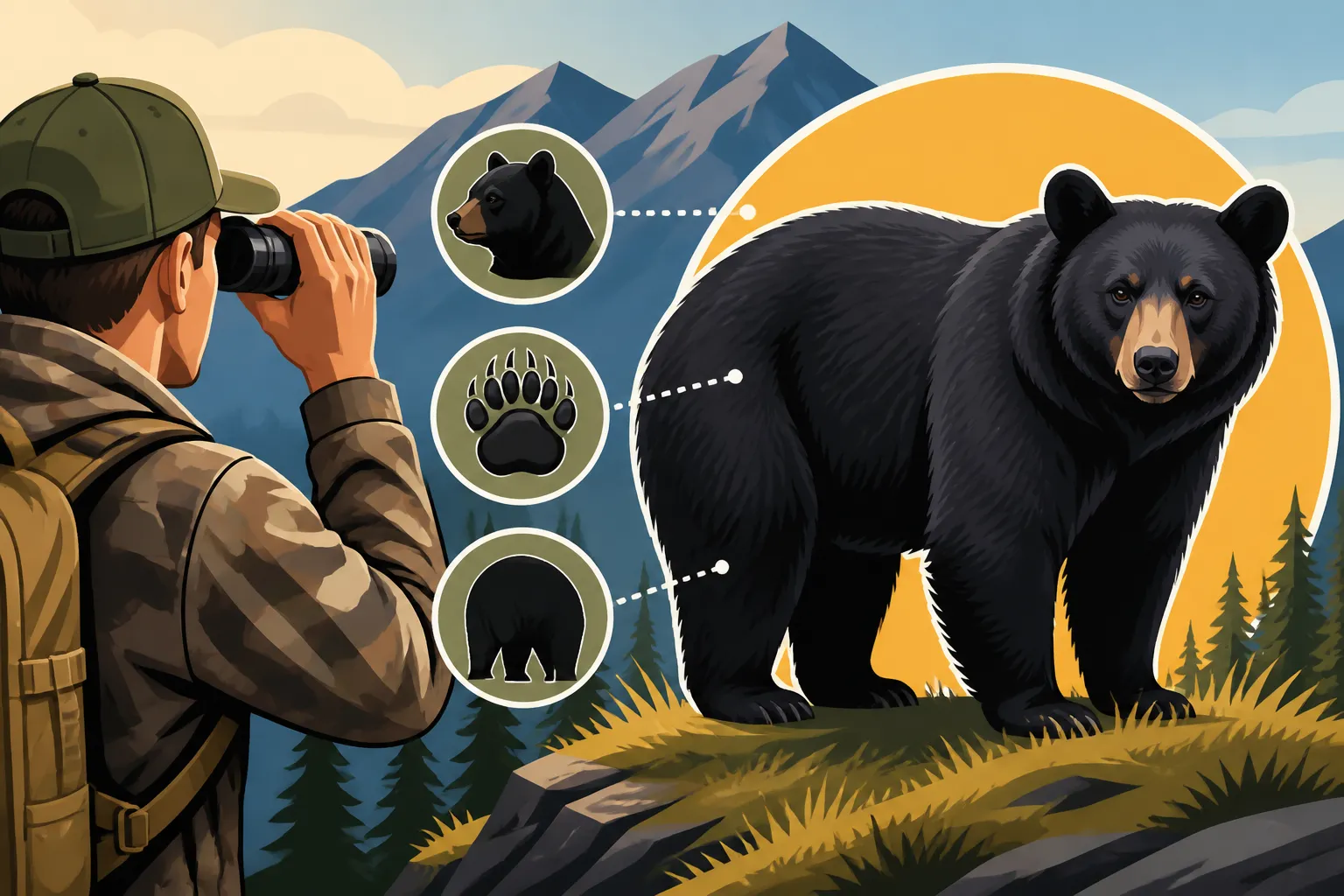
Colorado Black Bear Field Judging Tips
Trying to field judge a black bear in the heat of the moment can be incredibly challenging. Their shaggy coats, varied postures, and the vast, diverse terrain of Colorado can make a small bear look huge and a large bear seem average, often leading to misjudgments that leave hunters second-guessing. This guide is here to cut through that confusion, offering practical tips and reliable indicators to help you accurately size up a black bear in the wild, ensuring you make informed and ethical decisions during your hunt.
The Unique Challenges of Field Judging Black Bears
Let's be honest, judging a black bear in the field isn't like sizing up an elk or a deer, where antlers or horns provide clear, measurable indicators. Bears are notoriously deceptive, their appearance shifting dramatically based on their posture, angle, and even their mood. This makes it incredibly difficult for even seasoned hunters to consistently make accurate calls. You might be watching a bear in a dense timber patch, or across a wide-open basin, and what looked like a monster suddenly shrinks when it stands up or walks into a different setting.
Misleading Appearances and Environmental Factors
A bear's coat can play tricks on your eyes. A long, shaggy winter coat can make a smaller bear appear much bulkier than it actually is, especially if it’s hunched over or moving slowly. Conversely, a bear with a sleek, short summer coat might look smaller, even if it has significant muscle mass underneath. The terrain itself adds another layer of complexity. A bear standing on a ridge line against the sky can look enormous, while the same bear in a deep ravine might seem diminutive. Shadows, light conditions, and the presence or absence of surrounding vegetation all contribute to this visual trickery. It’s not uncommon to hear stories of hunters who were certain they had a large bear only to walk up and find it was much smaller than anticipated, a humbling experience many of us have faced.
Imagine you're glassing a distant hillside in the San Juan Mountains. You spot a black blob moving through the scrub oak. Through your binoculars, it looks massive, its silhouette seemingly huge against the sparse trees. You start planning your approach, heart pounding. But then, it stands on its hind legs to scratch its back against a tree, and suddenly, what appeared to be a broad, low-to-the-ground beast is revealed to be a lankier, younger bear. The initial impression was purely a trick of perspective and its interaction with the terrain. These moments of deception are precisely why having a systematic approach to field judging is so crucial.
The Pressure of the Moment
Let's not forget the adrenaline. When you finally spot a black bear, especially after days of hard hunting in a unit known for "Colorado Black Bear: Where to Find Them", that rush of excitement can cloud your judgment. You’ve put in the work, hiked the miles, and now, finally, an opportunity presents itself. It’s natural to want to pull the trigger, and in that heightened state, minor details can be overlooked or misinterpreted. This pressure is compounded by the fact that black bears don't always offer a prolonged viewing window; they can appear and disappear quickly, especially in thick cover.
This is where preparation truly pays off. Instead of making a snap decision, having a mental checklist or a routine to go through can help you stay grounded. Take a deep breath, settle your optics, and consciously run through the key judging indicators, even if it feels like the bear could vanish at any second. Remember that patience is a hunter’s best friend, and a few extra seconds of careful observation can prevent regret later. It’s always better to let a bear walk if you're uncertain about its size or age than to take one you’ll later wish you hadn’t.
Key Indicators for Estimating Bear Size and Age
While no method is foolproof, experienced hunters rely on a combination of visual cues to estimate a black bear's size and maturity. These indicators often involve comparing different body parts to each other and observing overall behavior. It’s about looking beyond the fur and focusing on underlying bone structure and musculature.
Head and Ear Proportions
This is perhaps the most reliable indicator. A young bear, say a two or three-year-old, will often have a head that appears relatively large in proportion to its body, almost puppy-like. Its ears will look quite prominent and rounded, sitting high on its head and seeming disproportionately large compared to its face. As a bear matures and puts on muscle and fat, its body grows significantly, making its head appear smaller. A truly mature boar, especially one 5-6 years or older, will have a small, almost pointy-looking head that seems tiny compared to its massive body. Its ears will also appear smaller, set wider apart, and might even look slightly pointed or more like nubs due to the growth of its neck and shoulder muscles.
Consider this: a bear with ears that look like Mickey Mouse on top of its head, large and round, is almost certainly a younger animal. On the other hand, if you see a bear with a big, blocky body and ears that look like they’ve shrunk or are merely small bumps on the sides of its head, you’re likely looking at a mature, older animal. These proportions are a consistent giveaway, regardless of coat length or posture. For those planning a trip, researching "Colorado Black Bear Behavior" can also give you insights into how different age classes might carry their heads or interact with their surroundings.
Body Shape and Musculature
Beyond the head, pay close attention to the bear's overall body shape. Young bears tend to be lanky, with a more rectangular or athletic build, especially if they haven't yet put on significant weight for hibernation. Their legs might look long in relation to their body, and you might be able to discern a more defined neck. Mature bears, particularly older boars, develop a much more substantial, blocky, and often saggy build. They’ll have massive shoulders and a thick, almost non-existent neck that flows seamlessly into their body. Their belly might sag lower, especially as they approach denning season, giving them a more pear-shaped or pot-bellied appearance.
Think of it like this: a younger bear resembles a well-toned athlete, while a mature boar looks more like a linebacker or even a sumo wrestler. The depth of their chest, the width of their back, and the thickness of their hindquarters will be visibly greater on an older bear. Observing their movement can also reveal musculature; a big bear will often have a slower, more deliberate gait, while younger bears might be more agile and quick. This can be critical when you're glassing from afar, perhaps from a vantage point you found while using tools like GoHunt to scout the area, as subtle shifts in posture reveal a lot.
Movement and Behavior Cues
A bear's behavior can offer clues about its age and experience. Sows with cubs, for example, will obviously be accompanied by smaller bears, instantly identifying them as mothers, which are often protected or not the target for many hunters. Beyond that, mature bears often exhibit more cautious, deliberate movements. They tend to be more solitary and might move with a sense of purpose, often traveling well-defined game trails. Younger bears, especially yearlings and two-year-olds, can sometimes be more curious, less wary, and more prone to playful or erratic behavior. They might spend more time foraging in open areas or investigating new smells.
Consider a bear that quickly bolts at the slightest sound or scent, disappearing into the timber. This skittishness is often characteristic of a younger, less experienced animal. In contrast, an older, more confident bear might pause, assess the situation, and then calmly continue its activity or slowly retreat. If you’re trying to determine if it’s a bear worth pursuing on a "How to Spot-and-Stalk Colorado Bears" hunt, observing these behavioral traits can add another piece to your judging puzzle. Of course, all bears are individuals, and there are always exceptions, but these general behavioral patterns can provide valuable insights.
Practical Field Judging Scenarios and Tips
Field judging is a skill that improves with practice and experience. It's not just about knowing what to look for, but also how to apply that knowledge in real-world, often dynamic, hunting situations.
Judging Bears at Varying Distances and Terrain
The distance between you and the bear, and the type of terrain, drastically affect your ability to judge accurately. A bear at 50 yards in an open meadow is much easier to evaluate than one at 300 yards picking through dark timber. When judging at long distances, it's essential to use high-quality optics. A good pair of binoculars or a spotting scope will allow you to pick out those crucial head-to-body ratios and ear placements. Remember the principle of comparison: try to find something near the bear of a known size – a tree stump, a rock, even a specific bush – to provide a reference point.
When a bear is moving through dense cover, like the spruce-fir forests common in many Colorado GMUs, you might only get glimpses of parts of its body. In these situations, focus on any clear view you can get of its head and ears, or the thickness of its neck and shoulders. Don't rush. If you only see a leg, wait for a better look. It's perfectly acceptable to decide you can't make a confident judgment and let the bear go. It’s an ethical decision that prioritizes responsible hunting. The more you familiarize yourself with the terrain you'll be hunting, for example by studying the "Colorado Backcountry Hunting Guide", the better you'll be at utilizing natural reference points.
Comparing Bears to Known Objects
This is a classic field judging technique for any big game, and it’s especially useful for bears. Before you even head out, familiarize yourself with the average size of common objects in the landscape you'll be hunting. For instance, if you know the typical height of a lodgepole pine sapling or the diameter of a specific type of boulder, these can become your "measuring sticks." When you spot a bear, try to position it visually next to one of these known objects. Does the bear's shoulder height clear that specific rock? Does its body appear wider than that small tree trunk?
Another excellent method is to compare the bear to itself. If you get a chance to see the bear stand on its hind legs, try to estimate its overall height. A black bear standing 5-6 feet tall is a good-sized bear, and 7 feet is a truly exceptional animal. Pay attention to how low its belly sags to the ground when it’s on all fours – a mature, well-fed bear will have a noticeable sag. This comparative approach helps remove some of the subjective errors that come from just eyeballing a fuzzy black mass in the distance.
Understanding Legal Requirements and Regulations
Colorado Parks and Wildlife (CPW) regulations are paramount. Always know the specific season dates, bag limits, and any restrictions for the unit you're hunting. For black bears, there are typically fall and sometimes spring seasons, with specific legal requirements around hunting with cubs or sows. In Colorado, it is illegal to harvest a cub or a sow with cubs. This adds another layer of responsibility to field judging. You must be able to confidently identify that a bear is not a cub and is not accompanied by cubs. This means observing the bear for an extended period, if possible, to ensure no smaller bears are trailing behind or hidden in the vicinity.
If you’re hunting in the fall, particularly early in the season, cubs might be quite small and stay very close to their mother. Always err on the side of caution. If there’s any doubt whatsoever about cubs being present, do not take the shot. Familiarizing yourself with the "Colorado Black Bear Season and Tags" is a critical first step for any bear hunter. Being ethical and legal means being absolutely certain of your target before you decide to harvest.
Tools and Technology to Aid Field Judging
In today's hunting world, we have access to incredible tools and technologies that can significantly enhance our field judging abilities, taking some of the guesswork out of those critical moments.
Using Optics Effectively
Quality optics are not just for spotting game; they are essential for judging it. A good pair of 10x binoculars is a minimum for mountain hunting, but a spotting scope (15-45x or 20-60x) is truly invaluable for black bear country, especially when glassing expansive basins or distant timberlines. Invest in the best optics you can afford from reputable brands like Kowa, Vortex, or Swarovski. The clarity, light transmission, and magnification will allow you to pick out those fine details—the shape of an ear, the bulge of a shoulder, the sag of a belly—that are impossible to see with the naked eye.
When using optics, don't just scan; settle in and truly study the bear. Use a tripod for your spotting scope to eliminate shake, allowing you to observe for longer periods without fatigue. Pay attention to the subtle movements, the way the bear carries its head, or how it interacts with its environment. Remember, you're not just looking at the bear, you're analyzing it. For a deeper dive into choosing the right gear, check out our guide on "Best Optics for Colorado Big Game".
Digital Scouting and Data
Modern technology has revolutionized pre-hunt scouting and data analysis. Platforms like GoHunt offer incredibly detailed maps and data layers that can show you historical harvest success rates, terrain features, and even recent bear sightings in specific Game Management Units (GMUs). By using GoHunt's filtering tools, you can research areas that have historically produced larger bears, giving you a better starting point for your hunt. You can study satellite imagery to identify prime bear habitat, bedding areas, and travel corridors, all from the comfort of your home.
This kind of detailed digital scouting allows you to go into your hunt with a much stronger understanding of the specific area, which can translate into better decision-making in the field. For example, if GoHunt data suggests that Unit 43 has a history of producing bears with larger skull measurements, you might be more inclined to spend extra time glassing and judging critically in that specific area. Understanding the "Colorado Elk Herd Size and Population" or similar data for bears can also inform your expectations. This preparation means you're not just hoping to see a big bear; you're actively seeking areas where they are more likely to exist, and you're better prepared to judge them when you do. For more on this, check out "How to E-Scout Before a Colorado Hunt".
Field Judging Black Bear Characteristics Table
| Characteristic | Juvenile Bear (1-3 years old) | Mature Bear (4+ years old) |
|---|---|---|
| Head Shape | Appears large relative to body; "puppy-like" | Appears small, sometimes pointed, relative to massive body |
| Ear Size/Placement | Large, round, prominent; set high on head | Small, nubbier, set wide and low on head; might blend with neck |
| Body Build | Lanky, rectangular, more athletic; defined neck | Blocky, broad, "pear-shaped" or pot-bellied; thick shoulders, minimal neck |
| Legs | May appear longer relative to body | Appear shorter, stockier relative to massive body |
| Belly Sag | Less pronounced or no sag | Often noticeable sag, especially in fall |
| Movement/Behavior | Often curious, quicker, erratic; may be with sow/cubs | Deliberate, cautious, purposeful; usually solitary |
Disclaimer
Hunting is an inherently dangerous activity. This guide provides general information and tips for field judging black bears in Colorado and is not a substitute for professional instruction, adherence to all Colorado Parks and Wildlife regulations, or personal judgment. Always prioritize safety, ethical hunting practices, and legal compliance. Laws and regulations can change, so it is your responsibility to consult the most current official CPW regulations before heading afield.