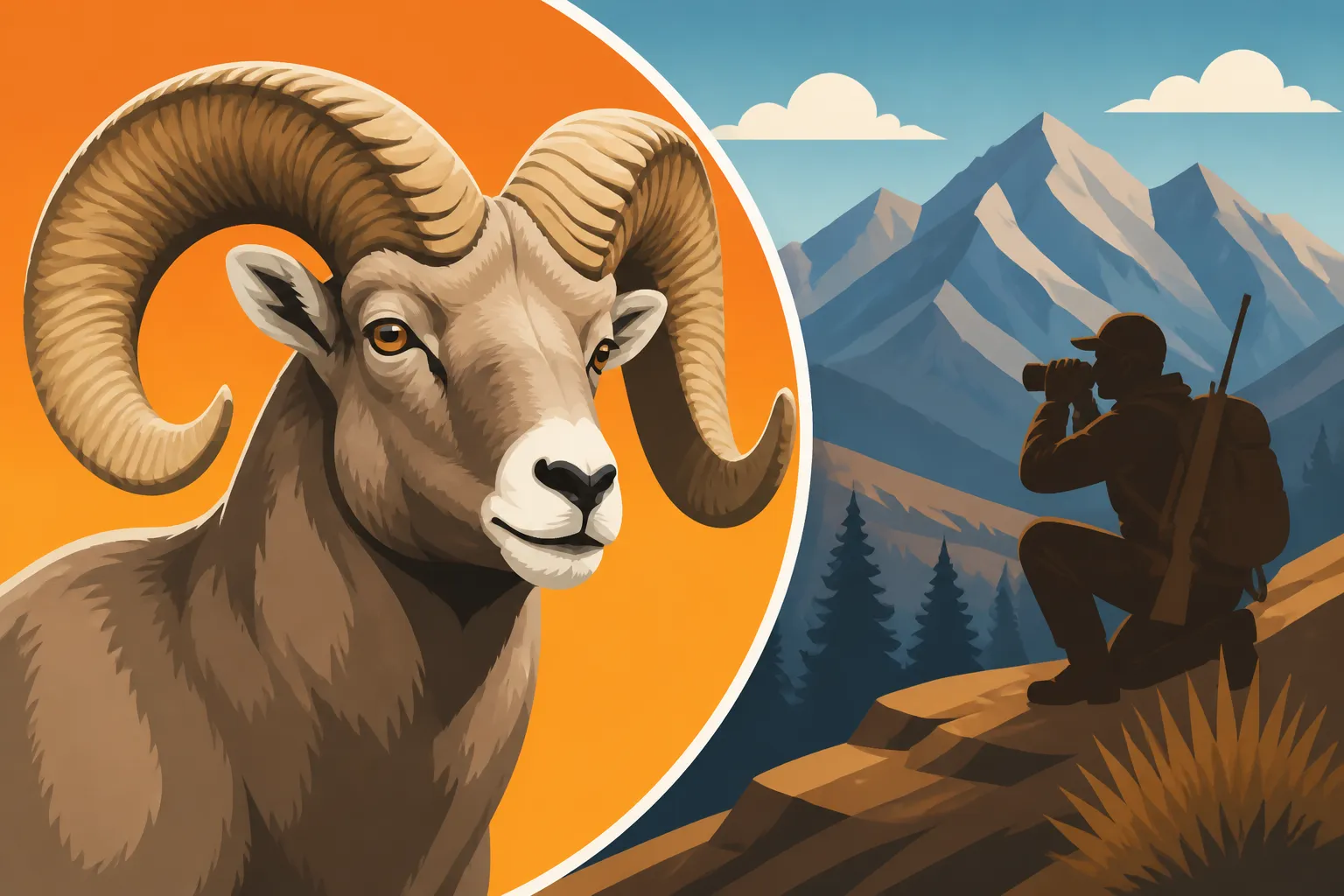
Colorado Bighorn Sheep Rams Explained
Hunting for bighorn sheep in Colorado isn't just a pursuit; it's a monumental challenge that tests a hunter's physical and mental fortitude to their absolute limits. The thought of spotting a magnificent ram high on a distant ridge, let alone closing the distance and making a shot, can feel utterly overwhelming for even seasoned hunters. This guide is here to break down the complexities of understanding, locating, and successfully hunting Colorado bighorn rams, offering realistic advice for navigating the draw, deciphering their behavior, and preparing for the arduous mountain terrain.
The Majestic Bighorn Ram and Why They're So Elusive
There’s something truly iconic about a bighorn sheep ram standing proudly on a craggy peak, horns spiraling toward the sky. They are the epitome of mountain resilience, and for many, drawing a bighorn tag is the pinnacle of a lifetime of hunting aspirations. But their sheer majesty is often matched by their incredible elusiveness, making every encounter a hard-won prize.
Physical Characteristics of Colorado Rams
Colorado’s bighorn sheep are generally of the Rocky Mountain subspecies, and the rams are truly impressive animals. Mature rams can weigh upwards of 300 pounds, with some of the biggest reaching closer to 350 pounds, although most average a bit less. Their most striking feature, of course, is their massive, curled horns. These horns are permanent, growing throughout their lives, adding a new segment each year. You can often see the distinct annual growth rings, or annuli, on a ram's horns, which serve as a natural timeline of their life.
The size and curl of these horns are directly correlated with age, health, and genetics. A young ram might have smaller, tighter curls, while a truly old, mature ram will sport heavy, sweeping curls that often extend past their jawline and can measure well over 30 inches in length along the outer curl. These horns are not just for show; they're used for defense against predators like mountain lions and in dramatic head-butting contests during the rut to establish dominance. When you're out in the field, observing the sheer mass and unique curvature of a ram's horns is the primary way to begin judging its age and legality.
Ram Behavior and Habitat Preferences
Bighorn rams are creatures of extreme elevation and rugged landscapes. They thrive in steep, broken terrain, often favoring rocky outcrops, cliffs, and sparse alpine meadows above timberline. This preference for high, exposed areas isn't just for the views; it's a critical survival strategy. The steep slopes offer protection from predators, allowing them to spot threats from a distance and quickly escape to impossible-to-reach ledges. You'll rarely find a bighorn ram far from escape cover in the form of sheer cliffs or boulder fields.
Their social structure is fascinating. Rams often segregate from ewes and lambs for much of the year, forming "ram bands." These bachelor groups can consist of rams of varying ages, from young, aspiring two-year-olds to truly ancient veterans. These bands typically stick to the highest, most inhospitable country, feeding on tough mountain grasses and forbs, and navigating treacherous terrain with surprising agility. It's during the rut, usually in late fall and early winter, that rams will descend to join ewe bands, where they engage in fierce head-butting battles to secure breeding rights. Understanding these seasonal movements and their preference for extreme, broken country is paramount when you're trying to figure out where to start your search, whether you're e-scouting from home or boots-on-the-ground. For an even broader look at the animals you might encounter, check out our Colorado Big Game Species Guide.
Understanding Bighorn Ram Age and Legal Harvest Criteria
One of the most intense pressures on any bighorn sheep hunter isn't just finding a ram, but finding a legal ram. Colorado, like most Western states, has very specific criteria for what constitutes a legal bighorn sheep ram, designed to ensure herd health and sustainable trophy management. This adds a whole new layer of complexity to an already challenging hunt.
Key Indicators for Judging Ram Age in the Field
Field judging a bighorn ram is notoriously difficult, especially for new sheep hunters or those whose only reference points are photographs. The most common legal requirement in Colorado is the "3/4 curl" rule, meaning the tip of the horn must extend past a line drawn from the back of the neck across the nose, or a full curl, where the horn tip breaks the plane of the opposite horn. However, some units might have different regulations, so always check your specific hunt code carefully.
Beyond the "curl" rule, hunters look for other age indicators. A ram's horns thicken significantly with age, especially at the base. Old rams often have heavy, broom-like tips from years of fighting and rubbing their horns. You'll notice the annuli or growth rings are more tightly packed in older rams, and the horn material itself often shows more wear and tear, appearing duller or chipped. A true monster ram will have heavy mass all the way to the tip, often appearing disproportionately large compared to its body, giving it a distinct, top-heavy look. It's crucial to spend time studying photos and even replicas of bighorn horns to train your eye before you ever step foot in sheep country. Even then, the optical illusions of mountain distances and angles can make judging incredibly frustrating.
Colorado's Specific Regulations for Bighorn Sheep
Colorado's bighorn sheep tags are among the most difficult to draw in the entire West, requiring an accumulation of many, many preference points. It's not uncommon for hunters to wait 20 years or more for a coveted ram tag, which is why when you finally draw, the pressure to succeed is immense. Tags are extremely limited, and some units might only offer one or two tags annually, if any. This is why understanding the Colorado Draw System and Preference Points is so vital for any aspiring sheep hunter.
Each hunt code for bighorn sheep in Colorado specifies not only the unit and season but also the legal ram definition. While 3/4 curl is common, always double-check. For example, some units might have a "minimum length" requirement or a specific measurement from the base. It’s a good idea to carry a measuring tape and even a printed diagram of how to judge a 3/4 curl ram in the field, just to be absolutely sure. This attention to detail isn't about being overly cautious; it's about respecting the resource and the immense effort it takes to secure one of these tags. If you're fortunate enough to draw, you'll want to be intimately familiar with all the Colorado Hunt Codes Explained for your specific unit.
| Age Class (Estimated) | Horn Characteristics | Body Characteristics | Behavior Notes | Legal Status (Colorado Standard) |
|---|---|---|---|---|
| Yearling (1.5 yrs) | Small, thin spikes, barely curved | Slender, deer-like body | Often with ewe/lamb bands | Not legal |
| Young Ram (2.5-4.5 yrs) | Horns forming a noticeable curl, still relatively thin, tips may point outwards | Growing, but still somewhat slender, lacks heavy shoulder mass | Often in bachelor groups, less dominant | Rarely legal, tips not past jawline |
| Middle-Aged Ram (5.5-7.5 yrs) | Horns have significant curl, often approaching 1/2 to 3/4 curl, good mass at base | Heavier build, pronounced shoulder, mature look | More dominant in bachelor groups, but still learning | Potentially legal (3/4 curl), requires careful judging |
| Mature Ram (8.5+ yrs) | Full 3/4 curl or more, heavy mass extending to tips, often "broomed" tips, distinct annuli | Robust, muscular body, deep chest, often scarred from fighting | Dominant, confident, often solitary or with other old rams | Legal (3/4 curl or full curl), often the target |
Strategies for Locating and Approaching Colorado Bighorn Rams
Finding bighorn rams is arguably one of the most challenging aspects of hunting in Colorado. They inhabit some of the most remote and unforgiving landscapes, making both initial location and subsequent approach incredibly demanding. Success often hinges on meticulous preparation and an understanding of their deep mountain habits.
E-Scouting and Pre-Season Reconnaissance
Your bighorn sheep hunt often begins months, even years, before you set foot in the field. E-scouting is absolutely crucial for bighorns. I always recommend using robust mapping platforms like GoHunt to really dive deep into your unit. Start by identifying areas with steep, south-facing slopes (which shed snow quicker and offer earlier forage), prominent rock bands, and alpine basins. Look for areas with a mix of open country for feeding and steep cliffs for escape. Pay close attention to "sheepy" looking terrain – the kind of places you wouldn't want to hike without proper gear.
Once you’ve identified potential areas, use the topographic layers to understand the elevation changes and access points. Satellite imagery can help pinpoint specific benches, natural crossings, and potential bedding areas. Mark these waypoints, paying attention to water sources, which are often limited in high alpine environments. This virtual reconnaissance will save you countless hours and thousands of feet of elevation gain in the field. For more detailed guidance, learn How to E-Scout Before a Colorado Hunt. Remember, bighorns are creatures of habit, and often use the same travel corridors and bedding areas year after year, so identifying these patterns on a map can be a game-changer.
In-Field Glassing and Stalking Techniques
Once you’re in the field, patience is your most important virtue. Bighorn hunting is primarily a glassing game. You need to position yourself on a vantage point that overlooks vast expanses of sheep habitat, then methodically pick apart every rock, cliff face, and patch of timber. High-quality optics are not a luxury; they are a necessity. A good 15x or 20x binocular mounted on a tripod, coupled with a powerful spotting scope (25-60x or 30-70x), will be your best friends. Spend hours, literally hours, scanning. Move slowly, let your eyes relax, and look for anything that breaks the natural pattern of the landscape – a patch of white rump, the curve of a horn, a slight movement. This is a skill that improves with practice, and I highly recommend honing your technique with our guide on How to Glass Big Colorado Basins.
When you finally spot a ram, the real work begins. Stalking bighorns often means navigating some of the most difficult terrain you'll ever encounter. Wind is critical; sheep have an incredible sense of smell, so always approach with the wind in your favor. Use terrain features—ridges, draws, rock formations—to conceal your approach. This might mean adding miles and thousands of feet of elevation to your stalk, but it's essential for success. Moving quietly and deliberately, placing each step with care, is paramount, as loose rock can give you away in an instant. The mental fortitude required to commit to a multi-hour, physically brutal stalk, often ending in nothing but a frustrating relocation of the sheep, is what truly defines a sheep hunter.
Gear Essentials for a Successful Bighorn Sheep Hunt
A bighorn sheep hunt isn't like other hunts. The terrain, the weather, and the physical demands are all amplified. Having the right gear isn't just about comfort; it's about safety and increasing your odds of success in an unforgiving environment. Don't skimp on quality when it comes to the essentials for a sheep hunt.
Optics, Footwear, and Clothing
As mentioned, optics are king. Invest in the best binoculars and spotting scope you can afford. Brands like Swarovski, Zeiss, and Kowa are popular for their clarity and light-gathering capabilities, which are crucial when glassing vast, shadowed mountainsides from dawn till dusk. A sturdy tripod is equally important for stable glassing. Without these, you're severely handicapping your ability to locate and judge sheep at long distances. You can learn more about optimal choices in our guide to Best Optics for Colorado Big Game.
Your feet will take an absolute beating, so don't overlook footwear. You need sturdy, stiff-soled mountain boots that offer excellent ankle support and traction on rocky, uneven terrain. Look for boots designed for mountaineering or serious backcountry hunting. Make sure they are well broken in before your hunt to avoid blisters. Brands like Kenetrek, Crispi, and Lowa are favorites among serious mountain hunters. For clothing, a reliable layering system is non-negotiable. You'll experience significant temperature swings, from freezing mornings to warm afternoons, and potentially sudden snowstorms. Focus on moisture-wicking base layers, insulating mid-layers (puffy jackets are excellent), and a bomb-proof waterproof/breathable outer shell. Consider wearing gaiters to keep scree and snow out of your boots. For general backcountry preparedness, our Colorado Backcountry Hunting Gear List offers a comprehensive overview.
Survival and Safety in Extreme Terrain
Hunting bighorn sheep often means venturing into truly remote and dangerous country, far from cell service or easy rescue. A robust first-aid kit, well-stocked for trauma and common mountain ailments, is absolutely essential. Carry a reliable satellite communication device (like a Garmin inReach or Zoleo) for emergencies. Always let someone know your detailed itinerary, including your planned routes and expected return times. A GPS device or a mapping app on your phone (with downloaded offline maps) is critical for navigation, as trails often disappear, and weather can obscure visibility quickly.
Physical conditioning is perhaps the most important "gear" you can bring. A bighorn hunt will push you to your physical limits, requiring you to climb thousands of feet with a heavy pack, often at elevations well above 10,000 or even 12,000 feet. Start training months in advance, focusing on cardio, strength, and endurance. Simulating mountain conditions by hiking with a loaded pack on steep inclines will pay dividends. Understanding How to Physically Prepare for Colorado Elk offers excellent cross-training advice relevant to sheep hunting, as the demands are similar, if not greater. Always carry enough water, or a reliable water filter, and high-calorie snacks to sustain your energy throughout long days in the mountains.
Disclaimer
Please remember that hunting regulations, season dates, and tag availability can change. Always consult the most current Colorado Parks and Wildlife (CPW) regulations and brochures before planning any hunt. This guide is for informational purposes only and does not supersede official CPW rules.