Colorado Elk Antler Scoring Explained
It can be incredibly frustrating to hear seasoned elk hunters or wildlife biologists talk about "Boone and Crockett scores" or "SCI minimums," throwing around numbers and jargon that leave you scratching your head. You might have just taken your first bull or are dreaming of a trophy, but understanding what those antler measurements actually mean, and how they relate to the grand total, feels like learning a new language. This guide is here to demystify Colorado elk antler scoring, breaking down the major systems and giving you the knowledge to appreciate the true magnificence of these animals, whether you're admiring them from afar or standing over your hard-earned harvest.
Why Antler Scoring Matters (Beyond the Record Books)
While the idea of getting your elk in a record book like Boone and Crockett or Safari Club International is certainly exciting, the practice of antler scoring goes beyond just bragging rights. For many hunters, it's about appreciating the animal, understanding its growth cycles, and even improving field judging skills. It's a way to standardize comparisons and to truly grasp the size and maturity of a bull, even if it never breaks a "minimum."
Understanding Personal Goals and the Hunt
Every hunter's definition of a "trophy" is deeply personal. For some, it's the first bull, regardless of size. For others, it might be a mature 6×6 with incredible mass, or even a unique non-typical bull with character. Learning about antler scoring helps you articulate what you're looking for, whether it's a specific spread, tine length, or simply a symmetrical rack. It gives you a vocabulary to describe the animal you're pursuing or have harvested. It's not about devaluing any bull, but rather about having a framework to appreciate antler development.
It also connects to the effort you put in. When you spend weeks scouting a unit, navigating the rugged terrain of the Flat Tops Wilderness, and finally get an opportunity at a bull, understanding its antler growth can add another layer to that accomplishment. Did you harvest a young, up-and-coming bull, or a seasoned old warrior? The antlers tell a story, and scoring helps you read it.
Navigating the Jargon: B&C vs. SCI
You'll most often hear two main organizations mentioned when discussing antler scores: the Boone and Crockett Club (B&C) and Safari Club International (SCI). Both are highly respected, but they approach antler measurement with slightly different philosophies, leading to different scoring methods and, consequently, different scores for the same animal.
Boone and Crockett is largely focused on North American big game and emphasizes the "typical" or symmetrical nature of antlers, penalizing for differences between sides. It's often seen as the gold standard for fair chase, traditional hunting, especially for public land animals. Conversely, Safari Club International has a broader, worldwide focus and is far more inclusive of non-typical features, often resulting in higher scores for uniquely antlered animals since it doesn't deduct for asymmetry. Understanding these differences is key, as a bull that scores exceptionally high in one system might not do as well in the other.
The Boone and Crockett Club Scoring System Explained
The Boone and Crockett Club scoring system is probably what most Colorado elk hunters are thinking of when they talk about antler scores. It's a meticulous method designed to measure the true bone growth of an animal, emphasizing symmetry and penalizing non-typical points. It's detailed, and frankly, a bit complicated at first glance, but once you break it down, it makes a lot of sense.
The Basics of B&C: Typical vs. Non-Typical
Before diving into the measurements, you need to understand the core concept of typical versus non-typical.
- Typical: This category is for antlers that are largely symmetrical, with points growing in a standard, recognizable pattern. The score heavily favors bulls with matching left and right sides. Any points that don't fit the normal pattern (e.g., drops, abnormal kickers, points growing off another point in an unusual direction) are considered "non-typical" and become deductions from the gross score.
- Non-Typical: This category is for bulls with significant non-typical antler growth. While symmetry is still part of the measurement, the system acknowledges and incorporates these abnormal points into the final score. Instead of being deductions, they add to the gross score, alongside the typical measurements, leading to a much higher net score for truly unique racks.
For a bull to be considered "non-typical" for B&C, it generally needs a certain amount of non-typical antler material, often around 15 inches or more, before it truly becomes advantageous to score it in that category. Most hunters are aiming for a typical bull score, but some of the most impressive and unique elk are indeed non-typical.
Measuring the Main Beams
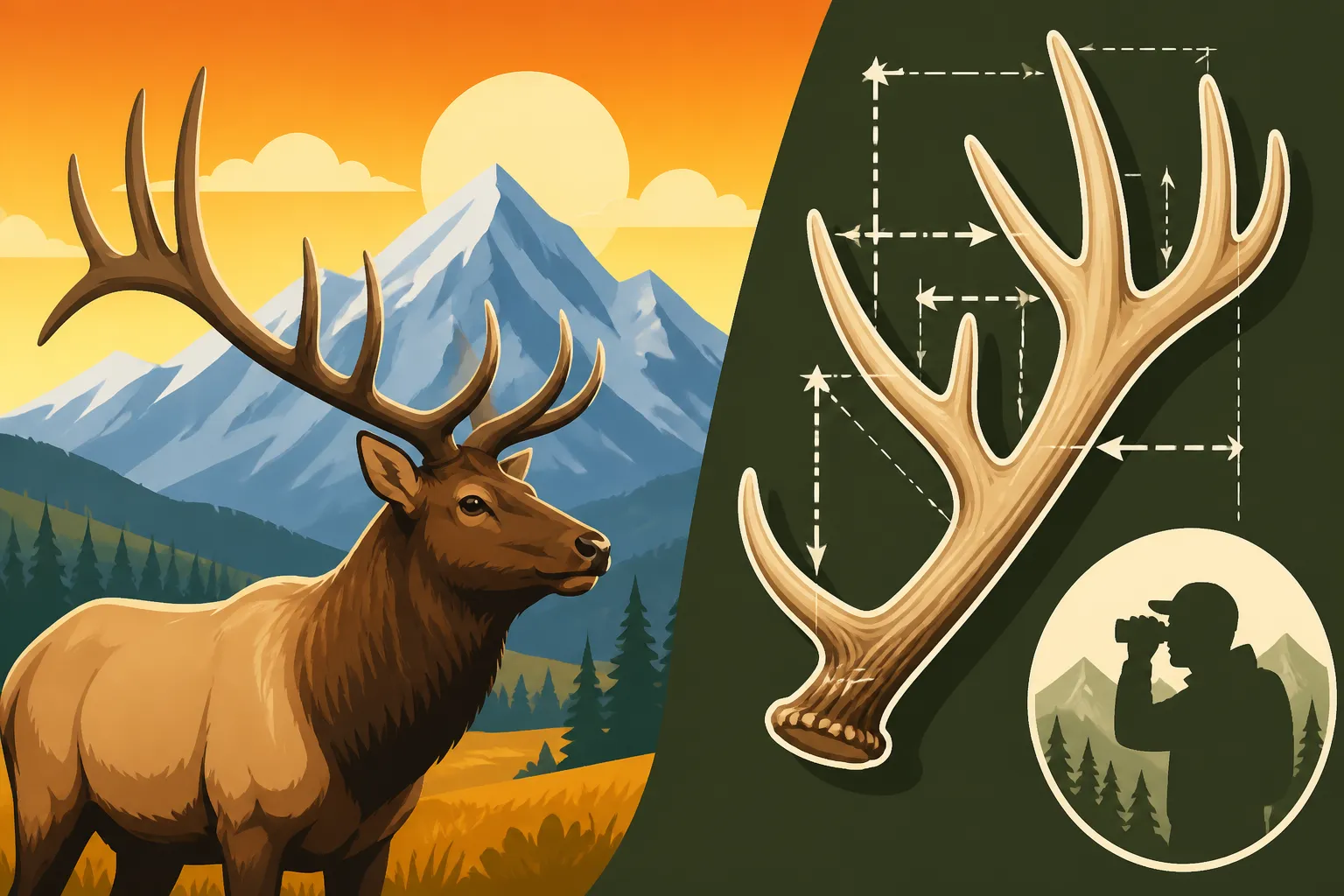
The main beams are the backbone of the antler, extending from the skull upwards and outwards. In B&C, you measure the length of each main beam from its base (the burr) along the outside curve to its tip. This isn't a straight-line measurement; it follows the natural curve. Imagine taking a flexible tape measure and carefully laying it along the longest edge of the beam. This requires a steady hand and a keen eye to follow the exact path of the curve. You'll measure both the left and right main beams separately.
A common challenge here is identifying the true "tip" of the beam, especially if it's broken or worn. The official B&C rules provide clear guidelines for these scenarios, often involving projections beyond the last measurable point. The goal is always consistency and accuracy.
Counting and Measuring Points
This is where things can get tricky. For B&C, a "point" must be at least one inch long and longer than it is wide at its base. It also must project upward or outward from the main beam. Points that are merely bumps or "nubs" don't count. Each measurable point on both the left and right antlers is measured from the nearest edge of the main beam along its longest dimension to its tip.
Here’s a breakdown of how points are typically classified:
- Brow Tines (G1s): The first point coming off the main beam, often projecting forward.
- Bay Tines (G2s): The second point, typically above the brow tine.
- Tray Tines (G3s): The third point, further up.
- Royal Tines (G4s): The fourth point.
- Back Tines (G5s, G6s, etc.): Any subsequent points further along the main beam.
The length of each point contributes to the overall gross score. The more impressive and longer the points, the higher the score. It’s critical to get a precise measurement of each point, always following the longest edge to its tip.
Circumference Measurements
Often called "H-measurements," these measure the circumference (or mass) of the main beam at various points. These measurements are crucial because they account for the "heft" or thickness of the antlers, which contributes significantly to the overall score. For elk, there are four circumference measurements taken on each main beam:
- H1: Between the burr and the G1 (brow tine).
- H2: Between the G1 and G2.
- H3: Between the G2 and G3.
- H4: Between the G3 and G4, or if there's no G4, halfway between the G3 and the beam tip.
Each of these eight circumference measurements (four on each side) is added to the total. A bull with thick, heavy antlers throughout its beams will score much higher than a bull with long but slender antlers. This is why you sometimes see elk with less impressive points, but a high score, because they have incredible mass.
The Inside Spread Credit
The inside spread is the widest measurement between the main beams, taken at right angles to the centerline of the skull. This measurement is only added once to the gross score. It's not a measurement of bone, but rather the air space between the beams. A wide-racked bull gets a nice boost from this measurement, but it doesn't count towards the net score if there are deductions for symmetry.
It’s important to note that while the inside spread is a visual indicator of a massive bull, it often has less impact on the final B&C score compared to beam length, point length, and especially mass measurements. Still, it’s a key component for the overall "presence" of a trophy.
The Dreaded Deductions: Penalties for Asymmetry
This is where B&C truly distinguishes itself from SCI. After all the main beam lengths, point lengths, circumference measurements, and inside spread are added together to create a gross score, B&C then looks for differences between the left and right antlers. These differences become deductions from the gross score, resulting in the net score.
Here’s how deductions work:
- Symmetry Deductions: For every typical measurement (main beam length, G1, G2, G3, G4, and other typical points, and the four circumference measurements), the corresponding measurement on the left antler is compared to the right antler. The difference between any matching typical points or segments is counted as a deduction. For example, if the left G3 is 15 inches and the right G3 is 14 inches, 1 inch is deducted. This happens for all matching typical measurements.
- Non-Typical Points: Any point that does not conform to the normal pattern of antler growth is considered non-typical. In the typical category, the length of all non-typical points on both antlers is added up and deducted from the gross score. This is a big reason why a bull with characterful kickers might not net high as a typical B&C entry.
This deduction process means that a perfectly symmetrical bull will have a net score very close to its gross score. A bull with significant asymmetry or many non-typical points will see its net score drop considerably from its gross score. This emphasis on symmetry is central to the B&C philosophy for typical animals.
To summarize the B&C score components:
| Measurement Category | Description | Calculation | Impact on Score |
|---|---|---|---|
| Main Beams | Length of each main beam (left & right) | Sum of Left Beam + Right Beam | Significant |
| Typical Points | Length of all normal points (G1, G2, G3, G4, etc.) on each side | Sum of all Left Points + Sum of all Right Points | Significant |
| Circumferences (Mass) | Girth of the main beam at 4 points on each side | Sum of 4 Left Circumferences + Sum of 4 Right Circumferences | Very Significant |
| Inside Spread | Widest distance between main beams | Measured once, added to sum | Moderate |
| Gross Score Total | Sum of all above measurements | ||
| Symmetry Deductions | Differences between corresponding typical measurements (L vs R) | Sum of all differences between Left & Right typical measurements | Deduction |
| Non-Typical Point Deductions | Length of all abnormal points | Sum of all non-typical points (if scoring as a typical entry) | Deduction |
| Net Score Total | Gross Score minus all Deductions |
The minimum score for an elk to make the Boone and Crockett All-Time Records is 375 for a typical bull and 390 for a non-typical. For Awards entries, the minimums are 360 and 375, respectively. These are truly exceptional animals, and harvesting one is a lifelong achievement.
Safari Club International (SCI) Scoring
Safari Club International takes a different approach to antler scoring, one that is often favored by hunters who appreciate the unique character and overall "trophy value" of an animal, regardless of perfect symmetry. It’s a global organization, so its scoring system is designed to be applicable to a wider range of species and antler configurations.
SCI's Different Approach to Antler Evaluation
The main philosophical difference with SCI is that it focuses on adding up all positive measurements and does not deduct for asymmetry. This means that a bull with a highly asymmetrical rack or many abnormal points will often score significantly higher under the SCI system than under B&C, particularly if scored as a typical entry for B&C. SCI's system celebrates the overall size and mass of the antlers as they are, rather than penalizing for deviations from a theoretical ideal.
SCI offers two categories for elk: "typical" and "non-typical," but even within the typical category, the approach to what constitutes a "non-typical point" is different and does not lead to deductions for asymmetry.
Key Differences from B&C
Let's break down the practical differences in how SCI scores compare to B&C:
- No Deductions for Asymmetry: This is the biggest differentiator. If your bull has a G3 that's 10 inches on one side and 14 inches on the other, B&C would deduct 4 inches. SCI simply adds both 10 and 14 inches to the score, without any penalty. This dramatically favors bulls with character and unique growth, as well as those with less-than-perfect symmetry.
- Main Beam Measurements: Similar to B&C, the main beams are measured along their outer curve from the burr to the tip.
- Point Measurements: All points over one inch are measured from the main beam. There's less emphasis on classifying points as G1, G2, etc., and more on simply measuring every point the antler produces.
- Circumference Measurements: SCI also takes circumference measurements for mass, but the locations can differ slightly from B&C. Generally, they aim to capture the thickness at the smallest diameter between points, similar in concept to B&C's H-measurements.
- Inside Spread: Like B&C, the greatest inside spread is measured and added to the score.
- Trophy Value: SCI often includes criteria beyond just antler measurements in its record book, sometimes considering skull size or even body size for certain species, though for elk antlers, it's primarily about the rack.
Because SCI doesn't deduct for asymmetry, it's not uncommon for an elk to have an SCI score that is 10-20% higher than its B&C net score. The minimum score for SCI records is generally lower than B&C for initial recognition, reflecting the inclusion of a broader range of antler configurations. For example, a bull might need around 360 SCI points to make their records, depending on the specific category.
Practical Tips for Field Judging and Post-Harvest Measurement
Understanding scoring systems is one thing, but applying it in the field, when a bull is bugling through the timber or pausing briefly on a distant ridge, is another challenge entirely. However, practicing field judging and knowing what to do after the harvest can greatly enhance your hunting experience.
Estimating on the Hoof: The Art of Field Judging
Field judging a bull elk, especially in the thick timber or at long distances, is a skill that takes years to hone. You're trying to quickly estimate main beam length, point length, mass, and spread, all while accounting for angles, light, and the animal's movement. This is where tools like binoculars and spotting scopes are invaluable. You can learn a lot about How to Glass Big Colorado Basins to improve your field judging skills.
Here are some tips for estimating antler scores in the field:
- Look for Main Beam Length: How far back past the ears do the main beams extend? A mature bull will often have main beams that reach well past its nose when its head is down. Think about where the tips would fall in relation to its body.
- Assess Point Length: Focus on the G3s and G4s (tray and royal tines), as these are often the longest and contribute heavily to the score. Are they long and dagger-like, or short and blunt? Compare them to the length of the bull's ear, which is roughly 8-10 inches.
- Judge Mass/Circumference: This is perhaps the hardest to estimate visually. Look at the bases. Are they thick and heavy, like a soda can, or slender like a broomstick? Does that mass carry out far along the beam, or does it drop off quickly? A bull with great mass will look "blocky" in the antlers.
- Estimate Inside Spread: How far out do the main beams go? Are they wider than the bull's ears? Wider than its body? A spread of 45-50 inches is considered wide, but some bulls can push 60 inches.
- Count Points Quickly: Try to quickly count how many points are on each side. A symmetrical 6×6 (six points on each side) is often what hunters are looking for.
- Practice with Photos and Videos: Spend time looking at photos and videos of harvested elk with known scores. Try to guess their score before looking at the actual numbers. Use apps like those offered by GoHunt to study trophy potential in various units. This can train your eye effectively.
Remember, field judging is about making a quick, educated guess. Don't let it consume your hunt, but it's a fun and practical skill to develop. For more in-depth knowledge on this, check out our guide on How to Field Judge a Colorado Bull Elk.
Post-Harvest Measurement: Getting it Right
Once you've harvested a bull, taking accurate measurements is crucial if you're considering a formal score or just want to accurately document your trophy.
- Wait for the Drying Period: Antlers can shrink slightly as they dry out. For official B&C scoring, there's a mandatory 60-day drying period after the skull plate is cleaned. This ensures stability in the measurements.
- Gather Your Tools: You'll need a flexible steel tape measure (often 1/4 inch wide for accuracy), a pencil, and the official score sheet for either B&C or SCI.
- Clean the Skull Plate: Ensure all flesh and tissue are removed from the skull plate.
- Follow the Score Sheet: Both B&C and SCI provide detailed, numbered diagrams and instructions on their score sheets. Follow these meticulously. Start with the main beams, then all the points, then the circumference measurements.
- Seek a Certified Measurer: If you believe your bull is truly exceptional and might qualify for the record books, it's highly recommended to have a certified B&C or SCI measurer do the official scoring. They are trained to interpret the rules accurately and consistently. You can find lists of official measurers on their respective websites. They can ensure your measurements are precise and avoid common errors.
Even if you don't pursue an official score, taking careful measurements yourself provides a tangible record of your hunt and a deeper appreciation for the bull you harvested. It's part of the respectful process of understanding the animal.
Utilizing Technology and Data
In today's hunting world, technology can be a huge asset in both pre-season planning and understanding antler potential. Websites like GoHunt provide detailed unit data, draw odds, and often include information on the historical trophy potential of specific Game Management Units (GMUs) in Colorado. This data can help you choose a unit where bigger bulls are more common, or where the genetics produce more impressive antlers.
For example, if you're researching Best Colorado Units for Bull Elk, platforms often integrate historical harvest data and trophy entries. While a specific antler score isn't guaranteed, this information can guide your expectations and strategy. Additionally, some mobile hunting apps offer features that allow you to roughly sketch antler dimensions over a photo to get a ballpark estimate in the field, though these are never a substitute for actual measurement. When you are looking to truly understand Colorado Elk Herd Size and Population, and how that impacts antler quality, these data sources are invaluable.
Colorado's Elk Antler Growth and Trophy Potential
Colorado is home to the largest elk herd in North America, offering incredible hunting opportunities. This vast population, combined with diverse habitats, leads to a wide range of antler growth characteristics across the state. Understanding how Colorado's environment and genetics influence antler development can give you a better grasp of trophy potential.
Environmental Factors Influencing Antler Growth
Antler growth isn't just about genetics; it's heavily influenced by environmental factors that directly impact a bull's nutrition and overall health.
- Nutrition: This is arguably the most critical factor. Bulls need a high-quality diet rich in protein, minerals (especially calcium and phosphorus), and energy to grow large antlers. Areas with lush forage, like high-alpine basins in the summer or fertile river bottoms, tend to produce healthier bulls with bigger racks. A tough winter or drought can severely impact the quality of the forage, leading to smaller antler growth the following year. Consider how Colorado Elk Migration Patterns can lead bulls to different forage sources throughout the year.
- Age: While nutrition is key, a bull needs to reach maturity to express its full genetic potential. Elk typically reach their prime antler growth between 6.5 and 10.5 years old. Younger bulls, even with excellent nutrition, simply haven't had enough time to grow massive antlers. Older bulls, past their prime, might start to show regressive antler growth, with thinner beams or fewer points. Understanding How Big Are Colorado Elk at various ages helps in field judging.
- Genetics: Naturally, some bulls are simply born with the genetic predisposition to grow larger, more symmetrical, or more unique antlers. While you can't control genetics, knowing that certain areas consistently produce bigger bulls can guide your unit selection.
- Weather and Habitat: Severe winters can stress elk, diverting energy from antler growth to survival. Conversely, mild winters and abundant moisture in the spring and summer lead to better forage and often, bigger antlers. Habitat diversity, offering a mix of feed, cover, and water, is essential for healthy herds and impressive antler growth. This ties into understanding How to Find Elk When They Go Quiet in varying conditions.
What Makes a Colorado Bull a "Trophy"?
The term "trophy" is subjective, but in the context of antler scoring, it usually refers to a bull that has reached a certain level of antler development as defined by B&C or SCI. For Colorado elk, achieving a score that makes the record books is truly remarkable.
- Typical Bulls: For a typical bull in Colorado, exceeding 300 inches is a respectable mature bull, 330-350 inches is a fantastic animal, and anything over 360 inches (for B&C Awards) or 375 inches (for B&C All-Time) is an absolute giant. These bulls typically have long, symmetrical main beams, impressive point length, and great mass carried out through their rack.
- Non-Typical Bulls: Non-typical bulls, with their unique character and abnormal points, are often judged by the sheer impressiveness of their bone. A non-typical over 350 inches is a very big bull, and hitting the B&C non-typical minimum of 390 inches means you’ve taken an elk with truly extraordinary antler growth. These could include majestic drop tines, multiple kickers, or beams that branch in unusual ways.
Colorado consistently produces bulls that make the record books. The state's robust elk populations, combined with vast public lands and dedicated wildlife management by Colorado Parks and Wildlife, ensure that the potential for trophy-class elk remains strong. Learning about Colorado Elk Hunting Guide or specific methods like Colorado Rifle Elk Hunting Guide can prepare you for the pursuit of such animals. Remember, the true trophy isn't always the highest score, but the experience and the memories made in the stunning Colorado backcountry.
Disclaimer
Please remember that hunting regulations and scoring rules can change. Always consult the most current Colorado Parks and Wildlife (CPW) regulations for season dates, licensing requirements, and specific GMU rules. For official antler scoring, refer directly to the Boone and Crockett Club and Safari Club International websites for their latest score sheets, rules, and lists of certified measurers. This guide is for informational purposes only and should not be considered legal or definitive advice.