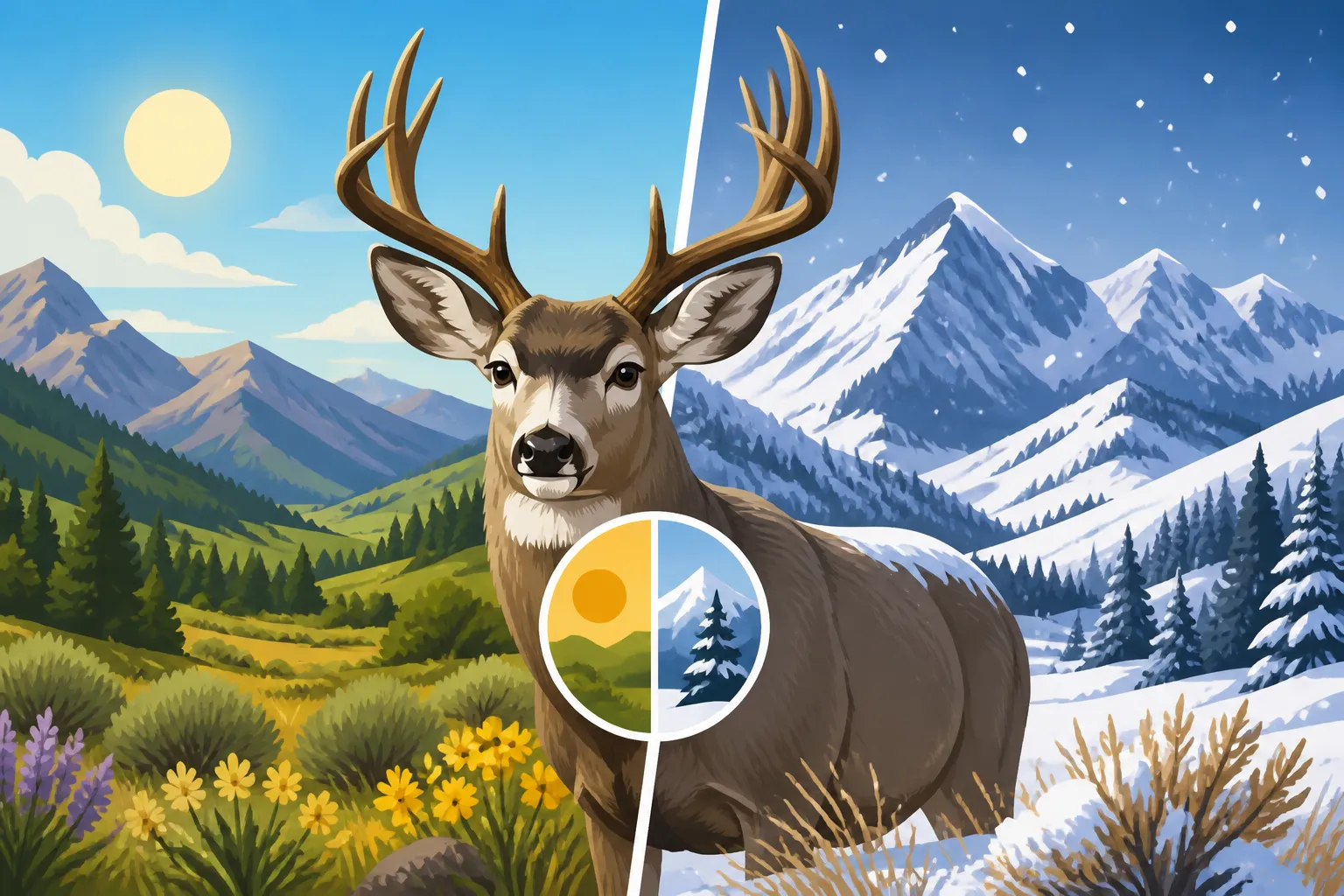
Colorado Mule Deer Summer vs Winter Range
It's a common dilemma for hunters: you scouted a promising area for mule deer in July, only to return for opening day in October and find the place devoid of life. This frustrating experience stems from a fundamental misunderstanding of how Colorado mule deer utilize their vast, varied habitats across the seasons. This guide aims to pull back the curtain on the distinct summer and winter ranges of Colorado mule deer, helping you grasp their seasonal movements so you can be in the right place at the right time.
The Seasonal Dance: Understanding Mule Deer Migration in Colorado
Colorado's diverse topography, from arid plains to towering peaks, dictates a dynamic lifestyle for its mule deer. Unlike some other deer species that might stick to a relatively small home range year-round, many Colorado mule deer are true migrants, covering significant distances to access optimal resources as the seasons change. This isn't just about finding food; it's about survival – escaping deep snow, finding security, and accessing nutrient-rich forage to sustain them through lean times and prepare for the next breeding cycle. If you're going to consistently locate these magnificent animals, understanding this seasonal dance is paramount.
Why Mule Deer Move: The Driving Factors
The forces compelling mule deer to migrate are complex, but largely boil down to weather, forage availability, and predator avoidance. As the snows begin to recede in spring and green-up occurs, deer will follow that new growth up in elevation. Conversely, when winter looms, deep snow can literally bury their food sources and hinder their movement, pushing them down to lower, often more sheltered, elevations.
Consider a herd in the San Juan Mountains, for instance. In early summer, they might be feasting on lush alpine forbs high above treeline. But come late October, a heavy snowstorm can render that area impassable and food-scarce. That same herd will be driven down to lower slopes, often south-facing aspects, where snow melts faster and browse is more accessible. This migratory behavior is hardwired and crucial for the herd's health and survival. Ignoring these patterns is akin to trying to hunt ducks in a desert – you'll simply be in the wrong place. Tools like GoHunt's detailed maps and data insights can be incredibly valuable for visualizing these historical migration routes and understanding the specific dynamics of different units, allowing you to effectively How to E-Scout Before a Colorado Hunt.
Genetic Predisposition and Learned Behavior
While environmental factors are the immediate triggers, the instinct to migrate is deeply ingrained. Generations of deer have followed the same paths, passing this knowledge down through matriarchal lines. There's a genetic component that influences whether a deer is migratory or residential, and the specific routes are often learned from their mothers. This means that if you find a migration corridor, chances are it's been used for a very long time, and will continue to be used, barring significant human disturbance or habitat alteration.
It’s not just about inherited knowledge; deer are also incredibly adaptable. If a specific winter range becomes over-browsed or a new human development impacts a traditional migration route, deer will adjust. They might find new paths or utilize different wintering areas, though this adaptation can take time and often comes with a cost to the herd's overall health and survival rates. This makes keeping up with current conditions and local biologist reports, or even just talking to seasoned locals, incredibly important for hunters.
The High Country Allure: Colorado Mule Deer Summer Range
When the snow melts and the mountains burst into life, Colorado mule deer head for the high country. This summer range is a paradise of abundant forage, cooler temperatures, and relative seclusion. But understanding where they go and why is key to finding them once hunting season rolls around.
Characteristics of Prime Summer Habitat
Mule deer summer ranges in Colorado are typically found at higher elevations, often above 8,000 to 9,000 feet and sometimes pushing into alpine zones above treeline. These areas are characterized by:
- Lush Forage: Think sprawling meadows dotted with wildflowers, aspen groves bursting with new growth, and north-facing timbered slopes holding moisture. Deer are seeking out highly nutritious forbs (broad-leafed plants), succulent grasses, and the tender new shoots of shrubs and trees. These high-protein, easily digestible foods are critical for bucks to grow impressive antlers and for does to recover from fawning and nurse their fawns.
- Water Sources: Pockets of snowmelt, bubbling springs, and clear mountain streams are abundant, providing constant hydration. While mule deer can derive a lot of moisture from their forage, reliable water sources are always a draw.
- Thermal Cover: While they enjoy open feeding areas, deer still need shade to escape the midday sun and dense timber to cool down. North-facing slopes with thick spruce and fir stands are often preferred.
- Security Cover: Areas with broken topography, dense timber, and remote basins offer refuge from predators and human disturbance. This is especially true for mature bucks, who often seek out more rugged, inaccessible areas to escape pressure and grow their antlers undisturbed.
Imagine glassing a vast basin in the Flat Tops Wilderness. You might spot a group of does and fawns lazily feeding on a sun-drenched avalanche chute, while a bachelor group of bucks might be tucked into a pocket of timber on a steep, shadowy slope above them, only emerging to feed in the cooler hours. This is typical summer behavior.
Hunting the Summer Range During Early Seasons
For archery and early muzzleloader hunters, understanding the summer range is paramount. While the deer are still generally at higher elevations, they're beginning to feel the first subtle shifts of impending fall.
- Pre-Rut Buck Behavior: During the early archery seasons (late August through September), bucks are often still in their bachelor groups and focused on putting on weight. Their antlers are hardened, and they might still be found high, especially if feed is plentiful and hunting pressure is low. They'll often feed aggressively in the mornings and evenings, retreating to thick timber or north-facing slopes during the day. This is a great time to implement Colorado Mule Deer Hunting: Spot-and-Stalk Tactics.
- Doe and Fawn Movement: Does and fawns will also be in the high country, generally in slightly less steep or timbered terrain than the bucks, though they will still use pockets of cover. They are often less spooky than rutting bucks and can offer good opportunities for those with antlerless tags.
- Reading the Micro-Terrain: Look for saddles, benches, and north-facing aspects that provide both food and security. Don't be afraid to put on the miles. Many successful early-season hunts happen deep in the backcountry, far from roads. This is where detailed maps, like those offered by GoHunt, become essential. You can identify historical bedding areas, water sources, and potential travel corridors long before you set foot on the mountain.
Remember, even in summer, the weather in Colorado's high country can be unpredictable. Early snowstorms can hit in September, immediately pushing deer down. Always be prepared for rapid changes in conditions and have a backup plan.
Seeking Shelter and Sustenance: Colorado Mule Deer Winter Range
As autumn progresses and winter tightens its icy grip on the high country, mule deer embark on their annual migration to lower elevations, seeking refuge and accessible food. This shift to winter range is a critical survival strategy and presents a completely different set of challenges and opportunities for hunters.
Defining Winter Range Characteristics
Colorado mule deer winter ranges are typically found at lower elevations, often below 8,000 feet, though this can vary greatly depending on snowpack and topography. These areas are designed for survival through harsh conditions:
- Reduced Snowpack: Lower elevations naturally receive less snow, and south-facing slopes melt off faster, revealing precious forage. This is the primary driver for deer moving down.
- Accessible Forage: Instead of lush forbs, winter forage primarily consists of woody browse – shrubs like bitterbrush, serviceberry, sagebrush, and mountain mahogany. These plants are crucial as they remain above the snow and provide sustenance, albeit with lower nutritional value than summer feed. Deer will also seek out grasses exposed on windswept ridges or sunny slopes.
- Thermal Protection: Dense stands of conifers (pine, spruce, fir) provide critical thermal cover, sheltering deer from brutal winds and heavy snowfall. Pockets of timber in drainages or on leeward slopes are often used for bedding.
- Security and Escape Terrain: While seeking easier travel, deer still need areas where they can escape predators. Broken country, steep canyons, and dense brush provide hiding spots and avenues for quick escape.
Think of areas like the lower slopes of the Uncompahgre Plateau, the Piceance Basin, or the piñon-juniper zones across western Colorado. These landscapes, which might seem desolate in summer, become vital havens for deer in winter.
Hunting Tactics on the Winter Range
Late season rifle hunts (3rd and 4th seasons, typically mid-November through December) often coincide with deer being settled on their winter range or actively migrating. This time of year demands a different approach:
- Glassing is King: With deer concentrated and often moving in larger groups, long-range glassing becomes indispensable. Find a high vantage point overlooking south-facing slopes, lower elevation timber, and major drainage systems. Use high-quality optics to systematically pick apart the landscape. Focus on edges where timber meets open sage, or sunny slopes within a canyon system. You'll be looking for any movement, a flicker of an ear, or the distinct shape of a deer against the snow.
- Following Migration Corridors: If you're hunting during an active migration period, understanding these corridors is vital. Deer will move along the path of least resistance – river bottoms, ridge lines, and saddle systems that connect summer and winter habitats. These can be incredible ambush points. GoHunt's mapping overlays showing historical migration patterns are invaluable here, helping you predict where deer will funnel.
- Focus on South-Facing Slopes: As snow accumulates, deer will invariably gravitate to south-facing aspects that receive the most sunlight and shed snow fastest. These become primary feeding and bedding areas.
- Pressure Points: With deer concentrated, hunting pressure can quickly push them into thicker cover. Look for the undisturbed pockets, dense timber patches, or secluded drainages where deer will seek refuge. How to Hunt Colorado Public Land Pressure is a critical skill in these situations.
Understanding Colorado Mule Deer Habitat Explained and knowing what food sources are available on the winter range will greatly improve your chances of success during these colder months.
The Crucial Transition: Hunting During Migration Periods
The times when mule deer are actively moving between their summer and winter ranges are often the most dynamic and, for savvy hunters, the most opportunistic. These migration periods are usually triggered by weather and occur in spring (upward movement) and fall (downward movement). For hunters, the fall migration is of paramount interest.
Predicting the Migration: Weather as the Key Trigger
The timing of the fall migration is highly variable, dictated almost entirely by weather patterns. It's not a set date on a calendar; rather, it's a direct response to conditions.
- Early Snowfall: The most significant trigger is early, heavy snowfall in the high country. A foot or more of snow at high elevations can immediately send deer packing for lower ground, sometimes in a matter of hours or days.
- Consistent Cold Temperatures: Even without heavy snow, a sustained period of cold weather can encourage deer to begin their descent as forage quality diminishes at higher elevations.
- Hunting Pressure: Intense hunting pressure in the high country can also push deer to migrate earlier or faster than they might otherwise.
This variability means a successful hunter must be constantly monitoring weather forecasts, snow depths, and local reports. Waiting until you see snow on the ground from your front porch might be too late; by then, many deer could already be halfway to their winter range. This is why having flexible hunting dates and scouting thoroughly, possibly with tools that integrate weather patterns, is a huge advantage.
Strategies for Hunting Migratory Deer
Hunting deer during migration requires different tactics than those employed on their static summer or winter ranges. It’s all about intercepting movement.
- Identify Migration Corridors: These are often traditional routes that deer have used for generations. Look for natural funnels like saddles, narrow canyon bottoms, passes, or finger ridges that connect high and low elevations. These corridors might not show much sign in summer, but they become superhighways during migration. GoHunt's digital mapping can highlight these historical routes, allowing you to focus your scouting efforts.
- Elevational Scouting: If you know an early storm is coming, strategically scout elevations just below the main summer range, along likely descent routes. The deer will be coming your way.
- Stand Hunting or Ambushes: Because deer are moving with a purpose during migration, setting up an ambush point along a known corridor can be incredibly effective. Consider pinch points, dense timber edges bordering open areas, or areas where deer might pause to feed before continuing their journey.
- Utilize Thermals and Wind: As deer move up and down mountains, they often follow thermals – the rising and falling air currents. In the morning, thermals rise, carrying scent uphill. In the evening, they fall, carrying scent downhill. Understanding How to Use the Wind Hunting Colorado Elk (which applies equally to deer) is critical for setting up correctly. Always position yourself so your scent is carried away from where you expect deer to approach.
The rut often overlaps with migration, especially during Colorado's 2nd and 3rd rifle seasons. Bucks, already on the move, become even more active as the urge to breed takes over. This makes hunting during this period incredibly exciting, but also challenging as deer movement can be even more unpredictable. If you're targeting a trophy buck, understanding How to Hunt Mule Deer in the Rut is absolutely essential.
Table: Key Differences in Mule Deer Ranges and Hunting Implications
| Feature | Summer Range (High Country) | Winter Range (Low Country) | Migration Period (Transition) |
|---|---|---|---|
| Typical Elevation | 8,000 ft + (often up to treeline or alpine) | Below 8,000 ft (piñon-juniper, sagebrush flats, lower timber) | Variable, bridging summer and winter zones |
| Primary Forage | Lush forbs, grasses, new aspen shoots | Woody browse (bitterbrush, serviceberry, sagebrush), exposed grass | Mix of residual summer forage & accessible winter browse |
| Cover | Dense conifer timber, broken rocky terrain, deep basins | Dense stands of piñon/juniper, conifer pockets, steep canyons | Linear features: ridges, drainages, saddles, timbered benches |
| Deer Grouping | Smaller bachelor groups of bucks, dispersed does/fawns | Larger herds, often concentrating in sheltered areas | Groups can be broken up or coalescing, actively moving |
| Hunter Activity | Backcountry focus, spot-and-stalk, calling, glassing vast areas | Glassing open areas, still-hunting timber, ambush points | Ambushes on corridors, tracking fresh snow, tactical scouting |
| Key Trigger | Spring green-up, receding snow | Heavy snowfall at high elevation, sustained cold | Early snow, cold fronts, diminishing high-country forage |
Ultimately, success in hunting Colorado mule deer hinges on your ability to adapt. What works in a high alpine basin in September might be completely ineffective in a lower elevation canyon in November. By understanding the specific drivers of Colorado Mule Deer Migration, and tailoring your approach to whether deer are on their summer range, winter range, or somewhere in between, you significantly increase your odds. Knowing the Best Colorado Units for Mule Deer in Colorado is a great start, but understanding their movements within those units is the real game-changer.
Planning Your Hunt: Integrating Range Knowledge
Putting this knowledge into practice involves meticulous planning and a willingness to be flexible. It’s not just about looking at a map, it’s about understanding the land in three dimensions, considering elevation, aspect, and the relentless influence of weather.
E-Scouting and Boots-on-the-Ground Reconnaissance
Modern e-scouting tools, especially those that incorporate historical data, are invaluable for this. Platforms like GoHunt allow you to overlay public and private land boundaries, identify historical deer migration corridors, pinpoint potential bedding areas, and mark water sources, all from the comfort of your home. You can analyze topography to find south-facing slopes, identify potential pinch points along migration routes, and even scout access points. This kind of preparation is essential for any serious hunter looking to pursue Colorado Mule Deer Hunting Guide.
However, nothing replaces actual boots-on-the-ground scouting. If possible, visit your chosen unit in the off-season. Walk the ridges, glass the basins, and look for sign. Even if deer aren't there, you can identify the types of forage available, find travel corridors, and get a feel for the terrain. Pay attention to rub lines, old beds, and historical droppings to understand how deer might use the area during different times of the year. This helps you build a mental map that goes beyond the digital rendering. For a comprehensive overview, checking out a Colorado Hunting Units (GMUs) Explained will provide the framework you need to start your research.
Adapting to Conditions on the Fly
Colorado’s weather is notoriously fickle. A bluebird day can turn into a blizzard overnight, especially in the mountains. This means your hunting plan needs to be dynamic.
- Monitor Weather Constantly: Before and during your hunt, keep a close eye on forecasts. Not just for your immediate area, but for higher elevations that might push deer down. Snow reports, temperature swings, and high winds are all indicators of potential deer movement.
- Have Backup Plans: If an early season hunt gets snowed out of the high country, do you have a plan for hunting lower? If a late-season area gets too much snow, where will the deer go next? Thinking ahead and having alternative locations scouted can salvage a hunt.
- Be Patient and Persistent: Deer movement, especially during migration, isn't always a stampede. It can be a slow, steady trickle. Be prepared to spend days glassing and patiently waiting for animals to appear.
Ultimately, the best advice for How to Hunt Mule Deer in Colorado comes down to understanding the animal, its habitat, and how those two factors interact throughout the year. By respecting their need for both summer abundance and winter refuge, you’ll not only become a more effective hunter but also gain a deeper appreciation for the resilience and adaptability of Colorado’s magnificent mule deer. Every successful hunt starts with knowledge, and knowing where deer should be at different times of the year is half the battle.
Disclaimer
Hunting is a challenging and rewarding activity that carries inherent risks. This guide provides general information and recommendations for hunting mule deer in Colorado. All hunters are responsible for understanding and complying with all current Colorado Parks and Wildlife regulations, licensing requirements, and safety guidelines. Conditions in the field can change rapidly, and hunters must be prepared for varying weather, terrain, and unexpected situations. Always prioritize safety, ethical hunting practices, and respect for wildlife and public lands.