Best GMUs for Mule Deer in Colorado
Trying to figure out where to hunt mule deer in Colorado can feel like a daunting task, especially with so many General Management Units (GMUs) and varying regulations. It’s tough to sift through all the data and whispered rumors to find those truly special places. This guide is here to help you cut through the confusion, offering a deep dive into what makes a GMU ideal for mule deer, highlighting top areas, and equipping you with the knowledge to plan a successful hunt.
Understanding Colorado's Mule Deer Habitat and Behavior
Before we dive into specific units, it’s crucial to understand the environment mule deer thrive in and how their behavior shifts throughout the year. Knowing this foundation will help you interpret GMU data and scout effectively, no matter where you decide to hunt.
The Diverse Habitats Mule Deer Call Home
Colorado's landscape is incredibly varied, and mule deer have adapted to make a home in many different parts of it. You might find them ranging from the high alpine basins, where they summer above tree line, down to the sagebrush-covered flats and cedar breaks of lower elevations during harsher winters. Their preference often lies in areas with a mosaic of habitat types: open areas for feeding, dense cover for bedding and security, and reliable water sources.
Throughout the year, mule deer depend heavily on specific vegetation. In the spring and summer, they often seek out high-elevation meadows and aspen groves, feasting on nutrient-rich forbs and new growth. As fall approaches and temperatures drop, they begin to transition to areas with more bitterbrush, serviceberry, and oak brush, which provide crucial browse. Understanding these seasonal shifts in diet is key to predicting where deer will be, especially when planning a hunt that straddles these transitions.
Water sources, though perhaps less obvious than for elk, are still critical. Mule deer need to drink regularly, and understanding the location of reliable springs, streams, and even snow patches can be a game-changer. Coupled with water, good cover in the form of broken topography, steep canyons, and dense conifer or oak stands offers mule deer safety from predators and hunters. These features provide thermal regulation and a place to escape when pressured.
It’s not just about what's there, but also how much of it. The abundance and quality of food sources can fluctuate significantly based on rainfall, snowpack, and past wildfire activity. A GMU might look fantastic on a map, but if a severe drought has impacted forage or a massive fire has eliminated crucial cover, the deer population and their patterns can change dramatically. This is why on-the-ground scouting or recent intelligence is invaluable.
Key Behavioral Patterns and Their Impact on Hunting Success
Mule deer behavior is highly influenced by the seasons, and understanding these patterns can significantly boost your hunting success. Perhaps the most anticipated time for many hunters is the rut, which typically occurs from late October through November, peaking around mid-November. During this period, bucks become much more active, shedding their cautious nature as they search for does, often covering vast distances and moving into more open areas than usual. This heightened activity makes them more visible and vulnerable.
Another critical behavioral pattern is migration. Many mule deer herds in Colorado undertake significant migrations between their high-elevation summer ranges and lower-elevation wintering grounds. These movements are primarily triggered by snow depth and forage availability. Knowing the timing and routes of these migrations can allow you to intercept deer as they funnel through specific travel corridors. While often discussed in relation to elk, the principles of how weather moves big game like deer are very similar. Understanding how deer migrate can turn a slow hunt into an action-packed one, especially during later rifle seasons.
Daily movements also play a huge role. Like most big game, mule deer are most active during the early morning and late evening hours, when they move from bedding areas to feeding grounds and vice-versa. Midday often finds them bedded down in thick cover, typically on north-facing slopes for thermal regulation or in broken terrain where they can watch their backtrail. Hunters who understand this pattern will plan their stalk or glassing efforts around these peak movement times and strategically approach bedding areas during the quiet midday hours.
Finally, mule deer are incredibly sensitive to hunting pressure. In units that see a lot of activity, deer quickly adapt by becoming more nocturnal, retreating to the deepest, nastiest cover, or moving into private land sanctuaries. This means that merely finding a unit with a high deer population isn't enough; you also need to consider how to hunt those deer when they're actively trying to avoid you. This often involves getting further off the beaten path than other hunters are willing to go, or patiently waiting for them to make a mistake.
The Colorado GMU System and Why It Matters for Mule Deer
Navigating Colorado's hunting regulations and finding the right place to hunt starts with understanding its Game Management Unit (GMU) system. It’s the backbone of wildlife management here, and for mule deer hunters, it dictates nearly every aspect of the hunt.
Deciphering Colorado's Game Management Units
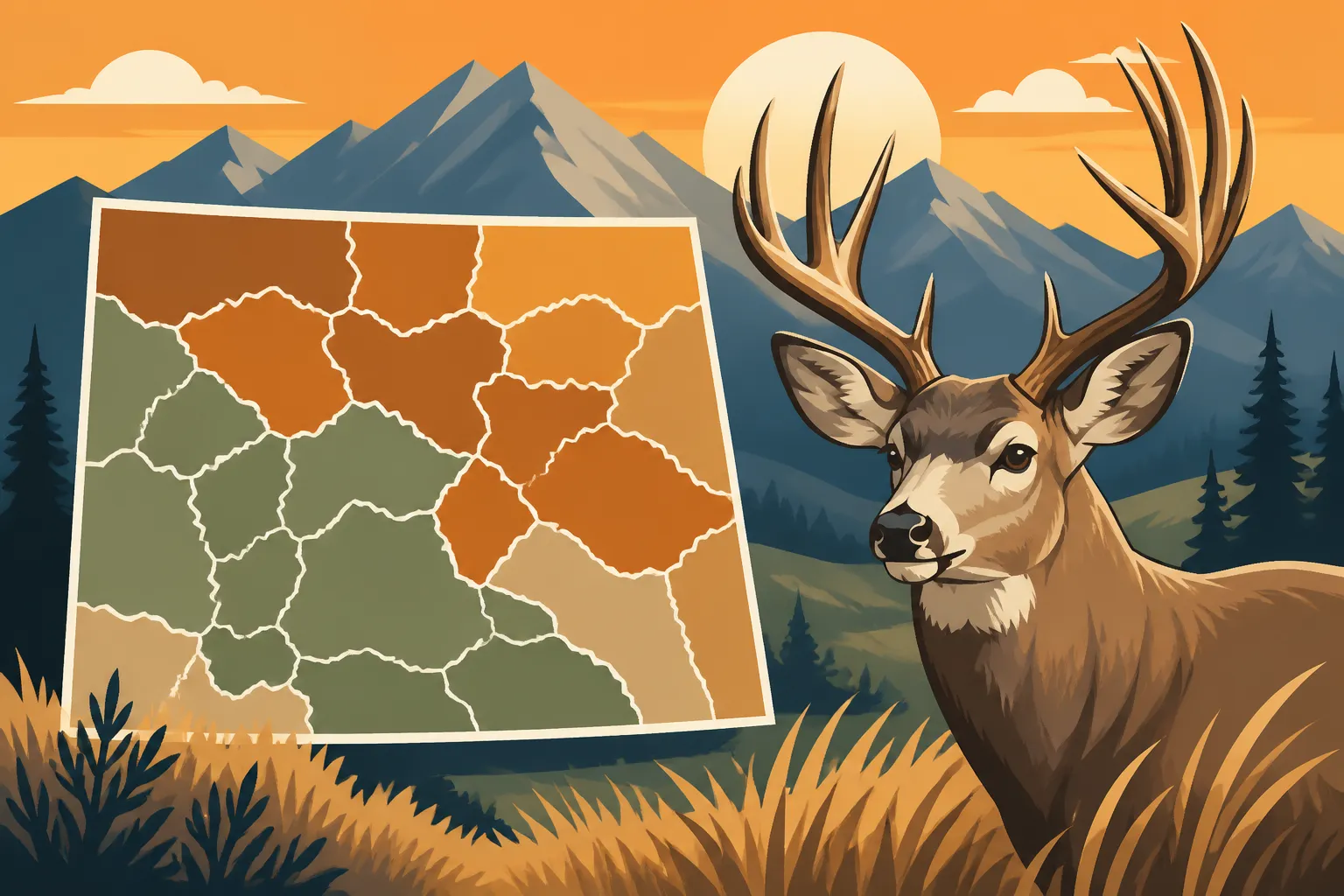
Colorado is divided into hundreds of GMUs, each acting as a distinct management area for wildlife. Think of them as individual puzzle pieces that make up the state's vast hunting landscape. The primary purpose of these units, as defined by Colorado Parks and Wildlife (CPW), is to manage specific game populations effectively. This means that harvest quotas, season dates, and specific rules can vary drastically from one GMU to the next, even if they're geographically close.
For mule deer hunters, the GMU system is critical because it dictates what kind of tag you can get, and when and where you can use it. A unit might be "limited draw" for a buck tag, meaning you have to apply and get lucky in a lottery, while a neighboring unit might offer an over-the-counter (OTC) tag for antlerless deer during a specific season. These variations are precisely why a deep dive into each GMU's regulations is paramount before you even consider applying. You can find detailed breakdowns of these rules and Colorado Hunting Seasons Explained on the CPW website.
CPW compiles extensive data for each GMU, including population estimates, buck-to-doe ratios, harvest statistics, and hunter success rates. This publicly available information is your best friend when trying to make an informed decision. Ignoring it is like trying to navigate a dense forest without a compass; you might get lucky, but you're probably going to get lost. It helps paint a picture of the health of the herd and the typical hunting experience in that specific area.
One of the inherent challenges of the GMU system is that deer don't recognize imaginary lines on a map. While GMU boundaries are fixed, mule deer populations often cross these lines, particularly during migration or in response to hunting pressure. This means that a GMU might have a good reputation, but if the deer spend a significant portion of the hunting season just outside its boundary on private land or in a neighboring, less-managed unit, your hunting experience could be affected. Smart hunters consider the habitat on both sides of a GMU line.
The Role of Draw Odds and Preference Points in GMU Selection
Unlike some states where you can simply buy an over-the-counter tag for a quality buck, most of Colorado’s prime mule deer units operate on a limited draw system. This means that you apply for a specific hunt code (GMU, season, weapon type), and your eligibility is determined by a lottery. For many hunters, especially non-residents, drawing a coveted buck tag in a top-tier unit can take years, even decades. This system is explained in more detail in resources like the Colorado Draw System and Preference Points guide.
This is where preference points come into play. Colorado uses a preference point system for most limited draw big game licenses. For every year you apply for a limited license and are unsuccessful, you accrue one preference point (as long as you apply for a point or a license in your first choice). These points act like a cumulative seniority system, increasing your odds of drawing a specific unit's tag in future years. The more points a unit typically requires to draw, the higher the quality of the hunt or the lower the hunter pressure tends to be.
Understanding draw odds isn't just about looking at the number of points required; it’s about delving into the raw data. CPW provides statistics on how many applicants there were for each unit, how many tags were issued, and the point totals of both successful and unsuccessful applicants. Tools like the GoHunt Insider platform take this public data and present it in an incredibly user-friendly format, allowing you to filter by unit, weapon, and point requirements. This kind of analysis is essential for figuring out How Many Preference Points for Colorado Mule Deer you'll need.
Ultimately, your GMU selection for mule deer often becomes a strategic game of balancing your dream units (which might require 10-20+ preference points for non-residents) with more realistic options that align with your current point totals or your willingness to hunt less-pressured seasons. Many hunters will build points for several years, applying for "point-building" hunt codes in units they don't necessarily want to hunt, just to eventually cash in on a high-point unit. Having a backup plan or considering units with lower point requirements for an "opportunity" hunt is often a smart move to avoid waiting years between deer hunts.
Key Factors for Identifying Top Mule Deer GMUs
Choosing a prime mule deer GMU involves looking beyond just a popular name. It requires a deeper dive into population metrics, terrain features, and access opportunities. When you understand what makes a unit tick, you can better identify those hidden gems or prepare effectively for the well-known hotspots.
Analyzing Population Data and Harvest Statistics
One of the first places savvy hunters look is at the population data provided by CPW. You want to see healthy herd objectives and, ideally, an increasing or stable population trend. A unit might have historically been good, but if its deer numbers have been in a consistent decline, it's probably one to reconsider. Look for information on buck-to-doe ratios; a higher ratio (e.g., 30-40 bucks per 100 does) generally indicates a healthier herd with better potential for mature, quality bucks, as there's less pressure on younger males for breeding.
Beyond raw numbers, harvest success rates are incredibly telling. This metric shows you the percentage of hunters who actually filled their tag in a given unit and season. If a unit boasts a 70% success rate, that’s a very different prospect from one with a 15% success rate, even if both have high deer populations. It can give you a realistic expectation of your chances and often reflects the huntability of the terrain and the density of quality animals. However, remember that success rates don't differentiate between a mature buck or a spike; they just indicate a filled tag.
Furthermore, it's critical to consider the hunter numbers within a GMU. A unit might have fantastic buck-to-doe ratios and decent success rates, but if it's flooded with thousands of hunters during the season, your actual experience might be far from ideal. High hunter density often leads to more pressured deer, meaning they become more elusive, nocturnal, and difficult to find. This isn't always reflected in success rates, but it significantly impacts the quality of the hunt. Less pressure means deer often behave more naturally, offering better opportunities.
When evaluating harvest statistics, also look for data on the average antler points or age structure of harvested bucks, if available. Some units consistently produce older, larger-racked deer, while others might yield more younger bucks. This kind of detail helps align your GMU choice with your personal hunting goals, whether you're after a trophy of a lifetime or simply a freezer full of meat. Keep an eye out for units where the average age of harvested bucks is higher, as these are often well-managed for quality.
Terrain, Access, and Public Land Percentages
The physical characteristics of a GMU are as important as its population numbers. Rugged, steep, and broken terrain, while physically demanding, often provides sanctuary for older, larger bucks. These areas naturally deter many hunters, creating pockets of less-pressured deer. Don't shy away from units that look difficult on a map; they might just hold the trophy you're looking for, provided you're physically up to the challenge.
For the DIY hunter, the percentage of public land within a GMU is a non-negotiable factor. Look for units with a high proportion of Bureau of Land Management (BLM) land, National Forest, or State Trust Lands. These are the areas where you can legally hunt without special permission or fees, offering vast expanses to explore. Resources like the Colorado Public Land Hunting Guide can provide more insights into navigating these areas. Tools like onX Hunt are indispensable here, as they visually depict public and private land boundaries, allowing you to quickly identify accessible hunting grounds.
Related to public land is road density. Units with extensive road networks often experience higher hunter pressure, as access is easy. Conversely, GMUs with large roadless areas, wilderness designations, or difficult-to-navigate terrain usually offer a more remote experience and potentially less pressured deer. These are the places where you might have to hike miles to find animals, but the reward can be significant. Prioritize units with significant backcountry or wilderness acreage if you're seeking a true wilderness hunting experience.
Finally, consider the influence of private land. Some GMUs might have good deer populations, but if the majority of the prime habitat is tied up in private ranches, your public land opportunities might be severely limited. In such cases, you might need to research seeking landowner permission or considering a guided hunt on private land. While this isn't always feasible for every hunter, it's an important factor to weigh when assessing a GMU's overall potential, ensuring that the deer you're targeting are actually accessible.
Spotlight on Specific High-Potential Mule Deer GMUs
While pinpointing "the best" GMUs is highly subjective and depends on your preference points, hunting style, and goals, certain regions and units consistently stand out for their mule deer populations and trophy potential. Let's explore some areas known for producing quality bucks.
West Slope Wonders: Gunnison and Surrounding Areas
The Gunnison Basin and its adjacent units, like GMUs 54, 55, 66, and 67, are legendary in Colorado mule deer circles. This region is characterized by vast, high-elevation sagebrush basins, aspen-covered hillsides, dark timber pockets, and rugged alpine country. It's a mosaic of habitats that mule deer absolutely thrive in, especially during their summer and early fall ranges. These units consistently boast some of the state's highest buck-to-doe ratios and produce impressive trophy bucks year after year.
However, drawing a coveted tag in these units often requires a significant investment of preference points. For non-residents, tags in GMU 54 or 55 can take well over 15 points, sometimes even more, reflecting the intense competition for these high-quality hunts. This "point creep" means you need to be patient and strategic with your applications, often building points for many seasons before you have a realistic chance. But for those willing to wait, the reward can be a truly exceptional mule deer hunt.
Hunting here presents its own set of challenges, primarily related to the high elevation and unpredictable weather. Many of these units feature vast roadless areas and can climb to 10,000-12,000 feet or higher. Hunters must be physically prepared for strenuous climbs and rapid weather changes, from warm sunny days to sudden snowstorms. Understanding How to Hunt Elk at High Elevation can offer valuable insights, as much of the same preparation and tactics apply to mule deer in this rugged terrain.
Despite the challenges and the long wait for tags, these units attract dedicated hunters for a reason. They offer not just the chance at a trophy buck but an authentic backcountry hunting experience amidst some of Colorado's most stunning landscapes. The expansive nature of these units often means that even with high hunter numbers, you can find solitude and unpressured deer if you're willing to put in the effort to get off the beaten path.
Northwestern Gems: The Routt and White River National Forests
Moving to the northwestern part of the state, units within and around the Routt and White River National Forests, such as GMUs 3, 4, 5, 12, 13, 23, and 24, offer a mix of draw and over-the-counter opportunities for mule deer. This region is renowned for its dense timber, expansive sage parks, and significant migration routes, supporting robust mule deer populations. Some of these units have excellent numbers of deer, and during the later rifle seasons, you can encounter migrating herds, especially after early snowfalls.
While some of these units require preference points for prime rifle seasons, others might offer leftover tags, particularly for antlerless deer or specific late-season hunts. Keeping an eye on the Colorado Leftover Tags Explained list after the main draw can sometimes yield a pleasant surprise for an opportunity hunt. These units can be a great option for hunters looking for a quality experience without having to accumulate a decade's worth of points.
The White River National Forest, in particular, is one of the largest and most rugged national forests in Colorado. It contains vast wilderness areas, like the Flat Tops, which are largely roadless and offer incredible opportunities for backcountry hunting. This ruggedness means physically fit hunters who are willing to pack in can often escape the crowds and find more natural deer behavior. E-scouting with onX Hunt is absolutely essential in these expansive units to identify potential access points, remote basins, and critical north-facing slopes where bucks often bed.
Whether you're looking for a draw hunt in a top-tier unit or a more accessible archery or late-season rifle opportunity, the Northwestern region provides diverse options. The sheer size of the landscape, coupled with healthy deer populations and varying levels of hunter pressure depending on access and season, makes it a perennially popular choice for Colorado mule deer hunters. Just be prepared for the diverse terrain and weather, as conditions can change rapidly.
Southern San Juans: Remote and Rewarding
For those seeking an extreme challenge and the potential for a truly memorable high-country buck, the Southern San Juan Mountains offer units like 76, 78, and 77. This region epitomizes rugged, high-elevation hunting, with towering peaks, steep canyons, and vast expanses of spruce-fir timber and alpine tundra. It's a place where you earn every mile and every view, and often, every opportunity at a deer.
Tags in these units typically require substantial preference points, comparable to the Gunnison Basin, due to their remote nature and reputation for producing mature deer. The extreme elevation and dense timber provide sanctuary for bucks, making them elusive and hard-earned trophies. This is not an area for the faint of heart or those unprepared for the physical demands; it often requires a multi-day backpack hunt deep into wilderness areas to find the least pressured animals.
The physical demands of hunting here cannot be overstated. High altitudes, steep ascents, and potentially long pack-outs are the norm. Resources like How to Physically Prepare for Colorado Elk are highly relevant, as the conditioning required for hunting in these mountains applies equally to both species. Hunters need to be in peak physical condition and intimately familiar with mountain navigation and survival skills.
Given the vast, open basins and broken terrain in many parts of the San Juans, spot-and-stalk hunting is often the most effective method. This involves hours of patient glassing from high vantage points, identifying deer, and then carefully planning an approach to get within shooting range. Mastering Spot-and-Stalk Hunting in Colorado techniques is crucial, as the deer here are often accustomed to using the terrain to their advantage, making stealth and wind awareness paramount. For hunters willing to embrace the wilderness and the physical grind, the Southern San Juans can deliver an unparalleled mule deer hunting adventure.
Strategies for Hunting Mule Deer in Colorado's Best GMUs
Once you've zeroed in on a GMU, the real work of planning your hunt begins. Having a solid strategy, from pre-season preparation to in-field execution, is what separates a successful hunter from one who goes home empty-handed.
Effective Scouting Techniques for Success
Scouting, both from home and in the field, is the cornerstone of a successful mule deer hunt. Pre-season physical scouting, if at all possible, offers invaluable ground truth. It allows you to put boots on the ground, explore potential access points, locate water sources, find natural funnels, and identify fresh deer sign like rubs, scrapes, and tracks. Walking the terrain helps you understand elevation changes and cover density in a way that maps simply can't convey. Try to visit the unit at least once in the months leading up to your hunt to get a feel for the landscape.
However, for many, extensive physical scouting isn't feasible, especially for non-residents. This is where e-scouting from home becomes an indispensable tool. Using digital mapping applications like onX Hunt and platforms like GoHunt is a game-changer. You can pore over satellite imagery and topographic maps to identify potential bedding areas (often on north-facing slopes or in dense timber), feeding grounds (sagebrush flats, aspen groves), and natural travel corridors (saddles, ridges, creek bottoms). Mark waypoints for promising spots, possible glassing locations, and emergency escape routes. These tools effectively allow you to How to E-Scout Before a Colorado Hunt from anywhere.
Beyond just identifying features, satellite imagery and topo maps can help you plan your approach angles and identify potential glassing points that offer expansive views of basins and hillsides. Look for areas with broken topography and natural benches where deer are likely to move or bed. Visualize how you would approach a specific area based on wind direction and cover. This pre-planning can save you precious time and effort in the field, guiding you directly to high-probability areas.
While not always legal or ethical in all situations (check local regulations!), strategically placed trail cameras can be highly effective in patterning deer movement, especially near water sources, mineral licks, or well-used trails on private land or less pressured public land. They can confirm deer presence, tell you what time deer are most active, and even give you an idea of the quality of bucks in an area. Just be mindful of local regulations and always practice responsible camera use to minimize impact on wildlife and other hunters.
Adapting Your Hunting Method to the Terrain and Season
No single hunting method works everywhere or all the time. Successful mule deer hunting in Colorado demands adaptability. In the vast, open, and broken terrain often found in prime mule deer country, spot-and-stalk is frequently the most effective method. This involves finding a high vantage point, patiently glassing for hours with high-quality optics, identifying a deer, and then executing a careful, stealthy approach to get within shooting range. It requires immense patience, attention to wind direction, and a keen understanding of mule deer behavior. Learn more about How to Spot-and-Stalk Colorado Mule Deer to refine your approach.
When deer retreat into dense timber or thick brush, especially after being pressured or during inclement weather, still-hunting becomes a primary tactic. This involves moving incredibly slowly and deliberately through the cover, taking one or two steps, then stopping for several minutes to scan for any sign of movement, a horizontal line in a vertical world, or the flick of an ear. Wind awareness is paramount in still-hunting; always move into the wind to keep your scent from blowing ahead of you. This method requires a level of focus and stealth that many hunters struggle to maintain, but it can be incredibly rewarding in close quarters.
Ambush hunting, while less common for trophy mule deer in expansive country, can be effective in specific situations. This involves setting up near known pinch points, water sources (especially in drier conditions), or bedding areas, waiting for deer to pass by. It's often most successful during warmer periods when deer need water more frequently, or in areas of high hunter pressure where deer are pushed into specific escape routes. Setting up early and remaining motionless and quiet is key to this tactic.
Finally, your strategy must adapt to the season and the rut. During the peak of How to Hunt Colorado Bucks in the Rut, bucks are much more preoccupied with breeding and will cover more ground, often venturing into more open areas. This is a prime time for calling (though less effective for mule deer than elk, a subtle grunt or doe bleat can sometimes work) and aggressive spot-and-stalk. In contrast, late-season hunts might focus on lower elevations where deer have migrated, often concentrating on south-facing slopes for warmth and remaining vigilant for any sign of deer seeking winter forage.
Leveraging Tools and Resources for Mule Deer GMU Scouting
In today's hunting world, technology has become an indispensable ally. Beyond physical scouting, modern tools and platforms provide an unparalleled advantage for researching and planning your Colorado mule deer hunt.
Digital Mapping Applications and Their Power
The digital mapping application onX Hunt has revolutionized how hunters approach scouting and navigation. Its core value lies in its ability to overlay property boundaries with public and private land distinctions, which is crucial in Colorado's checkerboard landscape. You can instantly see where you can legally hunt, avoiding accidental trespass, which is a common concern for public land hunters. This feature alone is worth its weight in gold.
But onX Hunt offers much more. It provides detailed topographic maps and high-resolution satellite imagery, allowing you to identify critical terrain features from your couch. You can pinpoint potential glassing knobs, dense timber for bedding, open areas for feeding, natural funnels between cover, and water sources. The ability to drop custom waypoints for everything from your truck parking spot to a fresh rub or a potential kill site means you can build a comprehensive digital map of your hunting area before you even set foot in it.
A critical, often-overlooked feature of onX Hunt is its offline map capability. In Colorado's high country, cell service is often nonexistent. Downloading your maps beforehand ensures you have full functionality—including GPS tracking, waypoints, and property lines—even when you're miles from the nearest signal tower. This isn't just a convenience; it's a vital safety feature, helping you navigate unfamiliar terrain and stick to your plan without fear of getting lost.
Furthermore, onX Hunt allows you to track your movements, measure distances, and share locations with hunting partners. This collaborative aspect is incredibly helpful for group hunts, ensuring everyone is on the same page regarding planned routes, spotted animals, and emergency rendezvous points. You can also view recent wildfire data, road closures, and specific unit regulations, helping you stay informed about current conditions that might affect your hunt.
Data Analysis Platforms and Community Insights
While onX Hunt excels at mapping and navigation, platforms like GoHunt offer a deep dive into the analytical side of hunt planning. Their "Insider" tool is particularly valuable for Colorado mule deer hunters, providing detailed draw odds, application statistics, and unit-specific data that goes far beyond what CPW typically publishes in an easily digestible format. You can filter units by point requirements, species, weapon type, and success rates, helping you strategically build preference points or choose a unit that aligns with your current point total.
GoHunt's power lies in its ability to help hunters make informed decisions about where and when to apply. It helps you understand the historical trends of point creep, success rates for different seasons within a GMU, and even provides insights into buck-to-doe ratios and population trends that might be harder to extract from raw CPW reports. For hunters playing the long game with preference points, GoHunt is an invaluable resource for developing a multi-year strategy to draw a premium tag.
Beyond the hard data, many hunting platforms and dedicated online forums offer community insights. While you should always take anecdotal advice with a grain of salt, these forums can sometimes provide real-time updates on conditions, recent animal sightings (without giving away secret spots, of course), or general trends in specific regions. It’s a place to ask questions, share experiences, and learn from other hunters, but always verify information with official sources and your own scouting.
The key to effectively using these tools is to cross-reference multiple sources. Don't rely solely on one app or one forum. Combine the mapping power of onX Hunt with the data analysis of GoHunt and the official CPW regulations. This comprehensive approach ensures you have the most accurate and up-to-date information, helping you make the best possible decisions for your Colorado mule deer hunt.
Common Challenges and How to Overcome Them in Mule Deer Hotspots
Hunting Colorado's mule deer, especially in prime GMUs, isn't without its hurdles. From crowded public lands to unforgiving mountain weather, anticipating these challenges and preparing for them is just as important as knowing where to hunt.
Battling High Hunter Pressure
It's an unfortunate truth: the best GMUs for mule deer often attract the most hunters. This high hunter pressure can dramatically alter deer behavior. Mature bucks, in particular, become incredibly wary, often moving exclusively at night, seeking refuge in the nastiest, steepest, or densest cover, or retreating to areas of private land where hunting is restricted. This can make finding and getting a shot at a quality buck extremely challenging. How to Hunt Colorado Public Land Pressure is a skill every Western hunter needs to master.
To overcome this, you need a strategy to outwork and outsmart other hunters. One of the most effective ways is to hunt harder-to-access areas. This often means walking further, climbing higher, or navigating rougher terrain than most other hunters are willing to tackle. Look for roadless areas, wilderness boundaries, or pockets of public land that are difficult to reach but are surrounded by heavy cover. Going in a mile or two further than the next guy can make a huge difference in finding undisturbed deer.
Another tactic is to hunt during less popular times. Weekdays, especially mid-week, generally see fewer hunters than weekends. Also, consider hunting during adverse weather conditions, like a light snowstorm or a cold, rainy day. While uncomfortable, these conditions often drive other hunters out of the woods and can push deer into more active movement patterns as they seek food or thermal cover. Just ensure you're adequately prepared for the elements.
Sometimes, thinking outside the box means looking for small, overlooked pockets of public land that might be surrounded by private property or are simply too small for others to bother with. These "islands" of public land can sometimes hold surprisingly good deer if they offer food and security. Persistence is also key; don't get discouraged if you encounter other hunters. Keep moving, keep glassing, and eventually, your efforts will likely be rewarded.
Overcoming Mountainous Terrain and Weather Variability
The rugged, mountainous terrain of Colorado is both the beauty and the beast of mule deer hunting. The high elevations, steep ascents, and long distances can take an incredible physical toll, especially if you're not accustomed to it. The thin air reduces your oxygen intake, making every step feel like a marathon. Without proper physical conditioning, you'll quickly become exhausted, impacting your ability to hunt effectively and safely. This is why thorough physical preparation, akin to what's needed for How to Physically Prepare for Colorado Elk, is absolutely essential.
Colorado's mountain weather is notoriously unpredictable. You can experience all four seasons in a single day, from warm, sunny mornings to sudden afternoon thunderstorms, hail, or even snow in late summer and fall. Hunters must be prepared for everything. This means bringing appropriate layering systems that allow you to adapt to temperature swings, including waterproof outer shells to protect against rain and snow, and insulation for cold snaps.
Your gear choices are critical for comfort and safety. Sturdy, broken-in Best Boots for Colorado Elk Hunting are non-negotiable for navigating steep, rocky terrain. A reliable backpack that can comfortably carry your gear and potentially pack out meat is also essential. Beyond clothing, you'll need reliable navigation tools, fire starters, and emergency supplies. Don't cut corners on quality or preparation here; your safety can depend on it.
Altitude sickness is a real concern for hunters coming from lower elevations. Symptoms can range from mild headaches and nausea to severe, life-threatening conditions. The best prevention is to How to Acclimate to Colorado Elevation by arriving a few days early, staying hydrated, avoiding alcohol, and easing into physical exertion. Recognize the symptoms, and if they worsen, descend to a lower elevation immediately. Never try to "tough it out" with altitude sickness; it can be dangerous.
Planning Your Mule Deer Hunt: Beyond the GMU
Once you’ve selected your GMU and developed your hunting strategy, the final piece of the puzzle is solidifying your gear list and understanding the practical logistics. A well-prepared hunter is a successful and safe hunter.
Essential Gear for a Colorado Mule Deer Hunt
Having the right gear is paramount for a successful and enjoyable mule deer hunt in Colorado. First and foremost, high-quality optics are non-negotiable. A good pair of 10x or 12x binoculars on a tripod is essential for glassing vast expanses of terrain, especially in open country or when trying to pick apart distant timber lines. Many hunters also carry a spotting scope (15-60x or 20-60x) for evaluating distant bucks. For more details, explore the Best Optics for Colorado Big Game.
Next, your backpack is arguably your most important piece of equipment after your weapon. It needs to be comfortable for long days of hiking, durable enough to withstand rugged terrain, and have sufficient capacity for all your gear, food, water, and ultimately, to pack out meat. Look for packs with a good frame system that can handle heavy loads. For an idea of what to look for, check out the Best Backpack for a Colorado Elk Hunt, as many principles apply.
Your weapon choice is a personal one, but it should be appropriate for the anticipated shots. For rifle hunters, a flat-shooting caliber capable of ethical shots out to 300-400 yards is common, such as a .270, .30-06, 7mm Rem Mag, or .300 Win Mag. Ensure you’ve practiced extensively at varying ranges and shooting positions. Bowhunters need a reliable, accurate setup with broadheads designed for penetration. Muzzleloader hunters must be proficient with their chosen setup. While focusing on elk, the Best Rifle Calibers for Colorado Elk article has useful insights applicable to deer.
Finally, dependable navigation tools are non-negotiable. While onX Hunt is excellent, always carry a backup. This could be a dedicated GPS device, a traditional map and compass (and know how to use them!), or even another GPS-enabled phone with downloaded maps. Batteries die, devices fail, and you don't want to be lost deep in the backcountry. Also, don't forget a headlamp, fire starter, multi-tool, first-aid kit, and a personal locator beacon (PLB) or satellite messenger for emergencies.
Practical Logistics and Safety Considerations
Getting to and from your hunting grounds often requires a reliable vehicle, particularly a high-clearance 4×4. Many trailheads and forest service roads in Colorado can be rough, rocky, and become impassable with rain or snow. Plan your routes, understand road conditions, and have a recovery plan in case you get stuck. Access can make or break a hunt.
When it comes to camp, decide whether you'll be setting up a comfortable base camp (which might be a wall tent or RV) or opting for a more minimalist spike camp. A base camp offers more amenities and warmth, but requires you to hike further each day. A spike camp, often a lightweight backpacking tent, allows you to stay closer to the animals but sacrifices comfort. For tips on setting up a minimalist approach, consider the advice in How to Set Up a Colorado Spike Camp. Always factor in water purification or ample water storage for your camp.
Meat care is a critical aspect, especially if hunting during warmer early seasons. Knowing How to Quarter an Elk in the Field is a skill that applies directly to deer, ensuring your hard-earned meat doesn't spoil. You'll need game bags, a sharp knife, and potentially a way to keep the meat cool until you can get it to a processor or refrigerator. Having a plan for packing out your animal, whether solo or with partners, is essential.
Finally, safety should always be your top priority. Always let someone know your detailed hunting plans, including your route, expected return time, and who to contact if you don't check in. Carry a comprehensive first-aid kit and know how to use it. Be aware of wildlife other than deer, especially bears and mountain lions. And never underestimate the power of the mountains; respect the weather, the terrain, and your own physical limitations.
Disclaimer
Please note that hunting regulations, season dates, and GMU boundaries can change. Always consult the official Colorado Parks and Wildlife (CPW) regulations and maps for the most current and accurate information before planning any hunt. This guide is for informational purposes only and should not be used as a substitute for official CPW resources.