How to Field Judge a Colorado Bull Elk
Oh, the age-old dilemma of standing on a mountain ridge, heart pounding, glassing a bull elk, and trying to decide in a split second if it's "the one." It’s exhilarating, nerve-wracking, and often, plain confusing. That moment of truth, where adrenaline blurs judgment, is where many hunters face the gut-wrenching question: is this bull big enough for my tag? This guide is here to walk you through the nuances of field judging a Colorado bull elk, helping you refine your eye so you can make confident decisions when it truly counts.
Why Field Judging a Bull Elk is So Challenging
Let's be real, seeing a bull elk in the wild is a spectacle in itself. They are magnificent creatures, and the sheer excitement of the moment can make even a modest set of antlers look like a world record. There are so many factors working against us when we're trying to quickly assess a bull’s size and score potential.
The "Ground Shrinkage" Phenomenon
This is probably the most common lament among elk hunters. You see a bull, he looks absolutely colossal through your binoculars, you make the shot, hike in, and when you finally stand over him, you think, "Wait a minute… he looked a lot bigger up on that ridge!" This phenomenon, affectionately known as "ground shrinkage," is incredibly real. Our minds play tricks on us. The excitement, the vastness of the landscape, the elevation, and the angle all conspire to inflate the size of an elk's rack.
Imagine you're stalking a bull that's bedded down 500 yards across a canyon. He stands up, his antlers silhouetted against the sky. In that moment, your brain, fueled by anticipation, might fill in the gaps, adding inches to his beams and tines. Then, once you're standing over him, the scale shifts. The environment that made him look so grand is gone, and you're left with the raw measurement, which often feels smaller than your initial impression. It’s not that the bull actually shrank; it's that your perception was skewed by the circumstances and adrenaline. This is why having a system for judging is so crucial.
Distance, Optics, and Mountain Terrain
Colorado's rugged landscapes are breathtaking, but they are also a master of optical illusions. When you're glassing a bull from a quarter-mile away, perhaps with a slight haze in the air, or with heat rising from the ground, your judgment is already compromised. Add to that the constant changes in elevation, and things get even trickier. A bull standing above you on a ridge can appear much larger than he actually is, simply because his antlers are silhouetted against the sky, creating an exaggerated profile. Conversely, a bull in a deep timber pocket or down in a valley might look smaller because you're only seeing parts of his rack or he's against a cluttered background.
Your optics are your best friend here, but they also require practice. A high-quality spotting scope can bring those antlers right into your lap, but if you're not used to consistently judging through it, you might still misinterpret. Are those G4s truly long, or is it just the angle making them appear so? Is that main beam sweeping way back, or is it an optical trick from his head position? Knowing how to effectively use your optics to gain a clear, consistent view, and how to compensate for the distortions of the mountains, is a skill honed over many hours in the field.
Time Pressure and Adrenaline
Picture this: you've hiked for miles into the backcountry, finally located a herd, and a bull steps out into a small opening. Your heart rate skyrockets, your breath hitches, and your hands might even tremble. This is the adrenaline dump, and it's a powerful force. In that moment, you might have only seconds to assess the bull, get steady, and make a shot. The pressure to make a quick decision can lead to hasty judgments. You've worked so hard, invested so much time and money, and here's a bull right now.
That intense desire to capitalize on the opportunity can override your rational judgment, especially if you haven't ingrained a clear field judging process. The fear of "letting a good one walk" or, worse, shooting a bull you might regret, weighs heavily. This is why practicing your field judging skills before the hunt, even with photographs or videos, can help mitigate the effects of adrenaline. The more familiar you are with what to look for, the faster and more accurately you can assess a bull when the pressure is on. This quick decision-making is a huge part of a successful Colorado Elk Hunting Guide.
Key Characteristics to Evaluate for Score
When you're trying to put a score to a bull's rack in your mind, you're essentially breaking it down into its core components. While Boone & Crockett (B&C) and Pope & Young (P&Y) scoring systems can be complex with their various measurements, for field judging, we focus on the most impactful visual elements.
Main Beam Length and Mass
The main beams are the foundation of a bull's rack, curving gracefully from his head. Their length is a huge contributor to the overall score. When you're glassing, try to visually extend the main beam past the last point. Does it sweep far back, almost parallel to his back, or does it cut off abruptly? A general rule of thumb many hunters use is comparing the main beam's sweep to the bull's ear or even his back. If the main beam extends significantly past his nose when viewed from the side, you’re looking at some serious length. A bull whose main beams extend a good distance past his G5s (fifth points) is likely a high scorer in this category.
Mass, or circumference, is the other critical component of the main beams. This is often the hardest to judge from a distance, but it contributes significantly to the score. Look for beams that are thick all the way up, not tapering too quickly. Pay attention to the "bases" – the thickest part right above the skull. Does it look like you could barely get your hand around it, or does it look like a fence post? A bull with heavy, gnarly bases that maintain their mass well into the upper parts of the beam will be a higher scorer. Sometimes, comparing the base thickness to the width of the bull's eye or muzzle can give you a rough estimation. This also applies when trying to How to Field Judge a Colorado Mule Deer Buck, where mass is also important.
Tine Length and Symmetry
Tines are those sharp, pointy protrusions that sprout from the main beams, often referred to as G1s, G2s, G3s, G4s, and sometimes G5s (or even G6s on rare occasions). The length of these tines is crucial.
- G1s (Brow Tines): These are the first points off the main beam. Are they long and dagger-like, extending well past his nose, or short and stubby? Long brow tines add significant inches.
- G2s, G3s, G4s: These are typically the longest tines on a mature bull. Assess their individual length. Do they look like they are a foot long, or are they closer to 6-8 inches? A good visual reference can be the length of the bull's ear, which is typically around 8-10 inches. If a tine looks substantially longer than his ear, it's a great sign.
- G5s: Not all bulls have a measurable G5, or "fifth point." If a bull has a distinct, long G5, it's a huge bonus to his score.
Symmetry is also a major factor, especially for typical scoring. Are the tines on one side a mirror image of the other side? Are the main beams roughly the same length and shape? The more symmetrical a bull is, the higher his typical score will be. However, don't discount non-typical points. While they are deductions in a typical score, they can add character and overall gross score for those not strictly chasing a typical B&C entry. Sometimes, a bull might have a broken point or an abnormal growth that can complicate judging, making you lean more towards a "character" bull rather than a "score" bull.
Inside Spread and Overall Width
Inside spread refers to the widest distance between the main beams, measured on the inside edge. While important, it’s often overemphasized by newer hunters. In most scoring systems, inside spread only counts once, up to the longest main beam measurement. So, a super wide bull doesn't necessarily score higher if his main beams and tines are lacking. However, a good inside spread can certainly boost a bull into that higher category.
To estimate inside spread, use the bull's body as a reference. The width of his ears when they are relaxed is usually around 24-28 inches. His body width at the shoulders is roughly 28-34 inches for a mature bull. If his main beams extend well outside his ears, or even outside his shoulders, he's a wide bull, likely 40+ inches in spread. If they barely clear his ears, he might be in the 30-36 inch range. This is less critical than tine length and mass but contributes to the overall aesthetic and perception of a "big" bull. Remember, a narrow but tall and massive bull can often outscore a very wide but short-tined bull.
Practical Strategies for On-the-Fly Evaluation
Field judging is a skill, and like any skill, it improves with practice and a consistent approach. When you’re staring down a bull, you need a quick, repeatable process to get an accurate read.
Using Visual Cues and Reference Points
One of the most effective ways to field judge is to use the bull's own body parts as a natural measuring stick. As mentioned, a mature bull elk's ear from base to tip is typically around 8-10 inches. His head from nose to the back of his skull is usually around 20-24 inches. His shoulder height can range from 50 to 60 inches. These are incredibly useful benchmarks.
For example, when looking at a G2 tine, how many "ear lengths" long is it? If it looks like one ear length, you're around 8-10 inches. If it's clearly two ear lengths, you're in the 16-20 inch range, which is outstanding! For main beam length, can you visually "stack" his head length along the beam? If the main beam extends two or more head lengths past his skull, that’s a very long beam.
Body condition can also subtly influence perception. A skinny, late-season bull might make his antlers appear larger in comparison to his emaciated frame, whereas a well-fed, robust bull during the rut might make his antlers look less impressive against his muscular physique. Always try to normalize your perception by focusing solely on the antlers.
Here’s a quick reference table for common elk measurements:
| Characteristic | Average Measurement (Mature Bull) | What to Look For | Score Impact |
|---|---|---|---|
| Ear Length | 8-10 inches | Use as a unit of measure for tine length | Indirect |
| Head Length (Nose-Skull) | 20-24 inches | Use as a unit of measure for main beam length | Indirect |
| Inside Ear Tip Width | 24-28 inches | Reference for inside spread | Spread adds to score |
| Main Beam Length | 45-60+ inches | Sweeps well past the G5s; often 2x head length | HIGH |
| Mass (Circumference) | 6-8+ inches (at bases) | Thick, heavy bases; carries mass throughout beams | HIGH |
| G1 (Brow Tine) Length | 10-18+ inches | Extends well past nose, looks like a daggers | MODERATE |
| G2, G3, G4 Length | 12-24+ inches | Visually longer than an ear, often the longest points | HIGH |
| G5 (Royal) Length | 6-12+ inches (if present) | Distinct, long point after G4 | SIGNIFICANT |
| Overall Symmetry | Highly variable | Matched length & mass on both sides (for typical score) | VERY HIGH |
The Power of Your Optics and How to Use Them
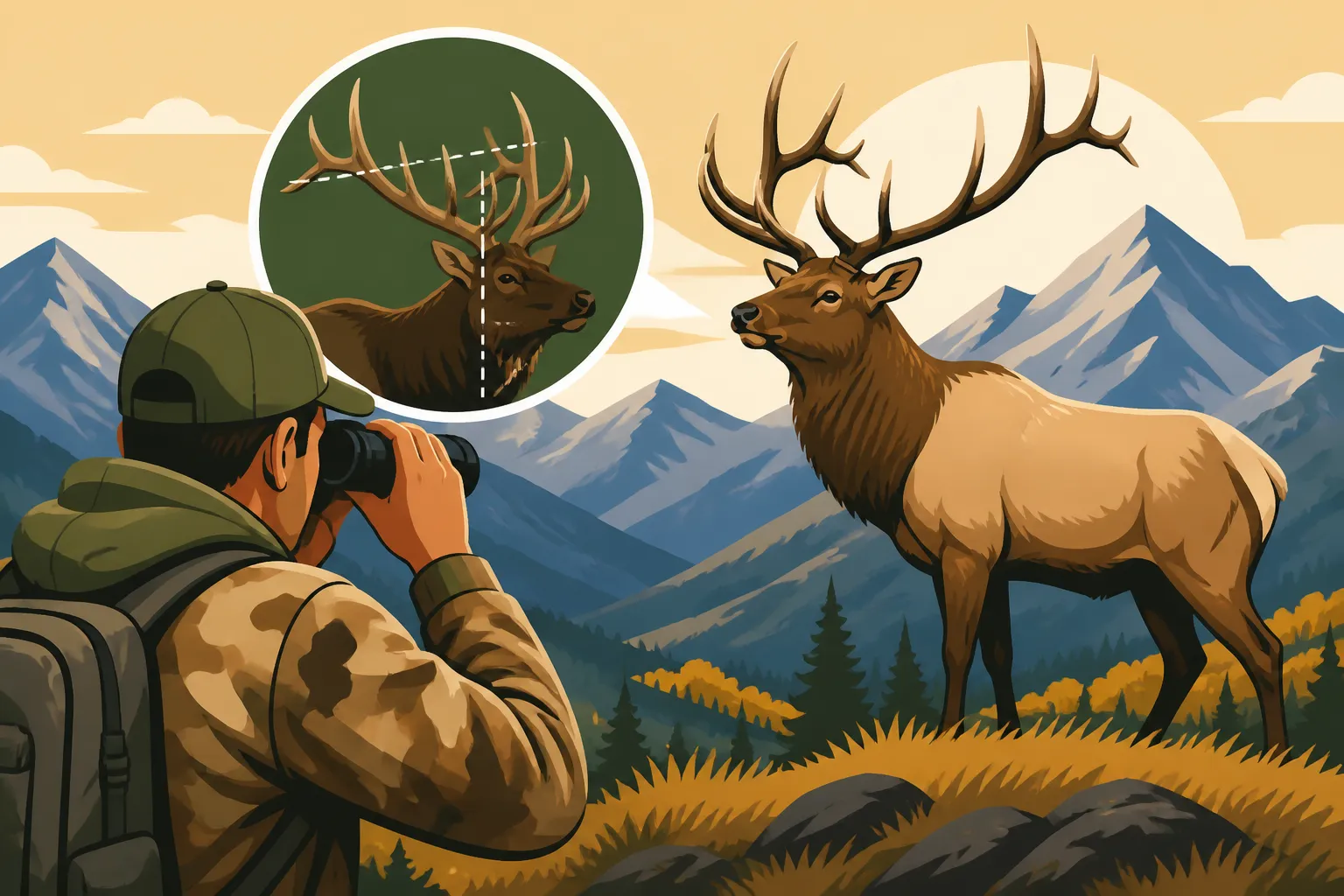
Your binoculars and spotting scope are not just for finding elk; they are indispensable tools for judging them. Don't just glance; scrutinize! When a bull steps out, immediately put your best optics on him.
First, count the points. This is fundamental. Make sure you count every measurable point on both sides. Don't assume. Sometimes a bull will have a sticker point, or a G5 hidden behind a G4. Then, quickly assess the main beam length. Follow the curve. How far back does it go? Is it proportional to the bull's body? Next, scan down the tines. Are the G1s long? Are the G2s, G3s, and G4s impressive? Try to estimate their length against the bull's ear. Finally, look at the mass. Do the beams look heavy all the way up, or do they pencil out quickly?
A quality spotting scope, especially one with a reticle, can really help you compare tines side-by-side or estimate measurements. Practice using your reticle to "measure" known objects before your hunt. When you're in the field, use the highest magnification you can, but remember that atmospheric conditions can make high magnifications blurry. Good glass from brands like Swarovski, Zeiss, or Maven can make a world of difference in discerning detail at long ranges. Before your hunt, you should definitely check out Best Optics for Colorado Big Game to make sure you're well-equipped.
Pre-Season Prep and Practice
The best field judges aren't born; they're made through countless hours of observation and dedicated practice. Before you even set foot in Colorado, you can start honing your skills.
- Study photos and videos: Spend time looking at various bull elk racks online, in hunting magazines, or at outdoor shows. Focus on bulls that have documented scores (e.g., from B&C or P&Y records). Try to guess their score, then check the actual score. Pay attention to how main beam length, mass, and tine length contribute.
- Utilize E-Scouting Tools: Websites and apps like GoHunt are invaluable for pre-season scouting. You can dive deep into specific Colorado GMUs (Game Management Units), analyze draw odds, and research historical harvest data. While GoHunt itself doesn't directly teach field judging, understanding which units produce larger bulls – information often gleaned from their detailed data – can mentally prepare you for the caliber of animal you might encounter. Knowing a unit's trophy potential helps you set realistic expectations and refine what kind of bull you're truly after. You can use their mapping features to identify potential bedding areas, feeding zones, and travel corridors, which can put you in a better position to get a good look at a bull. For more in-depth preparation, check out How to E-Scout Before a Colorado Hunt.
- Practice on other animals: Even if you're not hunting deer or other species, practice judging them. Train your eye to quickly estimate length, width, and mass on any animal with antlers or horns. This builds the foundational observational skills.
- Talk to experienced hunters: Seek out mentors or guides who have a reputation for good field judging. Ask them how they approach it, what cues they look for, and what common mistakes they see. Their insights can be incredibly valuable. This kind of research is a key part of any Colorado DIY Elk Hunting Guide.
Making the Call: When to Shoot, When to Pass
Ultimately, field judging leads to a decision: do I take this shot? This is where your personal hunting goals come into play. Are you primarily a meat hunter, happy with any legal bull? Or are you holding out for a true trophy? Your tag type also matters – a specific bull tag versus an either-sex tag gives you different options.
It’s helpful to have a mental "minimum" in mind before the hunt. For some, it might be a 6×6. For others, it's a bull that breaks a certain score (e.g., 280", 300", 320"). If the bull you're glassing clearly meets or exceeds that minimum, and you have a clean shot opportunity, then you can proceed with confidence. If he’s borderline, or if you simply can’t get a good enough look to judge accurately, it's often best to pass.
Remember the age-old question: "Will I regret passing this bull more than I'll regret shooting him?" Sometimes, the conditions just aren't right for a proper judgment. Maybe he's moving too fast, too far, or the light is fading. In those situations, knowing when to hold back, even if it's tough, is a mark of a disciplined hunter. There will always be another opportunity, and maintaining your standards will make that eventual harvest all the more meaningful. This mental fortitude is as important as the physical preparation described in How to Physically Prepare for Colorado Elk.
Common Pitfalls and How to Avoid Them
Even with practice, field judging can be tricky. There are certain common mistakes that even seasoned hunters fall victim to. Awareness is the first step to avoidance.
The "He's Bigger Than My Last One" Trap
It's natural to compare a new bull to past successes. You might have shot a 260-inch bull three years ago, and this new bull looks "definitely bigger" than that one. This comparative thinking can be a major pitfall. Each bull should be judged on its own merits, using the objective criteria we've discussed. Your past experience can inform your eye, but it shouldn't overshadow a clear, methodical assessment of the current animal.
The problem with this trap is that memory can be biased and imprecise. That 260-inch bull might have felt huge at the time, but without pulling out the tape measure again, your recollection might be fuzzy. Focus on the hard numbers and visual cues for the bull in front of you. How long are his G3s right now? How much mass does he carry in this moment? Don't let the emotional high or low of past hunts dictate your current decision.
Letting the Wind and Weather Rush Your Decision
Colorado weather is notoriously fickle. One minute it's calm, the next a gale-force wind rips through the canyon, or a snow squall rolls in. It's incredibly tempting to rush a shot and a judgment when you feel like your window of opportunity is closing fast due to deteriorating conditions. Perhaps the bull is just about to disappear into a patch of dark timber, or the light is fading rapidly.
While time is often of the essence in hunting, making a rushed decision due to weather or light can lead to poor judgment or, worse, a bad shot. If you can't get a clear, steady look, or if you're too hurried to properly assess the bull, it might be wiser to let him walk and try to relocate him later. A few seconds of calm, deliberate assessment can save you hours of regret or a difficult tracking job. Sometimes, waiting out a cold front or a gusty wind is the best decision for a responsible hunter. Knowing How to Use the Wind Hunting Colorado Elk and How to Use Thermals in Colorado Elk Country can give you a tactical edge, allowing you more time for judgment.
Misjudging Angles and Terrain
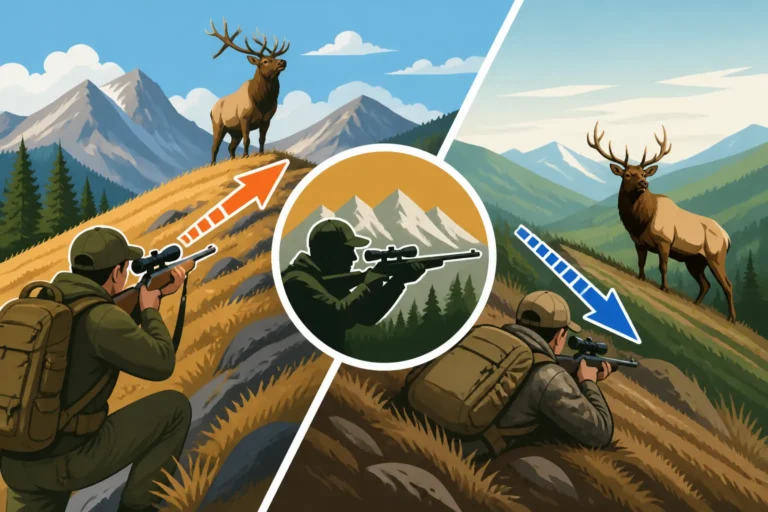
The mountains are beautiful, but they play tricks on the eyes. A bull standing on a steep slope can appear to have different proportions. If he's uphill from you, his body might look foreshortened, making his antlers seem disproportionately large or tall. If he's downhill, he might appear stretched out, making his antlers look smaller. The angle from which you view the bull profoundly impacts your perception of his spread, tine length, and even beam curvature.
Whenever possible, try to get a perspective that allows you to see the bull as close to broadside and level as possible. If that's not an option, mentally adjust for the angle. For instance, if a bull is directly below you, his tines might appear shorter than they are because you're looking down the length of them. Conversely, if he's directly above you, his spread might seem wider. Practice judging animals from various angles during your off-season training. This includes understanding How to Shoot Uphill and Downhill at Elk to minimize environmental influences on your shot and judgment.
Learning to field judge a Colorado bull elk is a continuous journey. It’s a blend of objective measurement, learned reference points, and controlling the adrenaline that makes elk hunting so addictive. By focusing on main beam length and mass, tine length, and using visual cues consistently, you'll be well on your way to making confident, ethical decisions in the field.
Disclaimer
Hunting is an inherently dangerous activity. Always prioritize safety, follow all local, state, and federal regulations, and obtain proper licenses and tags. The information provided in this guide is for informational purposes only and should not be considered a substitute for professional instruction or official hunting regulations. Be aware of your surroundings and hunt ethically and responsibly.