How to Use Thermals in Colorado Elk Country
Ah, the Colorado mountains. They're breathtaking, aren't they? But if you've spent any time chasing elk up and down those unforgiving slopes, you know how quickly your hunt can go south because a bull you were painstakingly stalking suddenly vanished, or worse, busted you without a whisper of warning. More often than not, this isn't just bad luck; it's a misunderstanding of how thermals, those invisible air currents, dictate everything in elk country. This guide is all about demystifying thermals, helping you predict elk movement, and ultimately giving you a crucial edge in your next Colorado elk hunt.
What Are Thermals and Why They Dictate Elk Movement in Colorado
Let's cut right to it: thermals are simply warm air rising and cool air falling. It's basic physics, but in the rugged, varied terrain of Colorado's elk country, this principle turns into a powerful, invisible force that governs nearly every aspect of an elk's daily life, from feeding to bedding. Ignoring them is like trying to navigate a dense fog without a compass – you're just asking for trouble.
The frustration for many hunters, especially those new to mountain hunting, is treating thermals like a random gust of wind. They’ll get into a good spot, feel a breeze, and think they're set, only for the wind to swirl unpredictably and send every elk in the drainage bolting. The key distinction here is that while localized winds can certainly influence things, thermals operate on a much more predictable cycle tied directly to the sun and the cooling/warming of the landscape. Understanding this cycle is paramount. It’s not just about knowing which way the wind is blowing right now; it's about knowing which way the air will be moving, and how elk exploit that for their survival.
The Science Behind Air Movement in Mountain Terrain
Imagine the sun beating down on a mountain. As the sun rises, it heats the ground, which in turn heats the air directly above it. Warm air is less dense than cold air, so it begins to rise. This is an upslope thermal. Conversely, as the sun sets and the ground cools, the air above it also cools. Cold air is denser, so it begins to sink down into the drainages and valleys. This is a downslope thermal.
This isn't a theory; it's a constant, daily phenomenon. Steep slopes, deep canyons, open parks, and thick timber stands all interact with the sun and shadows to create predictable thermal patterns. A south-facing slope might be heating up and sending air upwards, while a shaded north-facing slope right across the canyon is still holding cool, sinking air. Elk, with their incredible sense of smell, have adapted to use these thermals to their advantage, positioning themselves to detect danger approaching from below while they bed, or dropping down through cooling air currents to feed in the evening.
Why Elk Rely Heavily on Thermal Currents
Elk are incredibly sensitive to scent, and for good reason—their survival often depends on it. They instinctively understand that rising air (upslope thermals) will carry the scent of predators, including hunters, up the mountain, allowing them to bed high and feel secure from threats below. In the evenings, as the air cools and descends, they can confidently move down into feeding areas, knowing that any scent from above will be carried away from them.
This natural instinct dictates their daily routine. If you approach a bedding area from below during morning upslope thermals, your scent will be carried directly to them, busting your hunt before you even get close. Similarly, approaching from above in the evening as downslope thermals begin will put your scent right into their feeding zones. This deep reliance makes thermals arguably more critical than visible wind patterns in the mountains, because thermals are often guiding the invisible wind that truly matters for scent dispersal. Successfully hunting elk in Colorado means you must learn to think like an elk and predict these movements.
Decoding the Daily Thermal Cycle and Elk Behavior
Understanding the general principles of thermals is one thing, but applying them in the field requires knowing how they play out over a full day in Colorado's varied elevations. The thermal cycle isn't static; it constantly shifts, and so does elk behavior in response. Missing these subtle shifts can mean the difference between punching your tag and heading home empty-handed.
Morning Upslope Thermals and Elk Ascending
As the sun peeks over the eastern peaks, hitting the exposed slopes, the magic begins. Initially, it's just a whisper, but as the ground warms, the air starts its upward journey. This is the realm of the upslope thermal, typically strongest from about an hour after sunrise until late morning.
During this period, elk that have fed in the valleys or on lower benches throughout the night will begin their ascent. They're looking for secure bedding areas, often high on a ridge, tucked into a north-facing timber stand, or on a steep, rough bench where they can catch a cooling breeze and rely on the rising air to carry any unwelcome scent away from them. This is your window of opportunity to move up the mountain, below the elk, trying to stay out of their direct line of travel if you're still-hunting, or getting into a good position for a glassing session. You might hear this discussed in a guide on How to Hunt Elk at High Elevation. If you're hunting dense timber, mastering How to Still-Hunt Colorado Timber becomes critical during this time, allowing you to move silently while the thermals are in your favor.
Hunting Strategy: Your approach needs to be planned to capitalize on these rising currents. If you're pushing into a known bedding area, try to stay on a contour line below where you expect the elk to be, letting the rising air carry your scent harmlessly up and over them. Remember that east-facing slopes warm fastest, so elk might already be moving up those slopes earlier.
Mid-Day Thermal Stagnation and Elk Bedding
Around late morning and into the early afternoon, the thermal situation can get tricky. The sun is high, heating most slopes, which can create a sort of thermal "stagnation" or even localized turbulence. The dominant upslope or downslope currents might weaken, or you might experience swirling winds as different aspects of the mountain heat and cool at varying rates. This period can be a real challenge for hunters.
During these mid-day hours, elk are typically bedded down. They'll often seek out thick cover, shady north-facing slopes, or cool pockets along ridgelines. They're conserving energy, chewing their cud, and trying to stay hidden. Because of the unpredictable thermals, they might be extra jumpy. This is when a lot of hunters make mistakes, trying to push into bedding areas, only to get busted by a sudden, unexpected swirl of wind.
Hunting Strategy: For hunters, this is often a time for patience. It's an excellent opportunity to glass from a distance, scout new areas, or take a well-deserved break. If you must move, do so slowly and deliberately, constantly checking the wind with a wind indicator. This is also when you might consider focusing on areas where the terrain creates more consistent micro-thermals, like narrow canyons or deep ravines, though even those can be fickle. For those undertaking a longer trip, this downtime can be essential for conserving energy as detailed in a Colorado Backcountry Hunting Guide.
Evening Downslope Thermals and Elk Descending
As the afternoon wears on and the sun begins its descent, the air starts to cool, especially in the shaded areas and high elevations. This cooling causes the air to become denser and begin its journey down the mountain, settling into drainages and valleys. This is the downslope thermal, typically starting a few hours before sunset and continuing throughout the night.
Elk, sensing this shift, will begin to move out of their bedding areas and descend towards their evening feeding grounds. They'll often follow these falling air currents, feeling secure that any scent from above will be carried downwards, away from their approach. This is prime time for hunting, as elk are on the move and often more vocal. They might be heading to meadows, lower benches, or water sources. Understanding How to Hunt Elk Water Holes or How to Hunt Elk Wallows in Colorado becomes especially relevant during this period.
Hunting Strategy: Your best bet is to position yourself above known feeding areas or travel corridors as the downslope thermals begin. Get set up early, often along a ridge, saddle, or bench overlooking a likely feeding park or transition zone. Let the descending air carry your scent away from where the elk are likely to emerge. You want to be there and settled before the main movement starts. Using a mapping application like GoHunt can be invaluable here, allowing you to pinpoint potential feeding areas and understand the topography that will funnel these evening thermals.
Advanced Tactics for Hunting with Thermals
Knowing the basics is a great start, but truly mastering thermals in Colorado elk country involves more than just a general understanding. It's about using them strategically, almost as another tool in your hunting arsenal, combining them with other crucial hunting knowledge.
Strategic Approach Routes and Ambush Points
The art of hunting with thermals really shines in how you plan your movement and setups. Every step you take, every position you choose, should be informed by the current and anticipated thermal direction.
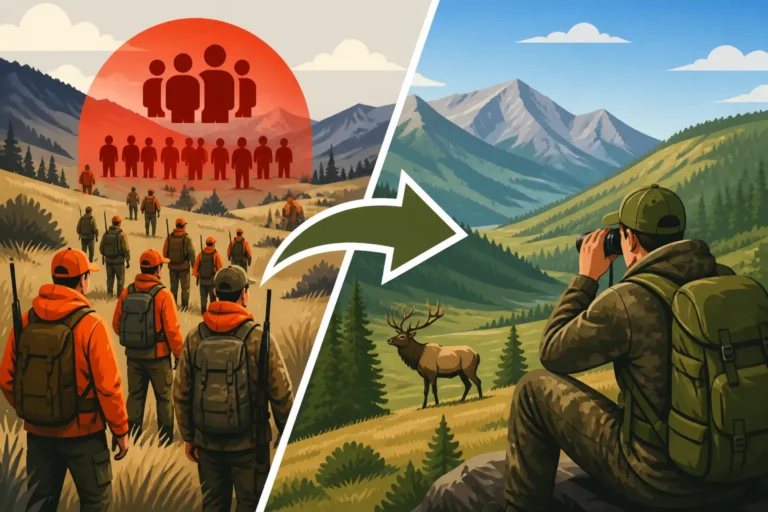
When planning your approach, always think about how your scent will travel. In the morning, if you're trying to reach a high-elevation basin where elk might be feeding, you'll want to take a route that keeps you below the rising thermals as much as possible. This might mean hugging a contour on the leeward side of a ridge, or timing your ascent to be a bit earlier than the full force of the upslope current. For evening hunts, when elk are coming down, you want to be above them. This often means getting to your glassing point or ambush site well before the descent begins, letting the cooling air flow over you and carry your scent down the drainage away from approaching elk. This strategic movement is key to avoiding How to Hunt Elk on Public Land Pressure.
For ambush points, consider terrain features that concentrate thermals. Saddles, narrow draws, and points overlooking benches can act like funnels for both elk and air currents. A narrow drainage, for instance, will often have a stronger, more consistent thermal flow than a wide-open hillside. By identifying these thermal highways, you can position yourself for a high-percentage encounter. For instance, knowing How to Hunt North-Facing Slopes for Elk becomes especially advantageous as they tend to hold cooler air longer into the day, influencing thermal patterns.
Leveraging Topography for Thermal Advantage
The topography of Colorado is a thermal hunter's best friend. Ridges, bowls, canyons, and even subtle benches all influence how air moves. Using a good mapping tool, like the one offered by GoHunt, can dramatically improve your ability to read the landscape for thermal advantage. Before you even set foot on the mountain, you can e-scout potential thermal funnels.
Look for features that will create predictable air movement:
- Drainage bottoms: These are natural thermal highways. In the morning, air rushes up them; in the evening, it settles down them.
- Ridge tops and saddles: These areas often experience swirling or inconsistent winds, but they can also be transition zones where thermals switch. Hunters often wait for the thermal switch at a saddle during the mid-day lull to make a move.
- Basins: Large bowls or basins can create their own localized thermal patterns, sometimes drawing air up and out, or letting it settle in. Understanding How to Glass Big Colorado Basins is crucial, as you'll also need to understand how thermals work within them to predict where elk will emerge or bed.
- Timber lines: The edge of a dense timber stand provides shade and can affect how quickly the ground heats or cools, creating micro-thermal differences that elk exploit. Knowing How to Find Elk in Deep Timber means understanding how those areas create sanctuaries with stable thermals.
| Time of Day | Thermal Direction | Elk Movement Tendency | Hunter Strategy |
|---|---|---|---|
| Pre-Dawn | Downslope | Descending to feed | Approach high, above feed zones |
| Early Morning (Sunrise + 1-3 hrs) | Upslope begins | Ascending to bed | Approach low, below bedding areas |
| Mid-Day (Late Morning to Early Afternoon) | Stagnant/Swirling | Bedded in thick cover | Patient glassing, slow movement, check wind constantly |
| Late Afternoon (3-4 hrs pre-sunset) | Upslope ends, Downslope begins | Descending to feed | Position high, above feed zones/travel corridors |
| Evening (Sunset onward) | Downslope | Feeding, moving lower | Ambush from above, focus on drainage travel |
Combining Thermals with Wind and Scent Control
Thermals are a predictable form of air movement, but they don't operate in a vacuum. They interact with broader weather patterns and localized winds. While thermals are often the dominant factor in scent dispersal on a mountainside, you still need to pay constant attention to the actual wind.
Always check the wind. Carry a wind checker (a small squeeze bottle of powder or some milkweed fluff) and use it constantly. Even with a perfect understanding of thermal direction, a gust of crosswind or a swirling eddy can betray your position. The goal isn't just to use thermals, but to use them in conjunction with the wind to ensure your scent is never where the elk are. You could read more about this in a detailed guide on How to Use the Wind Hunting Colorado Elk.
Scent control remains critical. While thermals help dictate where your scent will go, anything you can do to minimize that scent is a bonus. Wear clean hunting clothes, use scent-eliminating sprays (though their effectiveness is debated, every little bit helps), and avoid strong odors like coffee or tobacco. The clearer your scent signature, the better your chances when thermals inevitably shift or swirl.
Reading Real-Time Thermals and Adapting Your Hunt
Even with extensive e-scouting on platforms like GoHunt and a deep understanding of thermal theory, the mountains always throw curveballs. Conditions change, micro-climates exist, and sometimes the air just doesn't do what you expect. The true skill lies in reading the real-time conditions and being able to adapt your strategy on the fly.
Visual Cues and Scent Indicators
Don't just rely on what you think the thermals are doing. Look for tangible evidence:
- Fog or Mist: In the early morning or late evening, watch how fog or mist moves. If it's rising, you have upslope thermals. If it's sinking into the valleys, it's downslope.
- Smoke: If there's a distant campfire or a prescribed burn, observe how the smoke behaves.
- Leaves and Dust: Toss a few dry leaves or a pinch of dust into the air and watch their trajectory.
- Clouds: While high clouds indicate upper-level winds, low-hanging wispy clouds interacting with peaks can sometimes show localized air movement.
- Vegetation: Look for consistent swaying of branches or tall grass in a particular direction where there isn't obvious broad wind.
Beyond visual cues, your best friend is a wind checker. Milkweed pods are excellent because their fluff floats gently and indicates even the slightest air movement. Alternatively, squeeze bottles of fine powder work well. Use it every 50-100 yards, especially when you enter new terrain or an area with a significant change in elevation or aspect. It's a quick, reliable way to confirm what the air is doing at your immediate location.
Dealing with Micro-Thermals and Thermal Traps
The "rules" of thermals are general guidelines. Within a large drainage, you'll encounter micro-thermals – localized air movements that can be contrary to the dominant flow. A small side draw, a rock face, or even a dense patch of timber can create its own mini-thermal effect. This is why constant vigilance with your wind checker is so important.
A common scenario that can ruin a hunt is the "thermal trap." This often happens in the mid-morning or late afternoon, especially in steep, shadowed canyons. The dominant thermal direction might be upslope, but a pocket of cool air can remain trapped in a deep ravine, creating a temporary downslope draft. Or, as the sun begins to hit a specific ridge, it might create a sudden, short-lived upslope that draws your scent right into a bedding area. The key here is not to panic, but to recognize the shift and either adjust your path immediately or hold tight until the primary thermal reasserts itself. Sometimes, the safest bet is to back out and reposition entirely.
Hunting in the Colorado high country is an endurance test, both physically and mentally. Proper planning, including gear selection from a Best Colorado Elk Hunting Gear list and physical preparation, are crucial. However, it's the invisible forces like thermals that often determine success or failure. By learning to read and respect them, you'll not only improve your odds of success but also deepen your connection to the incredible wildness of Colorado's elk country. Always remember, the elk live there, and they've mastered this game. We, as hunters, are merely trying to catch up.
Disclaimer
Hunting is an inherently dangerous activity. This guide provides general information and strategies for hunting in Colorado and is not a substitute for professional training, comprehensive research, or adherence to all applicable state and federal hunting regulations. Always prioritize safety, understand local laws, and respect wildlife and the environment. Conditions in the backcountry can change rapidly, and hunters must be prepared for all contingencies.