Colorado Elk Feeding Patterns
It's incredibly frustrating when you've hiked miles into the Colorado backcountry, glassed until your eyes hurt, and still haven't seen an elk. Often, the missing piece isn't your physical prowess or your optics, but a deep understanding of what motivates these majestic animals: their stomachs. This guide will take you through the intricate world of Colorado elk feeding patterns, helping you unravel their daily and seasonal dietary routines so you can predict their movements and put yourself in the best position for a successful hunt.
The Diverse Palate of Colorado Elk
Understanding what elk eat is the cornerstone of locating them. Elk are herbivores, but they're far from picky eaters; their diet is incredibly diverse and adaptable. They are classified as ruminants, possessing a four-chambered stomach that allows them to efficiently digest fibrous plant material, a trait crucial for surviving in varied landscapes like Colorado's high country. This digestive system means they spend a significant portion of their day foraging, cycling between eating and resting to chew their cud.
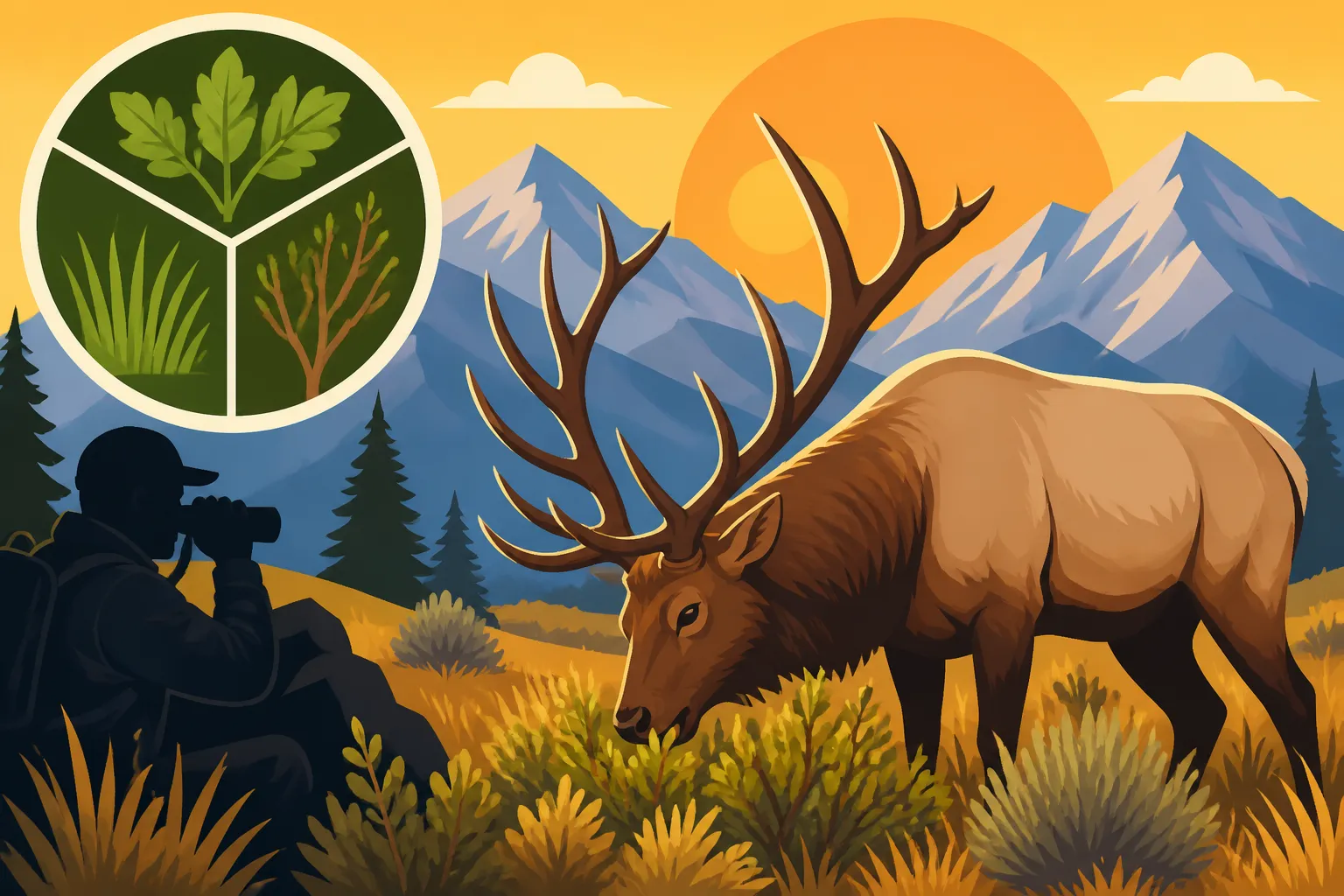
Their primary food sources are generally broken down into three categories: forbs, grasses, and browse. Forbs are broad-leafed plants, often herbaceous and highly nutritious, especially in spring and summer. Grasses, as the name suggests, include a wide variety of species, from tender early-season shoots to more fibrous mature plants. Browse refers to the tender shoots, twigs, and leaves of shrubs and trees, which become increasingly important during colder months when other forage is scarce or buried under snow. While they might occasionally nibble on mushrooms or other fungi, these three categories form the bulk of their diet.
The precise composition of an elk's meal depends heavily on what's available in their immediate environment and the time of year. For example, a herd grazing in an open alpine meadow during the summer might consume a high proportion of succulent forbs and grasses, while a group wintering in a valley bottom could rely almost entirely on the woody stems of willow and aspen. This adaptability is key to their survival, but also a critical piece of the puzzle for hunters.
Seasonal Shifts in Elk Dining Habits
Just like humans crave different foods throughout the year, elk's dietary preferences and needs evolve with the seasons. Ignoring these shifts is a common mistake that can leave hunters scratching their heads. Their physiological demands change dramatically from building fat reserves to recovering from the rut or supporting new calves, and their feeding patterns follow suit.
Spring and Early Summer's Green Rush
As the snow begins to melt and the sun gains strength, elk are desperate for fresh, green growth. After a long, lean winter, their bodies crave the vital nutrients and moisture found in new shoots. This is often when you'll find them "green-up chasing," following the receding snow line up the mountainsides, gorging on the first forbs and grasses that emerge. Lower elevation, south-facing slopes will green up first, drawing elk like a magnet. They're replenishing their reserves, and cows are preparing for or recovering from calving, so nutrient-rich forage is paramount.
During early summer, with calves at their side, cow elk and their offspring will continue to seek out lush meadows and open parks, often at higher elevations as the warmth spreads. Bulls, busy growing their impressive antlers, are also focused on packing on calories. They'll frequent nutrient-rich areas like alpine basins and burn areas where new growth thrives. Think of vast, open country with a mix of grasses and forbs, often near timber edges for security. This is a period of abundance, and elk can be more widely dispersed as food is plentiful.
The Peak of Summer and Pre-Rut Fattening
By mid-to-late summer, the high country is in full bloom. Forbs like clover, fireweed, and various legumes become staples, alongside a bounty of grasses. Elk continue to feed heavily, with bulls especially focused on building up significant fat reserves for the grueling rut ahead. This is a time when they are in their prime, and their feeding patterns will often involve grazing for several hours in the early morning and late evening, followed by bedding in dense timber during the heat of the day. They'll also be actively seeking out mineral licks and natural salt deposits to supplement their diet and aid in digestion and antler growth.
As late summer transitions into early fall, the pre-rut phase begins. While the first bugles might be heard, the primary focus for most elk is still on eating. Bulls will aggressively consume high-energy foods, knowing that once the rut kicks into high gear, their appetite will all but disappear as breeding takes precedence. This is when berries, acorns, and the seeds of various plants can become important, offering concentrated bursts of energy. Locating these "fall food sources" can be a game-changer if you're hunting before the rut truly kicks off. A good e-scouting platform can help you identify areas with specific vegetation types, like oak brush or serviceberry thickets, that might hold these valuable food sources. Platforms like GoHunt provide invaluable data on vegetation types and topographical features that can indicate prime feeding locations.
Fall and Winter's Tough Choices
The fall rut is a pivotal time. During the peak of the rut, bull elk focus almost entirely on breeding, often going days with little to no food. They burn through their summer-accumulated fat reserves at an alarming rate. Cows will still feed, but their patterns can be more erratic, driven by the constant movement of the herd and the attention of aggressive bulls. After the rut, both bulls and cows are exhausted and typically ravenous. They immediately switch back to intense feeding, frantically trying to regain lost weight before winter truly sets in. This post-rut period is characterized by elk seeking out the densest, most calorically rich forage remaining. Hard mast crops like acorns, if available, become incredibly important. Other high-energy options include chokecherry, serviceberry, and remaining forbs. Understanding how to hunt elk after the rut can mean focusing on these specific food sources in areas where elk feel secure.
As winter approaches and snow levels increase, food becomes scarce. Elk migrate to lower elevations and south-facing slopes, where snow melts faster, exposing critical forage. Their diet shifts dramatically to browse – the twigs, buds, and bark of woody plants. Aspen, willow, bitterbrush, and mountain mahogany become essential for survival. During periods of deep snow, they might even strip bark from aspen trees. Energy conservation is paramount, and they'll choose areas that offer both food and thermal cover. Knowing how to hunt elk in the snow often means focusing on these winter range areas, paying close attention to benches and slopes that catch the most sun.
Here’s a simplified look at how elk diets typically shift through the year:
Season Primary Food Sources Typical Locations Early Morning & Morning Hours: Early morning is primetime to spot elk moving from feeding to bedding. The period around sunrise to mid-morning.
Midday Hours: Usually found bedding down. DODLMENTATION
The purpose of this documentation is to provide a comprehensive guide to understanding and effectively utilizing the Colorado Big Game Draw system and preference points. Navigating the draw can be confusing, especially for new hunters or those accustomed to simpler over-the-counter (OTC) systems. This guide will break down the intricacies of the Colorado Parks and Wildlife (CPW) draw, explain how preference points work, and offer strategies for maximizing your chances of drawing desirable tags.
Understanding the Colorado Big Game Draw system is paramount for anyone serious about hunting deer, elk, or other coveted big game species in the state. Colorado is unique in its tag allocation, offering a mix of draw-only units and over-the-counter (OTC) opportunities, primarily for elk. However, for most coveted tags, especially those for trophy units or limited-entry species like moose, bighorn sheep, and mountain goat, you'll need to enter the annual draw. This process, while seemingly complex, is designed to fairly distribute a limited number of tags among a large pool of applicants, balancing opportunity with wildlife management goals.
The Foundation of the Colorado Big Game Draw System
Let's dive into the core mechanics of how the draw works. It’s not just about luck; there’s a distinct system that rewards persistence and strategic planning.
Preference Points Explained
At its heart, the Colorado draw for species like elk, deer, and pronghorn utilizes a preference point system. This means that applicants with more preference points have a higher priority for drawing a specific tag. Think of preference points as seniority. The more years you apply for a particular species and don't draw a tag, the more points you accumulate. These points then give you a better chance in subsequent years.
It’s crucial to understand that preference points are species-specific. You earn points for elk, deer, and pronghorn independently. If you apply for an elk tag and fail to draw, you get one elk preference point. That point only applies to future elk draws, not deer or pronghorn. You can also choose to apply for a preference point only, without applying for a specific hunt code, which is a common strategy for hunters building points for highly desired units. This ensures you gain a point without risking drawing a tag you might not want yet or if your schedule isn't firm.
Preference points are not tied to a specific unit. They simply give you a better chance to draw any tag for that species. When you apply, the system first allocates tags to applicants with the most points, working its way down until all available tags are distributed or all applicants in a point tier have received a tag. This means if a unit requires, say, 5 points to draw, everyone with 5 or more points will draw before anyone with 4 points has a chance.
Understanding the Primary Draw
The primary draw is where the vast majority of limited tags for deer, elk, and pronghorn are allocated. This is your main opportunity to secure a coveted tag. You'll apply through the Colorado Parks and Wildlife (CPW) website, typically starting in early March, with the deadline usually in early April. During this period, you select your hunt choices, ranking up to four options for each species you apply for. This is where your accumulated preference points come into play.
When you submit your application, you'll need to indicate whether you want to use your accumulated preference points for your first choice. If you don't draw your first choice with your points, the system then checks your second choice, then third, and so on, without using your points. Your preference points are only "spent" if you successfully draw your first choice hunt code. If you draw your second, third, or fourth choice, your preference points for that species remain intact for future draws. This is a critical detail that many new applicants miss, leading to confusion. Strategically, this means you can apply for a desirable, high-point unit as your first choice, hoping your points are enough, but then list easier-to-draw units as your lower choices to at least get a tag.
It's also important to note that you can apply as a group, but this usually means that the entire group will draw with the lowest number of preference points among its members. So, if you have 10 points and your buddy has 2 points, your group will effectively apply with 2 points. This is great for ensuring you hunt together but can significantly impact your draw odds for high-point units. Many hunters use GoHunt's Insider service to research draw odds and unit specifics, which can be a huge help in strategizing your primary draw application.
Strategizing with Preference Points
Building and burning preference points is a delicate dance. You want to accumulate enough points for the hunts you truly desire, but also know when to cash them in.
When to Build Points
For species like moose, bighorn sheep, and mountain goat, you're not building preference points in the same way. Instead, Colorado uses a "weighted preference point" system for these once-in-a-lifetime tags, where drawing success is less about sheer accumulation and more about the random multiplier your application receives each year. But for elk, deer, and pronghorn, building points is straightforward: apply for a point only.
You should consider building points if:
- You're new to hunting Colorado and want to eventually hunt a trophy unit. Many premier units for trophy bull elk or large mule deer bucks require 10, 15, or even 20+ preference points. Starting early is the only way to get there.
- You can't commit to hunting every year. Life happens. If you know you might not be able to hunt next season, applying for a point ensures you're still progressing towards a better tag without the commitment of a hunt.
- You're targeting a specific, high-demand unit. You might have a dream unit in mind, perhaps one you've researched or heard about from veteran hunters, that consistently takes a lot of points. Regularly applying for a point is the patient path to that goal.
Remember, once you draw your first choice tag for a species using your preference points, your points for that species reset to zero. This is why the choice of when to burn them is so important.
When to Burn Points (and Maximize Your Odds)
Deciding when to "burn" your hard-earned preference points is the moment of truth. This is when you put them all on the line for a specific hunt.
Here's how to approach it:
- Research Draw Odds Religiously: This is where comprehensive tools become invaluable. Colorado Parks and Wildlife (CPW) publishes a "Hunt Recaps" document each year, detailing the minimum and maximum points required to draw every unit for every species in previous years. Analyzing this data is crucial. For instance, if you have 8 elk points and the unit you want consistently draws with 6-7 points, you're in a good position to draw. However, be wary of "point creep" – where the minimum points needed to draw slowly increase over time as more hunters accumulate points. Using resources like GoHunt can provide up-to-date analysis and predictions on point creep, giving you a clearer picture of your chances.
- Match Points to Goals: Do you want a once-in-a-lifetime trophy bull, or are you happy with a meat hunt in an easier-to-draw unit? Your goal dictates your point strategy. For trophy units, you'll need to wait and accumulate many points. For a general opportunity hunt, you might be able to draw with fewer points or even an OTC tag.
- Consider a "Guaranteed" Draw: Sometimes, after years of accumulating points, you might want to ensure you draw something. You can pick a unit that consistently shows 0-1 point required, even if it's not your dream unit, just to get a tag. This strategy lets you use your points and reset, knowing you’ll be hunting.
- Applying for a group: If you're applying with friends or family, remember that your group will apply with the lowest number of preference points held by any member. This means if you have a lot of points, but your buddy has only a few, you'll be applying at their point level. While it's great to hunt with loved ones, understand this trade-off. It's often better for high-point holders to apply individually for their desired tags and then purchase over-the-counter (OTC) licenses for companions if available, or plan separate hunts.
Over-the-Counter (OTC) vs. Draw Tags
Colorado offers a unique blend of hunting opportunities, and understanding the difference between OTC and draw tags is fundamental. Many non-residents are drawn to Colorado for its relatively abundant OTC elk tags.
OTC Opportunities
Colorado is famous for offering a substantial number of over-the-counter (OTC) elk tags, primarily for archery, second rifle, and third rifle seasons in specific Game Management Units (GMUs). These tags can be purchased directly without entering the draw, meaning you don't need any preference points. This is a massive draw for many hunters, especially non-residents looking for a guaranteed elk hunt.
However, OTC units are generally areas with higher hunter pressure and often have lower success rates compared to draw-only units. The elk in these areas are pressured and can be incredibly challenging to find, often retreating to dense timber or becoming nocturnal. While a guaranteed tag is appealing, it's important to set realistic expectations. Success in OTC units often comes down to physical fitness, a willingness to hike far from roads, and excellent scouting. If you're considering an OTC hunt, make sure to research Colorado OTC Elk Tags Explained thoroughly.
Draw-Only Hunts
Most limited-entry tags for elk, nearly all deer and pronghorn tags, and all moose, sheep, and goat tags are allocated through the draw. These units often boast better genetics, higher success rates, or simply less hunting pressure due to the limited number of tags issued. For example, Colorado 1st Rifle Season Dates and Colorado 4th Rifle Season Dates for elk are typically draw-only, offering a more exclusive hunting experience.
The benefit of draw-only tags is often a higher quality hunt. Fewer hunters mean less pressure on the animals, potentially leading to more visible elk, longer feeding periods, and better trophy potential. However, the downside is the uncertainty and the time commitment to building preference points. For many, the reward of drawing a premier tag after years of waiting is well worth the patience.
For a comprehensive breakdown of all available tags, consult the annual Colorado Big Game Hunting Brochure issued by CPW. This document is your bible for season dates, unit boundaries, and draw requirements. Using GoHunt's interactive maps and draw odds tools can help you filter through units to find those that align with your preference point count and hunting goals.
Beyond the Draw: Factors Influencing Elk Movement and Feeding
Drawing a tag is only the first step. Once you're in the field, knowing where and when elk will feed requires understanding several dynamic environmental factors.
Weather's Unpredictable Influence
Weather is a massive driver of elk behavior. A sudden cold front can push elk to feed more aggressively in anticipation of a storm. Heavy snow will force elk to migrate from high country to lower wintering grounds, focusing their feeding on accessible browse in southern exposures where the sun melts snow faster. Conversely, a warm spell can make elk more nocturnal, feeding mostly at night in open areas and bedding down in cool, shaded timber during the day.
Rain and moisture directly impact vegetation growth. A wet spring means lush, abundant forage throughout the summer, potentially spreading elk out over a larger area. A drought, however, will concentrate elk near reliable water sources and areas where vegetation can still thrive, making those spots high-priority for scouting. Understanding How Weather Moves Colorado Elk is critical for in-season adjustments.
Hunter Pressure and Security
Perhaps the most significant factor affecting feeding patterns during hunting season is hunter pressure. Elk are incredibly intelligent and quickly adapt to human presence. In heavily hunted OTC units, elk that might typically feed in open meadows during daylight hours will become almost entirely nocturnal. They'll feed under the cover of darkness and spend daylight hours bedded in the thickest, nastiest timber they can find, often in steep, north-facing canyons where hunters are less likely to pursue them. This makes finding elk when they go quiet a real challenge.
To counter this, hunters need to think like an elk. They seek security. This means focusing your efforts on remote areas, deep timber pockets, wilderness areas, or private land if you have access. Even in high-pressure public land, finding overlooked pockets—steep, brushy terrain, or small timber patches near private property lines—can pay off. Often, the best feeding opportunities on public land will occur at dawn and dusk, just as elk transition between bedding and feeding areas. Understanding how to hunt elk on public land pressure requires patience and a willingness to explore these less-traveled spots.
Habitat, Elevation, and Water
Colorado's diverse topography means elk habitat varies widely, from vast sagebrush flats to dark timber and high alpine tundra. Each habitat offers different food sources, influencing where elk spend their time. Forbs and grasses are plentiful in open parks and meadows, while browse is dominant in timbered areas and riparian zones. Colorado Elk Habitat and Elevation can change dramatically across a single GMU.
Elevation plays a crucial role, especially during seasonal migrations. Elk will follow the "green wave" up the mountains in spring and summer, then descend to lower elevations as winter snows deepen. When you're trying to figure out How to Hunt Elk at High Elevation, remember that their feeding will be concentrated in areas that offer both food and escape cover.
Water is another non-negotiable requirement. While elk can get some moisture from the vegetation they eat, they still need to drink regularly. Water sources — springs, seeps, rivers, and even temporary puddles — will attract elk, especially in arid regions. Feeding areas are often close to water, or on a travel corridor between bedding and water. Learning how to hunt elk water holes can be a very effective tactic, especially during warmer seasons or in drier parts of the state.
Applying Knowledge of Feeding Patterns for Hunting Success
Now that you understand the "why" and "what" of elk feeding, let's talk about the "how" – how to use this knowledge to fill your tag.
Strategic Scouting and E-Scouting
Effective scouting is paramount. Before you even set foot in the field, you can leverage modern technology for How to E-Scout Before a Colorado Hunt. Using mapping applications like GoHunt's Insider tools, onX Hunt, or BaseMap, you can identify potential feeding areas by analyzing:
- Vegetation Layers: Look for concentrations of aspen (a key browse species), sagebrush, oak brush, or large meadows. Areas burned by wildfires in previous years often produce abundant new growth, making them prime feeding grounds.
- Elevation Contours: Identify south-facing slopes that get early sun exposure and lose snow first, or high alpine basins where succulent summer growth thrives.
- Water Sources: Mark all springs, creeks, and tanks. Elk often feed within a reasonable distance of water.
- Proximity to Cover: Ideal feeding areas will be adjacent to thick timber or rugged terrain, offering elk a quick escape route when danger approaches.
Once you’ve narrowed down areas on a map, ground scouting (pre-season or during your hunt) involves looking for actual sign: fresh droppings, tracks, rubbed trees (from bulls), and actual browse lines on vegetation. Focus on the edges of meadows, clearings within timber, and riparian zones.
Timing Your Approach
Elk are most active during the low-light hours of dawn and dusk. This is when they move between their bedding areas (where they rest and chew cud) and their feeding grounds. Your best chance to intercept them is often at these transition times. Positioning yourself along elk travel corridors between bedding and feeding is a classic and highly effective strategy.
During midday, especially in warm weather or heavily pressured areas, elk will typically be bedded down in dense, cool cover. If you decide to still-hunt or stalk during these hours, focus on moving quietly through thick timber, paying close attention to benches and subtle terrain features where an elk might feel secure. This is where How to Still-Hunt Colorado Timber comes into play.
Adapting to Conditions
Flexibility is key. The weather can change rapidly in Colorado, and so can elk behavior. If a cold front moves in, elk might feed longer into the day to pack on calories. If it’s unseasonably warm, they’ll stick to the coolest, shadiest feeding spots. Pay attention to wind direction and thermals, as elk will always use these to their advantage for scent detection. How to Use Thermals in Colorado Elk Country is an essential skill to master.
Ultimately, successful elk hunting in Colorado, especially when targeting their feeding patterns, demands a blend of careful planning, strategic point accumulation, and adaptive in-field execution. By understanding what elk eat, when they eat it, and what factors influence their choices, you'll be well on your way to becoming a more effective and successful elk hunter.
Disclaimer
Hunting involves inherent risks, and it is the sole responsibility of each individual to ensure they are compliant with all applicable laws, regulations, and safety protocols. This guide provides general information and recommendations; however, conditions, regulations, and wildlife behavior can change. Always consult the official Colorado Parks and Wildlife (CPW) regulations and local authorities before engaging in any hunting activities.