How to Hunt Colorado Elk Travel Corridors
There's nothing quite like the feeling of knowing elk are in your unit, yet being absolutely baffled as to where they've gone. You've checked the obvious feeding areas, glassed the open parks, and maybe even tried some calling, but the woods feel dead. This common frustration often stems from elk using hidden travel corridors—their secret highways between bedding, feeding, and watering areas. This guide will take a deep dive into how to identify, understand, and effectively hunt these crucial Colorado elk travel corridors, transforming those quiet periods into genuine opportunities.
Understanding Elk Movement and Their Hidden Highways
Elk aren't just aimlessly wandering through the mountains; every step they take has a purpose. Understanding these inherent movement patterns is the bedrock of successfully intercepting them in their travel corridors. It's about thinking like an elk and anticipating their next move.
Why Elk Use Corridors
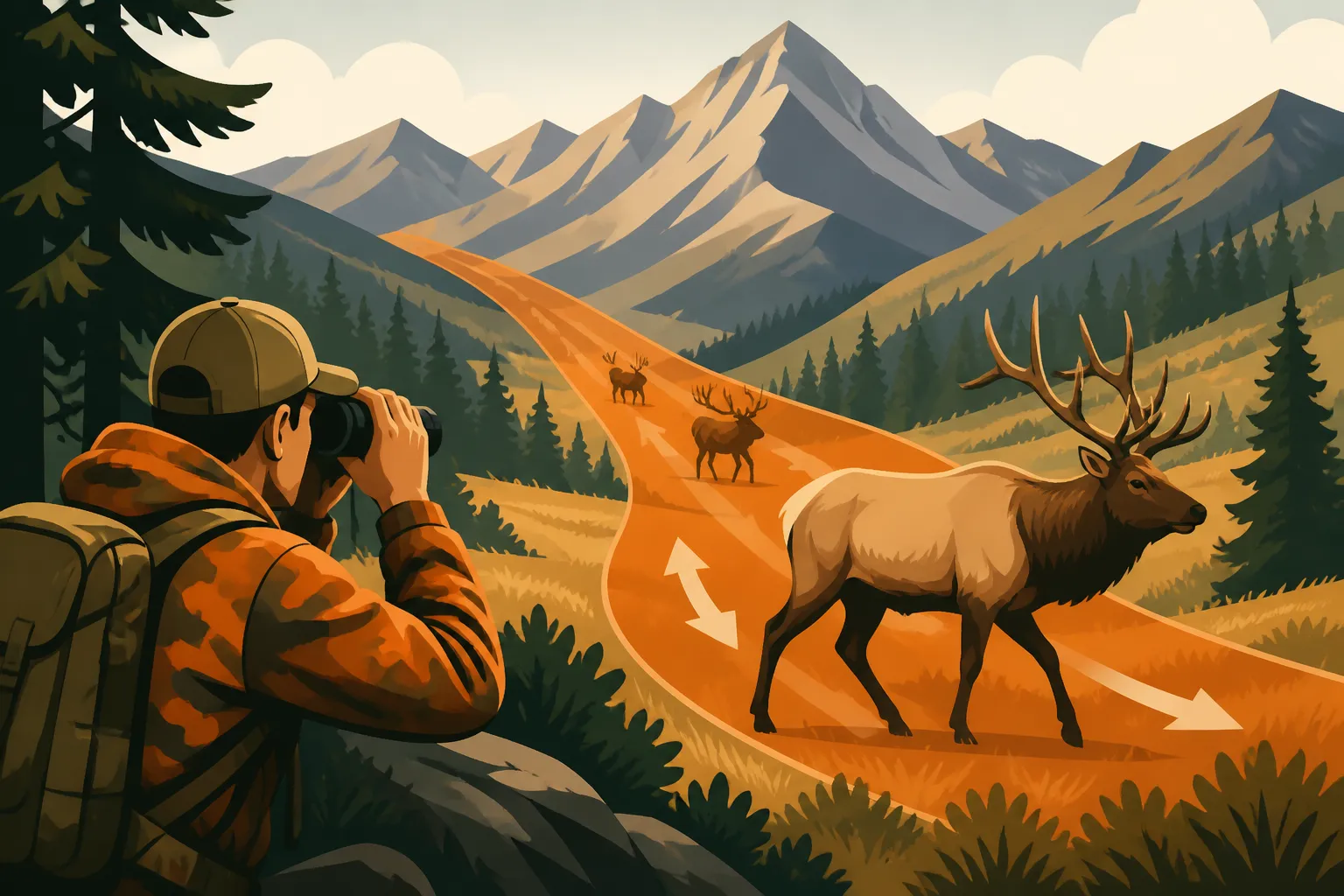
At its core, an elk travel corridor is simply the path of least resistance or the safest route an elk takes to get from Point A to Point B. These aren't always grand, obvious trails; sometimes they are subtle deer-like paths, and other times they might be more widespread routes through timber or along benches. Elk prioritize efficiency and security. They'll choose a path that conserves energy, minimizes exposure to predators (including hunters), and provides access to critical resources. For instance, a narrow saddle connecting two steep drainages is a classic corridor, as it's often the easiest way over a ridge. Similarly, a stringer of dark timber running through a more open area offers cover and a direct route.
Consider a scenario in the White River National Forest during the rut. A bull might bed in a north-facing slope of thick timber, then travel a ridge line down to a wallow in a secluded basin, and finally make his way to an aspen-filled feeding ground at dusk. The path he takes, often repeated, is his corridor. These routes become ingrained patterns, especially if they’ve historically proven safe.
Seasonal and Daily Movement Patterns
Elk movement isn't static; it's a dynamic dance influenced by the time of year and the time of day. During the early archery season, elk might be more visible and move through open parks and meadows in their pursuit of lush forage. Their corridors might be less defined as they spread out. However, as hunting pressure increases and the rut kicks in, their movements become more strategic. During the peak rut, bulls become singularly focused on cows, often following them through well-worn paths between larger groups. This is where knowing How to Hunt Elk During the Peak Rut becomes paramount.
Daily, elk exhibit crepuscular activity—they're most active at dawn and dusk. This means they'll be using their corridors most heavily during these low-light periods as they transition from bedding areas (where they rest during the day, often in dense cover at higher elevations) to feeding grounds (where they graze on grasses, forbs, and browse). Midday, they might use smaller, more localized corridors to access secondary bedding areas, water sources, or just shift within their primary bedding cover. Being in position along a key corridor an hour before first light or staying an hour after sunset can make all the difference.
Impact of Pressure on Travel
Here's where the frustration often builds: public land hunting pressure. When hunters descend upon popular areas, elk don't just disappear; they adapt. They abandon easy-to-access, wide-open corridors for routes that offer maximum concealment and safety. These might be steeper, thicker, or less obvious paths through dense timber, or along contours that provide natural visual barriers. A well-trafficked trail might become a ghost town overnight, while a barely discernible game trail through a nasty blowdown suddenly becomes a superhighway for elk.
This is why traditional hunting spots can sometimes fail you. Elk learn quickly. If hunters are consistently bumping them from certain areas, they'll seek out the path of least resistance from human interaction, not just terrain. This often means moving into dark timber, north-facing slopes, or extremely rugged terrain that most hunters shy away from. Understanding How to Hunt Elk on Public Land Pressure is crucial, and targeting these pressured-induced corridors is a key strategy.
Identifying Travel Corridors on the Landscape
Successfully hunting travel corridors begins long before you ever set foot in the field. It requires a blend of digital reconnaissance and meticulous on-the-ground scouting. You're essentially piecing together a puzzle, looking for the lines that connect the larger habitat features.
Utilizing Topographic Maps and Satellite Imagery
Modern e-scouting tools are absolute game-changers for identifying potential elk corridors. Platforms like GoHunt's mapping features, OnX Hunt, or even Google Earth allow you to virtually explore your hunting unit from your couch. Start by identifying the obvious: large blocks of dark timber (potential bedding), open parks or meadows (feeding), and prominent water sources (creeks, ponds, wallows). Then, look for the natural "lines" that connect these areas.
What you're looking for are topographical funnels and pinch points:
- Saddles and Passes: Low points along a ridge that make it easier for animals to traverse a mountain range.
- Benches: Flat or gently sloped "shelves" that run horizontally along steep mountainsides, providing easier travel than going straight up or down.
- Ridge Lines: Elk often travel along the tops or just below the tops of ridges, especially if timbered, as it offers a good vantage point and relatively easy footing.
- Creek and Drainage Bottoms: Often provide thick cover and water, and can act as natural corridors, particularly in timbered areas.
- Timber Edges and Stringers: Where dense timber meets open parks, or narrow bands of trees that connect larger timber blocks. Elk love to skirt these edges for security and cover.
For example, if you're looking at a unit in the Gunnison Basin, you might see vast expanses of open sagebrush connected by fingers of aspen or pine. These fingers are prime corridor candidates. Overlaying public land boundaries is also vital here, as elk will often travel along the edges of private land onto accessible public ground. This thorough digital groundwork is essential for How to E-Scout Before a Colorado Hunt.
Reading Sign on the Ground
E-scouting gets you in the ballpark, but ground-truthing is what truly confirms a corridor. Once you're in the field, you're looking for physical evidence that elk are regularly using a specific path. Fresh sign is your gold standard.
- Tracks: Look for fresh elk tracks, especially those that appear to follow a consistent path. The fresher the tracks (sharp edges, not dried or eroded), the more recently elk have used that corridor. Pay attention to track size and direction; often, larger tracks indicate a bull, and knowing their general direction of travel helps confirm a corridor.
- Droppings (Scat): Piles of fresh elk droppings along a trail are undeniable proof. Green, moist droppings mean recent activity, while older, dried-out scat indicates past use.
- Rub Lines: During the rut, bulls will rub their antlers on small trees and saplings to mark territory and strip velvet. A series of fresh rubs along a consistent line indicates a travel corridor heavily used by bulls.
- Wallows: Muddy depressions where elk roll to cool off and deter insects are often located along or near travel corridors, especially those connecting bedding and water. A fresh wallow, muddy and disturbed, is a hotspot for activity. Learning How to Hunt Elk Wallows in Colorado can be a game-changer.
- Worn Trails: In areas of frequent use, elk trails can be as defined as human hiking paths, often visible as depressions in the forest floor. In steeper terrain, look for "terraces" where elk have consistently walked, creating flat steps.
Don't just look at the ground. Scan eye-level and higher for broken branches, rub lines, or even hair snagged on low branches. The more consistent the sign along a route, the more confident you can be it's an active corridor.
Key Terrain Features to Look For
Beyond the general features like saddles and benches, there are nuanced terrain characteristics that act as magnetic forces for elk movement. These are the natural funnels and bottlenecks that concentrate elk traffic.
- Pinch Points: Any narrowing of terrain that forces elk into a smaller area. This could be a tight draw between two cliffs, a narrow strip of timber between an open clear-cut and a road, or the neck of a ridge where it drops into a basin. These are ambush hot zones because elk must pass through them.
- Slope Changes: Elk prefer to travel on less steep terrain when possible. Where a steep slope eases into a more gentle one, or where a bench breaks up a vertical climb, you'll often find a natural travel route.
- Vegetation Changes: The transition zone between different types of cover—say, dense pine to open aspen, or thick brush to meadow—often serves as a travel corridor. Elk use the edge of cover for security while still being able to access feeding areas.
- Natural Obstacles: Sometimes, a major obstacle like a large rock slide, a dense thicket of impenetrable brush, or even a steep cliff will force elk to travel around it, creating a natural funnel around the obstacle's perimeter.
Think of it like this: if you were trying to walk across a dense forest, you'd naturally follow game trails, avoid thick tangles, and opt for the easiest path. Elk do the same, but with an inherent sense of their survival needs. Studying these natural funnels on a map and verifying them on the ground is key to predicting their movements.
Effective Hunting Tactics for Elk Corridors
Once you've identified those prime travel corridors, the next step is to strategize how to effectively hunt them. This involves a mix of patience, stealth, and a keen understanding of elk behavior within these constricted pathways.
Ambush Hunting and Stand Placement
Ambush hunting is arguably the most effective way to capitalize on elk travel corridors. It involves positioning yourself in a concealed location along an active corridor and waiting for elk to come to you. This is a game of patience and precision.
First, identify the exact location within the corridor where elk traffic is most concentrated – a pinch point, a well-worn crossing, or a bend in the trail. Next, consider your setup:
- Wind Direction: This is non-negotiable. Elk have an incredible sense of smell. You must be downwind of where you expect the elk to come from. Even a slight shift in wind can blow your cover. Regularly checking wind direction with a wind checker or a light piece of string is paramount. For more on this, understand How to Use the Wind Hunting Colorado Elk.
- Concealment: Whether using a portable tree stand or a ground blind, ensure you are completely concealed from all directions an elk might approach. Break up your outline with natural vegetation. If on the ground, utilize fallen logs, rock outcroppings, or thick brush.
- Shot Opportunities: Position yourself for clear shooting lanes. Trim small branches that might deflect an arrow or bullet. Practice shooting from your chosen position beforehand to understand your limitations.
- Entry and Exit: Plan your approach and departure routes to avoid disturbing the area. Get into position well before first light and stay until after dark.
Setting up near a natural wallow or a water hole along a corridor can be particularly effective, as elk often pause or linger there.
Still-Hunting and Stalking Corridors
While ambush hunting relies on waiting, still-hunting and stalking involve actively moving through a corridor with extreme stealth. This method is particularly effective when you've identified a long stretch of active corridor or if you're trying to locate elk that might be bedding just off the main path.
- Pace: This is not a hike. Your pace should be agonizingly slow, often taking 15-20 minutes to cover 50 yards. You're moving at the speed of a snail, pausing frequently to glass, listen, and scan your surroundings.
- Quiet Movement: Every step must be intentional. Pick up your feet, place them down slowly, heel first, then roll to the toe, feeling for twigs or rocks. Wear quiet clothing. This is where mastering How to Move Quietly Through Colorado Timber comes into play.
- Observe and Listen: Use your binoculars or spotting scope constantly. Look for parts of an animal, not a whole animal – an ear flick, a patch of hide, the horizontal line of a back among vertical trees. Listen for subtle sounds: a twig snap, a rustle of leaves, a soft mew.
- Wind and Thermals: Always be aware of your wind direction and how thermals are shifting, especially in the mountains. Thermals rise in the morning and fall in the evening, carrying your scent accordingly.
- Hunt into the Wind: Always try to still-hunt or stalk into the wind to prevent your scent from reaching the elk before you see them.
This method requires immense patience and mental discipline, but it can be incredibly rewarding, allowing you to cover ground while actively hunting.
Calling Strategies in Travel Lanes
Calling can be a potent tool when hunting elk corridors, but it often requires a more subtle approach than open-country bugling. The goal isn't always to provoke a challenge, but to pique curiosity or stop a moving animal.
- Soft Cow Mews and Chirps: These are often the most effective calls in a corridor. A soft, inquisitive cow mew can stop an elk that's moving through, especially if it's not pressured. It sounds like a lone elk looking for company. If an elk stops and looks, that's your chance to assess and potentially take a shot.
- Calm Bugles or Grunts: If you're confident there's a bull in the corridor, a soft, questioning bugle or even a deep, contented grunt can sometimes draw him closer to investigate, without sounding overtly aggressive. Avoid overly aggressive bugling in tight quarters, as it can alert elk to your exact location and send them fleeing.
- Interception Calling: Position yourself downwind in the corridor, make a few soft calls, and then be absolutely still and ready. You're trying to intercept an elk that's already on the move, not necessarily call one in from a long distance.
- Calling at Wallows/Water Holes: As mentioned, these are natural congregation points along corridors. Subtle calls here can be very effective in drawing an elk closer that's coming in to drink or roll.
For a deeper dive into vocalizations, explore How to Call Elk in Colorado. Remember, in a travel corridor, less is often more with calling. You're aiming to subtly influence movement, not necessarily engage in a full-blown calling sequence.
Integrating E-Scouting and On-the-Ground Reconnaissance
Hunting elk corridors is a strategic endeavor that merges the best of modern technology with time-honored fieldcraft. Neither one is fully effective without the other.
Pre-Season Digital Scouting
Your hunting season truly begins long before you pack your bags. Pre-season digital scouting is your first, and arguably most critical, step in locating those elusive elk corridors. This is where you can cover vast amounts of terrain from the comfort of your home.
Start by meticulously dissecting your chosen Colorado GMU (Game Management Unit) using powerful mapping applications. Platforms like GoHunt provide layers that highlight public and private land, topography, and vegetation types. Look for obvious connections between known bedding areas (often dense, dark timber on north-facing slopes or high elevation benches) and feeding areas (aspen groves, open parks, or even agricultural fields if you're on the fringes of public land). Pay close attention to:
- Elevation Changes and Contour Lines: Elk prefer paths of least resistance. Look for gradual slopes, saddles, and benches that provide easier travel across difficult terrain. Steep, jagged contour lines usually indicate terrain elk will avoid unless heavily pressured.
- Vegetation Interfaces: Where different types of cover meet—e.g., a pine forest transitioning to an aspen stand, or timber meeting an open meadow—these edges often serve as travel lanes.
- Drainage Systems: Creek bottoms, dry washes, and riparian areas can act as natural corridors, providing cover, water, and easy navigation.
- Roadless Areas/Wilderness Boundaries: Elk often seek refuge in areas with minimal human disturbance. Utilize map layers that show roads and trails to identify untouched zones that might contain prime, unpressured corridors.
Mark potential corridors, wallows, water sources, and bedding areas as waypoints. This creates a virtual blueprint for your hunt, guiding your future on-the-ground efforts. This thorough preparation is covered in detail in Colorado Backcountry Hunting Guide.
Boots-on-the-Ground Verification
As powerful as digital tools are, they are never a complete substitute for physical reconnaissance. Once you've identified potential corridors on your maps, it's time to lace up your boots and hit the actual terrain. What looks perfect on a satellite image might be impassable due to blowdowns, or it might be too open and expose elk to predators.
During your physical scout, ideally in the summer or early fall before the hunt:
- Walk the Identified Corridors: Physically traverse the paths you've marked. Look for fresh elk sign: tracks, droppings, rubs, and areas of browse. Is the sign fresh and consistent?
- Assess Cover and Concealment: Evaluate the quality of cover along the corridor. Are there sufficient hiding spots for elk? Are there good ambush locations for you?
- Check for Water and Wallows: Confirm any water sources marked on your map. Are they actively being used? Are there wallows nearby?
- Observe Micro-Terrain: Note small depressions, rock outcroppings, or tight clumps of timber that might funnel elk even further. These subtle features can be critical for stand placement.
- Identify Pressure Points: Look for evidence of human activity (old boot prints, trash, abandoned camps). If a corridor shows heavy human use, elk may abandon it for a more secluded route when hunting season arrives.
This boots-on-the-ground work validates your e-scouting, helps you understand the nuances of the terrain, and reveals active elk trails that maps alone can't show.
Adapting to Elk Behavior
Elk are intelligent, adaptable animals. Their patterns can shift due to hunting pressure, weather changes, or even food availability. Just because you found an active corridor during your summer scout doesn't guarantee it will be active come hunting season. You must remain flexible and observant.
- In-Season Scouting: Even during your hunt, you should always be scouting. Pay attention to new sign, changes in elk vocalizations, or sudden shifts in weather (like a cold front push or early snow, as explored in How to Hunt Elk in the Snow). These can all influence elk movement.
- Flexibility with Tactics: If an ambush spot isn't producing, be willing to move. Perhaps still-hunting that corridor is a better option, or maybe moving to an adjacent bench is required.
- Post-Rut Shifts: After the rut, bulls and cows often separate, and their travel corridors might change. Bulls may seek out solitary bedding areas, while cows and calves remain in larger groups. This requires a shift in focus, often to secure bedding areas and escape routes.
- Public Land Pressure: As discussed, elk on public land quickly learn where hunters are present. If a corridor becomes too pressured, they'll find another. Be prepared to go deeper, steeper, or into thicker cover where other hunters might not venture. This is often where you find How to Find Elk in Deep Timber.
The ability to adapt your strategy based on current conditions and elk behavior is what separates consistently successful corridor hunters from those who endlessly search for "the spot."
| Corridor Type | Description | Best Hunting Method | Optimal Time to Hunt | Key Sign to Look For |
|---|---|---|---|---|
| Ridge Line Saddle | Low points in ridges connecting drainages or benches | Ambush, Still-hunt | Early/Late Day | Tracks, droppings, rubs |
| Timber Stringer | Narrow bands of timber connecting larger blocks of cover | Ambush, Still-hunt, Call | All Day, especially Midday | Tracks, browse, rub lines |
| Creek/Drainage Bottom | Low-lying areas, often with thicker cover and water | Still-hunt, Ambush | Early/Late Day, Midday | Tracks, droppings, wallows, fresh browse |
| Bench Trail | Horizontal "shelves" along steep mountainsides, connecting bedding and feeding | Ambush, Still-hunt | Early/Late Day | Worn trails, droppings, tracks, broken twigs |
| Vegetation Edge | Transition zone between dense and open cover | Ambush, Still-hunt | Dawn/Dusk | Tracks, fresh droppings, areas of frequent use |
| Natural Pinch Point | Narrowing of terrain that forces elk into a small area | Ambush (priority), Call | All Day | Concentrated tracks, rubs, droppings |
Disclaimer
Hunting in Colorado involves inherent risks. Always prioritize safety, adhere to all Colorado Parks and Wildlife regulations, and be aware of current weather and terrain conditions. This guide is for informational purposes only and does not guarantee hunting success. Always hunt ethically and responsibly.