Colorado Moose Hunting for Beginners
Dreaming of a Colorado moose hunt is a powerful vision for any big game hunter, but let's be realistic: it's one of the most coveted, challenging, and often once-in-a-lifetime opportunities the state offers. If you're new to the idea of pursuing these majestic animals in the Rockies, you're likely facing a mountain of questions about where to start, what it takes to draw a tag, and how to even begin planning such an epic adventure. This comprehensive guide is designed specifically for beginners, walking you through the unique aspects of hunting Shiras moose in Colorado, from understanding their behavior to navigating the daunting draw system and preparing for a hunt that could define your hunting career.
Understanding Colorado's Moose Population and Habitat
Colorado’s Shiras moose population is a real success story. While not native to the extent of other western states, moose were reintroduced in the 1970s and have thrived, expanding their range across much of the state's high country. This unique scenario means hunting them here requires a different approach than hunting elk or deer. Unlike the vast, open landscapes often associated with moose in Alaska or Canada, Colorado moose prefer dense, willow-choked creek bottoms, dark timber, and high-elevation basins, making their pursuit an intimate and often physically demanding experience.
Where Colorado Moose Roam
Moose in Colorado are quite particular about their real estate. They love areas with abundant willow browse, which is their primary food source, often found in riparian zones, around beaver ponds, and in high-elevation marshes and drainages. This preference for thick, wet environments dictates where you'll find them and, subsequently, where Colorado Parks and Wildlife (CPW) allocates hunting tags.
Historically, North Park, in the northern part of the state, was the original reintroduction site and remains a stronghold. The Laramie River drainage, stretching into Wyoming, also holds a significant population. Moving south, you'll find healthy herds in Middle Park, near Kremmling, and increasingly in the Flat Tops Wilderness. Further south, populations have expanded into the San Juan Mountains and other ranges in western Colorado. These are not migratory animals in the same way elk are; they tend to have smaller home ranges and stick to specific habitat types year-round. Understanding these core areas is your first step in even dreaming about a hunt, as it directly correlates with where tags are issued.
Moose Biology and Behavior for Hunters
Moose are fascinating creatures, and understanding their basic biology and behavior is absolutely crucial for a successful hunt. They are primarily browsers, meaning they prefer to eat twigs, leaves, and bark from shrubs and trees, especially willows and aspens. This is a key differentiator from deer and elk, which are primarily grazers. This feeding preference keeps them in those dense, wet areas mentioned above, rather than open grasslands or sparse timber.
Unlike the highly vocal elk, moose are generally much quieter. While bulls do grunt during the rut and cows can emit calls, they aren't nearly as loud or frequent as elk. This means locating them by sound is less common, making visual scouting and tracking more important. They are also largely solitary animals, especially the mature bulls, though you might occasionally see cows with calves or small groups during the rut. The rut, typically occurring from late September through mid-October, is when bulls are most active and potentially receptive to calling, though it's still a much more subtle affair than the elk rut. Their dark coloration and preference for dense cover make them incredibly challenging to spot, even at relatively close distances. This emphasizes patience, keen observation, and thorough glassing of suitable habitat.
The Colorado Moose Draw System: A Steep Hill to Climb
Okay, let's talk about the elephant in the room – or rather, the moose in the willows: getting a tag in Colorado is hard. In fact, for most non-residents and even many residents, drawing a Colorado moose tag is truly a once-in-a-lifetime proposition, requiring many years, often decades, of building preference points. This isn't a hunt you just decide to do next year; it's a long-term goal that demands patience and persistence.
Explaining the Preference Point System for Moose
Colorado utilizes a preference point system for its limited-draw big game tags, including moose. For moose, it's one of the most extreme examples of point creep. You earn one preference point each year you apply for a limited draw tag and are unsuccessful. These points accumulate, and in subsequent years, when you apply for a specific hunt code, your application is essentially "weighted" by the number of points you have. The applicant with the most points for a given unit and season generally draws the tag.
The challenge with moose is that the demand far outstrips the supply. CPW manages moose herds carefully to ensure sustainable populations, and as a result, only a very limited number of tags are issued each year. This scarcity drives the preference point requirements sky-high. As of recent draw statistics, drawing a bull moose tag in many units, especially for non-residents, can require upwards of 20 to 30 preference points, and sometimes even more. It's not uncommon for hunters to start applying in their 20s or 30s and not draw a tag until their 50s or 60s. This truly makes it a testament to patience and a long-term commitment.
How to Apply for a Colorado Hunting License and Preference Point
Navigating the application process is crucial. You'll need to purchase a qualifying license (typically a small game or fishing license) each year before you can apply for preference points or limited draw tags. The application period for the primary big game draw usually runs from early March through early April. During this window, you can apply for your desired moose hunt code or, more commonly for beginners, simply apply for a preference point only.
To apply, you'll visit the Colorado Parks and Wildlife website (cpw.state.co.us) and log into your account. If you don't have one, you'll need to create a customer account. From there, you'll navigate to the "Apply for a License" section, select "Big Game," and then choose "Preference Point Only" for moose if you're just starting out. This ensures you earn a point without actually entering the draw for a tag you won't get (unless you have 20+ points already!). Make sure you understand the Colorado Draw System and Preference Points thoroughly to avoid any missteps. The Colorado Big Game Draw Deadlines are strict, so mark your calendar!
Understanding Draw Odds and Realistic Expectations
This is where the rubber meets the road. Before you even think about applying for a specific unit, you need to understand the draw odds. CPW publishes draw results and statistics each year, showing how many points were required to draw tags in various units. This data is your most valuable tool. Websites and apps like GoHunt also compile this data, often presenting it in user-friendly formats that allow you to track trends and predict future point requirements. Using tools like GoHunt to research How Many Points for a Colorado Moose Tag is highly recommended.
Realistically, as a beginner, your expectation should be to accumulate preference points year after year. Don't be discouraged by the high point totals; think of it as an investment in a future dream hunt. Some hunters choose to apply as a group to increase their odds, but this also means everyone in the group must have enough points to draw the tag. This strategy works best if all members have very similar point totals.
Here's a simplified look at recent average preference points required for some bull moose tags:
| GMU Area | Resident Points (Approx.) | Non-Resident Points (Approx.) |
|---|---|---|
| North Park (e.g., GMU 6) | 18-22+ | 25-30+ |
| Middle Park (e.g., GMU 18) | 16-20+ | 22-28+ |
| Flat Tops (e.g., GMU 12) | 15-19+ | 20-26+ |
| San Juans (e.g., GMU 76) | 18-23+ | 26-31+ |
Note: These are approximations and can fluctuate annually. Always check the most recent CPW draw data.
These numbers highlight the long game involved. For more details on the process, refer to the Colorado Preference Points Explained guide.
Pre-Hunt Preparation for Your Colorado Moose Adventure
Once you've finally beaten the odds and drawn that coveted moose tag, the real work begins. A Colorado moose hunt is physically and mentally demanding, often taking place in rugged, dense terrain at high altitudes. Being unprepared can quickly turn a dream hunt into a miserable experience.
Physical Fitness: High Elevation, Dense Cover
This isn't a stroll in the park. Moose habitat in Colorado often means steep climbs, navigating through thick, deadfall-choked timber, traversing swampy willow thickets, and doing it all at elevations that can easily exceed 9,000 to 11,000 feet. The air is thin, and every step feels like two. You need to be in excellent physical condition.
Start a rigorous fitness regimen well in advance. Focus on cardiovascular endurance (hiking, running, stair climbing with a loaded pack), leg strength, and core stability. Practice hiking with the same weight you plan to carry in your pack. Simulating hunt conditions by doing uphill climbs with weight is invaluable. Altitude sickness is a real concern for anyone, especially those coming from sea level, so research Altitude Training for Colorado Hunting and give your body time to acclimate. Even if you're normally active, the combination of elevation and rugged terrain will test your limits. Remember, a downed moose can weigh over 1,000 pounds, and you'll likely be quartering and packing it out in challenging conditions. Read up on How to Physically Prepare for Colorado Elk – much of that advice translates directly to moose hunting.
Gear Considerations: Optics, Rifle or Bow, Clothing
Your gear can make or break a high-country moose hunt. Investing in quality equipment is not a luxury; it's a necessity.
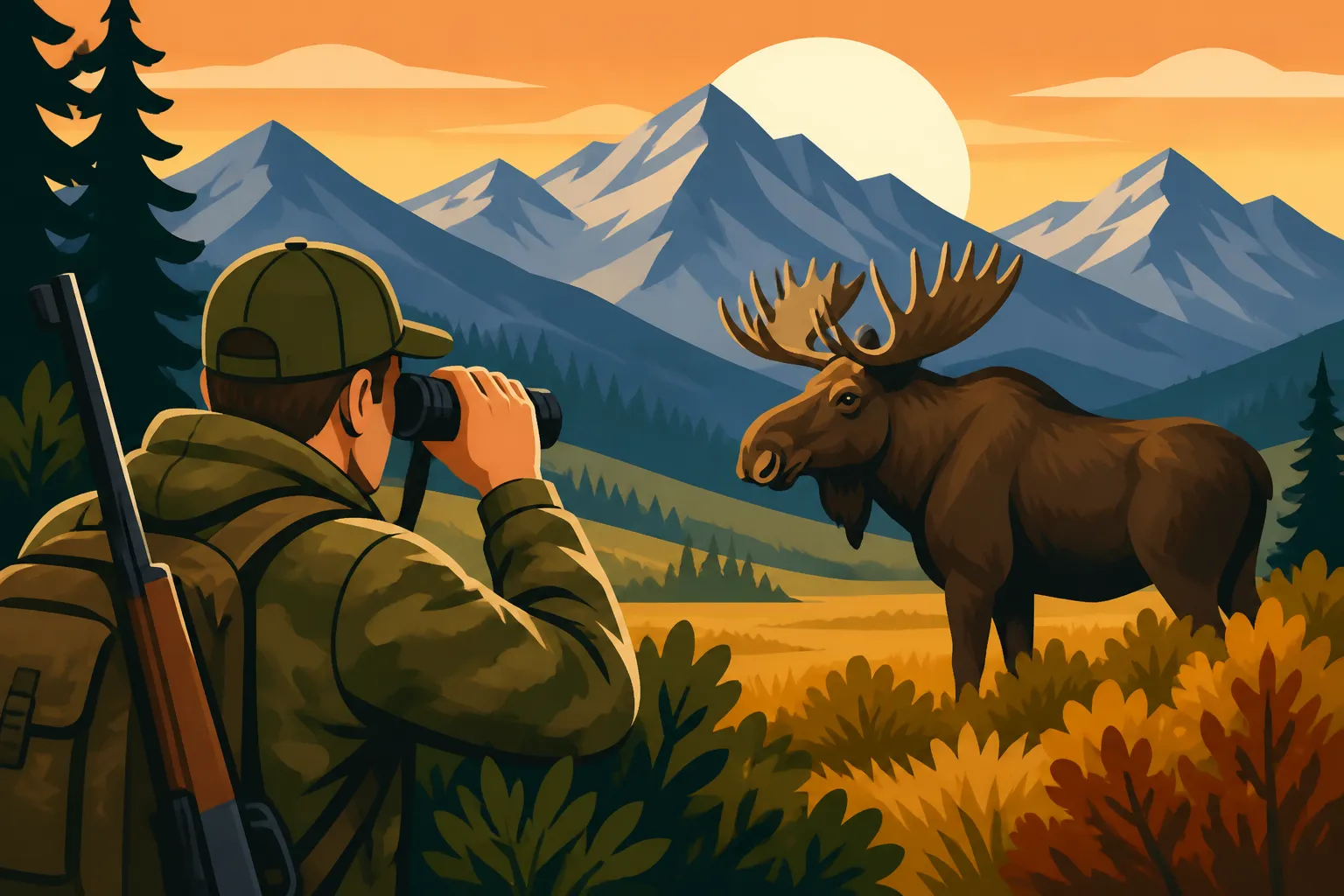
- Optics: This is paramount. You'll be doing a lot of glassing in low light and dense cover. High-quality binoculars (10×42 or 12×50 are common) and a spotting scope (15-45x or 20-60x) are essential for picking apart willows and dark timber. A tripod for your optics is non-negotiable for stable viewing. You can find excellent recommendations in our guide on Best Optics for Colorado Big Game. Rangefinders are also crucial for accurate shot placement in variable mountain terrain.
- Weapon: For rifle hunters, a caliber capable of taking large game at reasonable distances is needed. Common choices like .30-06, .300 Win Mag, .338 Win Mag, or 7mm Rem Mag are popular and effective. Ensure your rifle is sighted in properly and practice shooting from various field positions. Archery hunters will need a powerful setup capable of clean kills on a large animal. Shot placement is critical regardless of weapon choice.
- Clothing: Layering is key for Colorado's unpredictable mountain weather. Expect everything from warm sunshine to driving snow and freezing rain, sometimes all in the same day. Quality waterproof and breathable outer layers, warm insulating layers (puffy jackets, fleece), and moisture-wicking base layers are essential. Good boots, broken in and waterproof, are also vital for comfort and safety in wet, rough terrain.
- Pack: A sturdy, comfortable backpack with a good frame is indispensable for carrying gear and, crucially, for packing out meat. Look for packs with at least 5,000-7,000 cubic inches of capacity. Check out our Colorado Backcountry Hunting Gear List for a more detailed breakdown.
E-scouting and Boots-on-the-Ground Scouting
Drawing a tag is just the start; locating a moose is the real challenge. E-scouting from home is an incredibly powerful first step. Utilize satellite imagery, topo maps, and land ownership maps (like those found on GoHunt or OnX Hunt) to identify potential moose habitat: willow bottoms, north-facing slopes with dark timber, creek drainages, and areas with beaver activity. Look for areas away from roads and trails where hunting pressure might be lower. Our guide on How to E-Scout Before a Colorado Hunt offers detailed strategies.
Once you have a plan, nothing beats boots-on-the-ground scouting. If possible, visit your unit during the summer or early fall before the season. Look for moose sign: large tracks, droppings, rubs on small trees (especially by bulls during the pre-rut), and most importantly, browsed willows. This pre-season scouting helps you understand terrain, pinpoint high-percentage areas, and discover escape routes. It also gives you a chance to verify your e-scouting observations and develop a real-time game plan for when you're actually hunting.
Moose Hunting Tactics in Colorado
You've got the tag, you're in shape, and your gear is dialed. Now, how do you actually hunt a Colorado moose? It's a combination of patience, stealth, and adapting to the moose's preferred environment.
Spot-and-Stalk Techniques Specific to Moose
Spot-and-stalk is arguably the most effective method for moose hunting in Colorado. However, it's not like spotting elk on an open hillside. You'll be spending long hours patiently glassing dense cover.
- Patience in Dense Cover: Moose are masters of camouflage in their preferred habitat. Their dark bodies blend seamlessly with shadows and timber. You need to painstakingly pick apart every willow clump, every shadowed pocket of timber, and every beaver pond with your optics. Look for a patch of black, a subtle outline, the white antler tips of a bull, or the flick of an ear. Moose can stand absolutely still for long periods. Take your time.
- Wind Direction: As with any big game hunting, playing the wind is critical. Moose have an excellent sense of smell. Always approach with the wind in your favor, especially when stalking. Given the varied terrain and dense cover, thermals can be tricky in moose country, often dropping in the mornings and rising in the evenings. Pay close attention to wind currents throughout the day.
- Slow and Silent Movement: When you do spot a moose or are moving into a likely area, extreme stealth is required. Moose habitat often means navigating through tangled deadfall and noisy underbrush. Move agonizingly slowly, picking up your feet, and placing each step carefully to avoid breaking twigs or rustling leaves. Think of it as still-hunting on steroids.
- Focus on Colorado Moose Habitat and Elevation: Target areas with dense willow growth along creeks, around ponds, and in high-elevation cirques. Also check timbered ridges adjacent to these water sources where moose might bed.
Calling Strategies
While not as dominant as elk calling, moose calling can be effective, particularly during the peak of the rut (late September into early October).
- Cow Calls: Soft, drawn-out cow calls can sometimes pique the interest of a bull looking for a mate. These are typically long, mournful moans.
- Raking Antlers: Mimicking the sound of antlers scraping against brush or small trees can challenge a dominant bull, drawing him in for a confrontation. This is a subtle art and needs to be done carefully to sound natural.
- Patience and Situational Awareness: Moose might respond by coming in silently, so be ready. They might also take their time, circling to get downwind. Calling is best done in conjunction with spot-and-stalk, using it to draw an unseen bull closer or stop a moving one. Don't overcall; less is often more.
Hunting Different Types of Terrain
Colorado's diverse landscape means moose might be found in various environments, each requiring slightly different tactics.
- Swamps and Wet Bottoms: These are prime moose habitat. Wading through knee-deep water, navigating mud, and pushing through thick willows is often necessary. Wear appropriate footwear and clothing. Focus on edges where willows meet timber.
- Dense Timber: Moose use heavy timber for bedding and security, especially when pressured. This means slow, methodical still-hunting through dark timber, pausing frequently to listen and scan. This is where patience truly pays off. Consider learning How to Hunt Elk in the Dark Timber as many of those principles apply.
- Burn Areas: Old burn scars, particularly those with new growth of aspen and willow, can be fantastic moose habitat years after a fire. These areas can offer slightly better visibility while still providing the browse moose love.
- High-Elevation Basins: In some areas, moose will inhabit open alpine basins, especially if they have willow-choked tarns or small lakes. These spots can offer better glassing opportunities, but getting there often requires a tough climb into How to Hunt Colorado Alpine Basins.
Shot Placement and Recovery
Once you've finally got a bull in your sights, shot placement is paramount. Moose are large, tough animals. Their vitals are located relatively low and forward, behind the shoulder. Aiming for the shoulder can break bone and anchor the animal, but a double-lung shot is always ideal. Take your time, ensure a clean shot, and be prepared for follow-up shots if necessary.
After the shot, give the animal time, especially if the shot wasn't perfect. Even if it was, approaching too quickly can push a wounded animal further. Once you confirm it's down, the hard work of field dressing and packing out begins. A full-grown Shiras bull can yield hundreds of pounds of meat. Understanding How to Pack Out an Elk in Colorado will be a critical skill, but be prepared for an even larger animal. This is where your physical conditioning, sharp knives, game bags, and a good pack system will truly be tested. Many hunters hire a packer or use horses for moose retrieval due to the sheer size and rugged terrain.
Good luck on your quest for a Colorado moose! It's an unforgettable journey that truly rewards perseverance.
Disclaimer
Hunting is an inherently dangerous activity. This guide provides general information for educational purposes only and is not a substitute for official regulations, professional instruction, or personal judgment. Always consult current Colorado Parks and Wildlife (CPW) regulations, obtain all necessary licenses and tags, and prioritize safety. The author and publisher are not responsible for any accidents, injuries, or legal infractions that may occur.