How Elevation Affects Colorado Unit Choice
You’ve spent countless hours poring over maps, scrutinizing draw odds, and reading forum posts about the best Colorado hunting units for elk or mule deer. But often, in all that research, one critical factor gets overlooked or underestimated: elevation. It’s not just a number on a contour line; it’s a living, breathing component of the landscape that dictates where animals live, what they eat, how they move, and, crucially, how you will feel and perform on your hunt. Failing to consider elevation can lead to wasted effort, missed opportunities, or even serious physical challenges. This guide is here to shed light on how profoundly elevation affects your Colorado unit choice, helping you understand its impact and make smarter decisions for a more successful and enjoyable hunt.
The Unseen Influence of Elevation on Colorado Hunting
It’s easy to think of a hunting unit as a two-dimensional boundary on a map, but the reality in Colorado couldn't be further from that. The state’s dramatic vertical relief means that within a single GMU (Game Management Unit), you could experience environments ranging from sagebrush flats at 6,000 feet to windswept tundra above 12,000 feet. This isn't just a scenic backdrop; it's a dynamic system that dictates almost everything about your hunt.
More Than Just a Number: Why Elevation Matters
When we talk about elevation in Colorado, we're not just discussing how high a mountain peak is. We're talking about a cascade of interconnected environmental factors that directly influence hunting success. Think of it this way: a unit at 7,000 feet is fundamentally different from one at 10,000 feet, even if they share the same geographical coordinates on a flat map.
First, consider the air itself. Higher elevations mean less oxygen. This isn't just an abstract scientific fact; it's a very real physical challenge that can quickly turn an otherwise healthy hunter into someone battling headaches, nausea, or debilitating fatigue. If you’re not physically prepared for the thin air, even the easiest hike can feel like climbing Everest. This physiological impact is paramount and often underestimated by hunters coming from sea level.
Second, elevation dictates vegetation. The type of forage available to elk, deer, and other game changes dramatically with altitude. You'll find different tree species, different grasses, and different shrubs. This, in turn, influences where animals feed, bed, and travel. A prime elk feeding ground in a timbered basin at 9,500 feet will look entirely different from a lower, drier mule deer habitat at 7,000 feet. Understanding these transitions is key to anticipating game movement.
Finally, weather. The mountains are notorious for their unpredictable and extreme weather, and elevation amplifies this tenfold. A gentle autumn rain in the foothills can quickly turn into a blizzard at 11,000 feet. Temperatures drop significantly with every thousand feet of ascent, and wind speeds pick up dramatically. This means your gear choices, your packing strategy, and your safety protocols all become intrinsically linked to the elevation you plan to hunt. Ignoring these elevation-driven variables is like trying to navigate without a compass – you might get lucky, but you're probably going to get lost.
Elevation Zones and Their Distinct Hunting Characteristics
Colorado is often described in terms of its diverse landscapes, and these landscapes are largely defined by elevation. Each zone presents unique challenges and opportunities for hunters. Knowing these characteristics can help you narrow down your unit choice based on your target species, hunting style, and physical capabilities.
Let's break down these distinct zones:
-
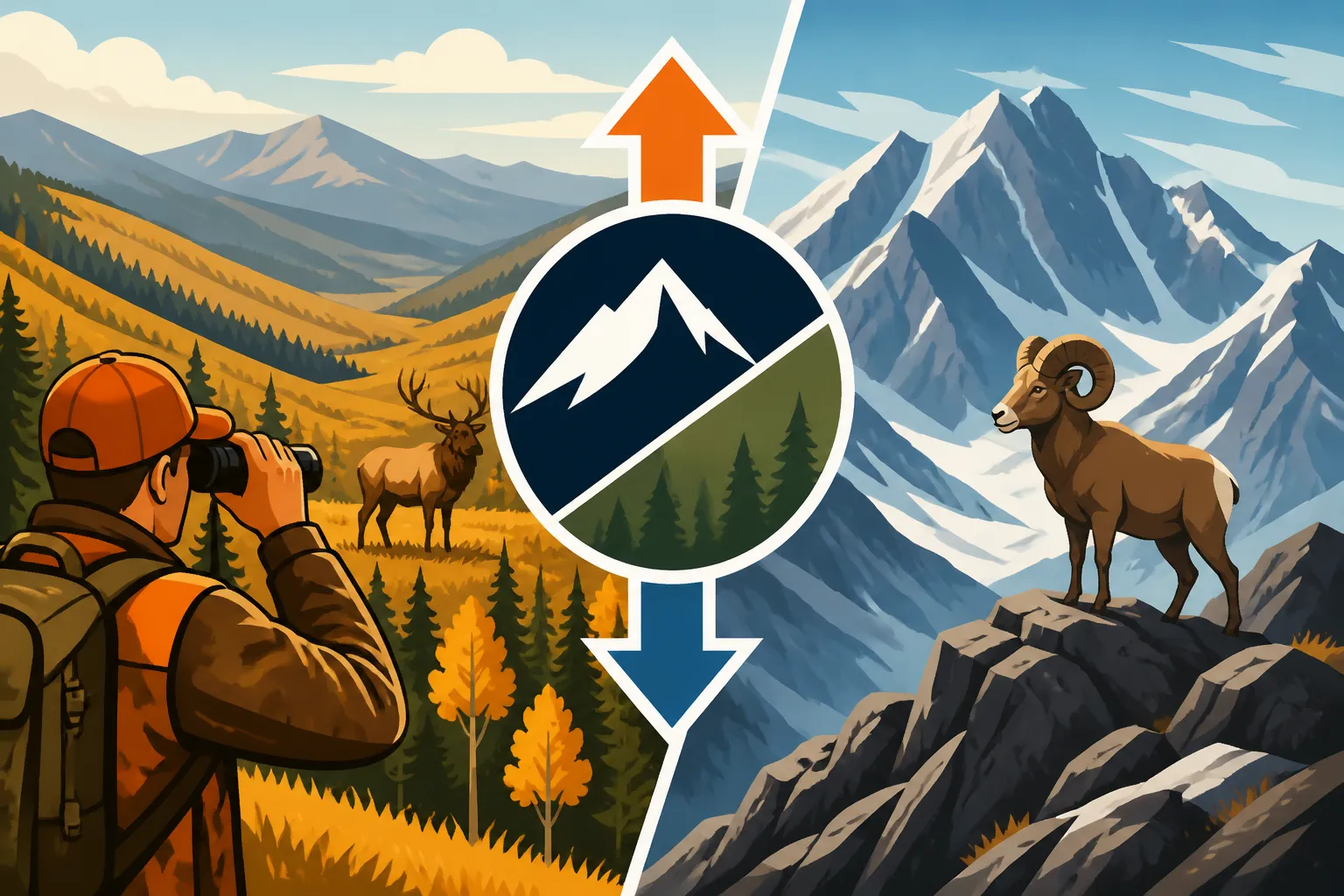
Alpine (Above 11,000 feet): This is the realm of tundra, rocky peaks, and cirque basins. Trees are sparse or non-existent, giving way to low-lying grasses, wildflowers, and lichens. Hunting here demands extreme physical fitness, specialized gear for harsh weather, and often calls for a true backcountry approach. Game animals like bighorn sheep and mountain goats thrive here, but trophy mule deer and elk can also be found in these high, remote reaches, especially during early seasons before heavy snows. The air is thin, and storms can materialize out of nowhere.
-
Subalpine (9,000 – 11,000 feet): This is classic "elk country." Dominated by evergreen forests like Engelmann spruce, subalpine fir, and lodgepole pine, interspersed with aspen groves, open parks, and willow-choked creek bottoms. This zone offers abundant forage and cover. It's where you'll find elk during the rut, and many mule deer during their summer range. Access can vary from roads to extensive wilderness areas. Weather here is still volatile, with significant temperature drops at night and the potential for early snow. Units with large tracts of subalpine habitat are often prime choices for those targeting elk.
-
Montane (7,000 – 9,000 feet): This zone is characterized by ponderosa pine forests, Douglas fir, and vast aspen stands. It often borders agricultural lands or more populated areas. It’s a transition zone where game animals may spend time in spring and fall, particularly if winter range is at lower elevations. Many "over-the-counter" (OTC) elk units or draw units that offer more accessible hunting often fall into this elevation band. Mule deer, black bear, and occasionally elk utilize these areas. You'll find a mix of public and private land, and pressure can be higher due to easier access.
-
Foothills and Valleys (5,500 – 7,000 feet): This zone represents the transition from the plains to the mountains, featuring pinyon-juniper woodlands, scrub oak, and grasslands. It often serves as critical winter range for deer and elk, especially as snow pushes them down from higher elevations. Hunting here might involve different tactics, such as glassing open sagebrush hillsides or still-hunting thick brush. Pronghorn are also common in these lower, more open areas. Access is generally better, but private land becomes a more significant factor.
-
Plains (Below 5,500 feet): Predominantly eastern Colorado, this is a landscape of expansive grasslands and agricultural fields, with riparian corridors supporting cottonwood and willow trees. This is prime habitat for pronghorn, whitetail deer, and some plains elk. Hunting here is vastly different from mountain hunting, often involving long-range shooting and glassing vast open areas. While not typically considered "mountain hunting," it's an important part of Colorado's diverse hunting landscape, and some plains GMUs offer draw opportunities for elk and deer.
How Elevation Shapes Game Animal Behavior and Habitat
Understanding how each species interacts with different elevation bands is perhaps the most crucial aspect of using elevation in your unit selection. Animals aren't static; they are constantly moving, driven by food, water, weather, and hunting pressure. And elevation is the primary conductor of this intricate dance.
Elk: Following the Green Wave and Snow Lines
Elk are perhaps the most elevation-sensitive of Colorado's big game species, especially the Rocky Mountain elk. Their annual movements are a masterclass in adapting to vertical changes, following what hunters often call the "green wave" in spring and being pushed by the "white wave" (snow) in the fall.
In the spring, as the snow melts and new growth emerges, elk typically "green up" with the advancing vegetation, moving to higher elevations. They spend their summer months in the cooler, richer forage of the subalpine and alpine zones, often feeding on lush grasses in high-mountain parks and timbered slopes. If you're planning an early archery hunt, targeting these higher elevations, perhaps above 9,000 feet in areas like the White River National Forest or the Flat Tops Wilderness, is often your best bet. Here, you might find them in secluded basins or timbered north-facing slopes, trying to escape the summer heat and hunters. This is where understanding how to hunt elk at high elevation becomes paramount.
As fall approaches and hunting seasons open, the story changes. The first significant snowfalls, particularly during the early rifle seasons or even late archery, act as a natural elevator, pushing elk down to lower, more protected winter ranges. This migration can be subtle or dramatic depending on the severity of the weather. During the peak of the rut in September and early October, you might still find bulls bugling in those high subalpine pockets, but a cold front or a couple of feet of snow can send them pouring down into the montane zones or even the foothills overnight.
For later rifle seasons (3rd and 4th), especially after consistent snow accumulation in the high country, focusing on units or sections of units that offer good cover, south-facing slopes (to catch the sun), and lower elevation feed becomes critical. They'll be looking for less snow, more accessible browse, and thermal cover. This often means glassing lower benches, saddles, and dense timber where they feel safe. Consider units with good montane forest cover and diverse terrain that allows them to escape pressure and find food without expending too much energy.
Mule Deer: High-Country Summer to Lower-Elevation Winter
Mule deer also exhibit significant vertical migration, often spending their summers at much higher elevations than their winter ranges. However, their patterns can differ from elk in terms of their preferred habitat within those elevation bands.
During the warmer months, especially in the early archery season, you'll often find trophy mule deer bucks in the high alpine and subalpine, often above the timberline or just within the timber's edge. They'll frequent remote basins, high-elevation parks, and north-facing slopes where nutritious forage is abundant, and human pressure is minimal. These bucks are often in velvet or hardening their antlers, prioritizing food and seclusion. Units with expansive high-country terrain, such as portions of the San Juan Mountains or Collegiate Peaks, are ideal for pursuing these high-country giants. Learning how to glass for Colorado Mule Deer in these vast landscapes is a skill unto itself.
As the days shorten and temperatures drop, mule deer begin their annual migration to lower winter ranges. This movement can be triggered by decreasing daylight, dwindling high-country forage, or the first heavy snows. By the time rifle seasons kick into full swing, especially 3rd and 4th season, many mule deer will have descended into the montane and foothills zones. They seek out areas with less snow, south-facing slopes that melt faster, and reliable food sources like bitterbrush, serviceberry, and sagebrush.
When choosing a unit for mule deer, especially in later seasons, it’s vital to understand the unit's winter range potential. A unit that holds a lot of deer in summer might be virtually empty in November if all those deer migrate to lower elevations in an adjacent or even distant GMU. Tools like onX Hunt or GoHunt can help you visualize these transitions, looking at elevation changes, snow depth data, and potential migration corridors. This type of analysis is crucial for a successful Colorado Mule Deer Hunting Guide.
Pronghorn and Other Plains Species: The Low-Lying Landscape
While elk and mule deer are masters of vertical migration, other species in Colorado are firmly rooted in the lower elevation zones. Pronghorn, in particular, are creatures of the open plains and rolling foothills, rarely venturing into dense timber or steep mountain terrain.
Pronghorn prefer expansive grasslands and sagebrush flats, typically found in the plains and lower foothills elevation zones, often below 7,000 feet. They are built for speed and long-distance visibility, which makes dense forests unsuitable for their survival. If your target is pronghorn, you'll be looking at entirely different units than an elk hunter, focusing on the eastern plains or broad valleys in western Colorado. These areas might include units around Craig, Limon, or Pueblo, characterized by minimal elevation changes, vast vistas, and often a mix of public and private agricultural lands.
Other species like whitetail deer are also found predominantly in lower elevations, often along riparian corridors in agricultural areas of the eastern plains or in the river bottoms of western Colorado. Black bears, while capable of roaming high country, are also frequently found in the montane and foothill zones, especially where oak brush or berry patches provide abundant food sources. When considering these species, your unit choice will naturally gravitate towards areas with less dramatic elevation changes and specific habitat types. For example, some bear units are excellent because they offer a mix of dense cover and diverse food sources across moderate elevations, allowing bears to move freely.
Navigating the Physical and Logistical Challenges of High-Altitude Hunting
Okay, so we’ve talked about how elevation dictates where the animals are. But now let’s get real about what it means for you. Hunting at 10,000 feet is not the same as hunting at 2,000 feet, and ignoring the physical and logistical demands can quickly turn a dream hunt into a miserable, or even dangerous, ordeal.
The Air Up There: Altitude Sickness and Conditioning
This is arguably the biggest personal hurdle for many hunters coming to Colorado, especially those from lower elevations. The simple truth is, there's less oxygen in the air the higher you go. At 10,000 feet, the air pressure is significantly lower, meaning each breath delivers fewer oxygen molecules to your lungs and bloodstream. Your body needs time to acclimate, to produce more red blood cells, and to adjust its respiratory rate.
If you arrive from sea level and immediately start hiking hard at 10,000 feet, you're a prime candidate for Acute Mountain Sickness (AMS). Symptoms can range from mild headaches, nausea, and dizziness to severe fatigue, difficulty sleeping, and shortness of breath. In its more severe forms (HACE or HAPE), it can be life-threatening. This isn't just about feeling a bit tired; it can genuinely incapacitate you, making hunting impossible and even self-rescue challenging.
To combat this, physical preparation is paramount. Long before you even think about which Colorado hunting unit to pick, you should be focused on your fitness. Regular cardiovascular exercise, strength training, and especially exercises that mimic mountain hunting (like hiking with a loaded pack up steep inclines) are crucial. This will not only make the physical exertion easier but also help your body cope with the lower oxygen levels. For those coming from out of state, arriving a few days early to allow for acclimatization in a lower-elevation town like Fairplay, Salida, or even Durango before heading into high country is highly recommended. Staying hydrated and avoiding alcohol upon arrival also helps significantly. Seriously, don't underestimate the mountain; it doesn't care how tough you are at sea level. This is why a good Altitude Training for Colorado Hunting plan is non-negotiable for many.
Weather Extremes and Gear Considerations at Different Elevations
Colorado's mountains are famous for their fickle weather, and elevation only magnifies this unpredictability. What starts as a sunny, calm morning in a valley can quickly turn into a torrential downpour, hail storm, or even a blizzard on a ridge just a few thousand feet higher.
-
Temperature Swings: The temperature typically drops about 3 to 5 degrees Fahrenheit for every 1,000 feet of elevation gain. This means that if it's 50 degrees in the valley, it could be freezing on a distant peak. Furthermore, mountain temperatures can fluctuate wildly throughout the day. You might start your morning in below-freezing temperatures, hike into 60-degree sunshine by midday, and then face a sudden storm that drops temperatures back below freezing. Layering your clothing system, with moisture-wicking base layers, insulating mid-layers, and a waterproof/windproof outer shell, isn't just a suggestion; it's a survival strategy.
-
Sudden Storms: Convective storms in the summer and early fall can develop rapidly in the high country. They bring lightning, heavy rain or snow, and strong winds. Being caught on an exposed ridge above timberline during a lightning storm is incredibly dangerous. Knowing when to turn back or seek shelter is a critical skill. Even in October rifle seasons, a balmy day can precede an overnight dump of two feet of snow. Your gear needs to be robust enough to handle everything from mild autumn days to full-blown winter conditions, even within the same hunt. Think quality raingear, insulated puffy jackets, warm hats, gloves, and waterproof, breathable boots.
-
Wind: Wind speeds often increase dramatically with elevation and exposure. On a high ridge, even a moderate temperature can feel biting cold due to wind chill. Exposed passes and alpine basins are notorious for persistent, strong winds that can quickly sap your body heat and make glassing or shooting accurately a major challenge. When e-scouting, pay attention to terrain features that might offer some wind protection, like timbered bowls or leeward slopes.
The gear you pack needs to reflect the highest elevation and worst conditions you might encounter in your chosen unit. It's always better to carry a bit extra and not need it than to be caught unprepared.
Access and Terrain Difficulties in High-Elevation Units
Choosing a high-elevation unit often means embracing a different kind of challenge: the terrain itself and how you access it. Unlike lower-elevation units that might have extensive road systems, many of Colorado's prime high-country hunting areas are characterized by vast wilderness, roadless areas, and extremely rugged topography.
-
Roadless and Wilderness Areas: Many of Colorado's best elk and mule deer units contain significant portions of designated wilderness or large roadless areas. These are phenomenal places to escape pressure and find unmolested game, but they demand a serious commitment. You won't be driving your ATV down a forest road; you'll be hiking in on foot, or perhaps with horses or llamas. This means packing everything you need for several days on your back, including food, shelter, and emergency supplies. A good Colorado Backcountry Hunting Guide is essential reading if you plan to venture into these remote areas.
-
Steep Slopes and Rugged Terrain: Higher elevations typically mean steeper, rockier, and more broken terrain. Even a short distance "as the crow flies" on a map can translate to thousands of feet of elevation gain and loss across steep, unstable scree fields, dense timber, or thick brush. Navigating these areas is slow, arduous work. Expect to move at a fraction of your normal pace. Proper footwear with excellent ankle support and traction is non-negotiable. Trekking poles can save your knees and provide stability on steep descents or ascents.
-
Backcountry Packing Challenges: The logistics of getting an animal out of high-elevation, rugged country are immense. If you’re successful, you'll need to quarter the animal and pack it out, often over several trips, through the same difficult terrain you hunted in. This requires specialized gear like a high-quality external frame pack, game bags, and an understanding of how to properly field process an animal in remote conditions. Factor in the added physical strain of packing hundreds of pounds of meat at altitude, and you realize that physical conditioning isn't just about the hunt itself, but about the extraction too. This is a critical consideration for any Colorado DIY Elk Hunting Guide adventure.
Practical Strategies for Incorporating Elevation into Unit Selection
So, how do you take all this information and turn it into actionable steps for choosing the right Colorado hunting unit? It comes down to smart research, honest self-assessment, and understanding the interplay between seasons and altitude.
E-Scouting with Elevation in Mind
Modern e-scouting tools have revolutionized how hunters approach unit selection and in-field navigation. When you're looking at Colorado units, don't just see green and white; see the contour lines as a roadmap to game.
Start by looking at the topo maps on platforms like onX Hunt or GoHunt. These tools allow you to visualize terrain in 3D, analyze slope angles, and identify key elevation features. Look for areas within a unit that offer a diverse range of elevations. This is often where you'll find game, as they move between different altitude bands for feeding, bedding, and security.
Specifically, pay attention to:
- North-Facing Slopes: Often hold snow longer, providing cooler bedding areas for elk and deer in early seasons. In later seasons, they might become deep snow traps.
- South-Facing Slopes: Catch more sun, melting snow faster and greening up earlier. These are crucial for winter range and can be game magnets in colder weather.
- Elevation Benches and Saddles: These are natural travel corridors and often serve as bedding areas where animals can survey their surroundings. Using the contour lines, identify these "flat" spots within steep terrain.
- Timberline: The elevation where trees transition to alpine tundra is a critical habitat boundary. Elk and mule deer often move along this line or just above/below it.
- Water Sources: Identify perennial streams, springs, and wallows at various elevations. Water is a constant need, and animals will move vertically to access it.
Using the elevation profile tools on these apps, you can draw a line across a potential hunting area and see the exact elevation changes, helping you assess the steepness and ruggedness before you even set foot on the mountain. This level of detail in e-scouting is indispensable for making informed choices about unit selection and planning your attack.
Matching Your Fitness and Experience to Elevation Levels
This is perhaps the most important, and often the most honest, conversation you'll have with yourself. Be realistic about your physical capabilities and hunting experience. There’s no shame in choosing a unit that aligns with your current fitness level. A successful hunt isn’t defined by how high you climb, but by the memories made and, ideally, the meat in the freezer.
-
High-Elevation (10,000+ feet): This is for the well-conditioned, experienced mountain hunter. Expect extreme physical demands, potential for severe weather, and often a need for advanced backcountry skills (navigation, survival, first aid). If you’re a flatlander or new to western hunting, this is probably not the place to start unless you've committed to a serious physical training regimen and plan to hire a reputable outfitter.
-
Mid-Elevation (8,000 – 10,000 feet): Many of Colorado’s most popular elk and deer units fall into this range. It still requires good physical fitness and an understanding of mountain conditions, but it's generally more accessible than true high country. You'll find a mix of roaded access and extensive backcountry. This can be a great sweet spot for those looking for a challenging but manageable hunt. For those new to the state, exploring Best Colorado Elk Hunting Areas for Beginners might guide you towards units in this range.
-
Lower-Elevation (Below 8,000 feet): These units offer more moderate terrain and easier access. While the physical demands are less, hunting here often means dealing with more private land, potentially higher hunter pressure, and different game behaviors as animals are pushed down by snow or concentrated in winter ranges. These units can be excellent choices for hunters with physical limitations, those bringing youth hunters, or anyone looking for a less grueling experience. Don't discount them; they can offer fantastic opportunities for elk, mule deer, and pronghorn.
Be honest about how much weight you can carry, how far you can hike comfortably with a pack, and how well you recover from exertion. There's no quicker way to ruin a hunt than to arrive physically unprepared for the demands of Colorado's mountains. Consider implementing a rigorous Colorado Elk Hunt Fitness Plan months before your trip.
Season-Specific Elevation Planning
The hunting season you choose is inextricably linked to the elevations where you’re most likely to find game. This is where understanding animal migration patterns truly pays off.
-
Early Archery (Late August – September): During the archery season, particularly the peak of the rut, elk are often in their summer high-country range. This means you're typically looking at units with good subalpine and alpine habitat, above 9,000 feet, where the air is cool, and forage is abundant. Mule deer bucks can also be found high at this time. Focus on basins, timbered ridges, and transition zones just below timberline. This is prime time for calling, as bulls are vocal.
-
Muzzleloader/1st Rifle (Mid-September – Early October): These seasons often coincide with the tail end of the rut for elk and before heavy snows really start pushing animals down. You might still find elk in the subalpine, but they could begin moving towards lower elevations if a significant cold front or snowstorm hits. Mule deer are also beginning their descent. Pay attention to weather forecasts leading up to your hunt. Units with a good mix of subalpine and montane habitat offer versatility.
-
2nd and 3rd Rifle (Late October – Early November): These are often considered prime times for migration. Elk and mule deer are usually on the move, pushed by increasing snow depth in the high country and seeking out winter range. Focus on units with strong migration corridors, lower-elevation benches, and south-facing slopes. Areas with good connectivity between high summer range and low winter range are key. This is when a lot of game can be found in the 7,000-9,000 foot range.
-
4th Rifle and Late Seasons (Mid-November – December): By this point, most game animals will have firmly settled into their winter ranges at lower elevations. This means focusing on montane, foothills, and even plains units or the lower portions of mountain units. Look for areas with minimal snow, good cover, and available forage. South-facing slopes, dense timber pockets, and areas adjacent to agricultural lands or private wintering grounds can be excellent. Understanding these patterns is crucial for a successful Colorado Elk Season Dates Guide or deer hunt.
| Elevation Zone | Typical Altitude (feet) | Primary Game Species | Key Considerations for Hunters | Best Season Examples |
|---|---|---|---|---|
| Alpine | 11,000+ | Bighorn Sheep, Mtn Goat, Elk, Mule Deer | Extreme fitness, harsh weather, remote, specialized gear | Early Archery (Elk/Deer) |
| Subalpine | 9,000 – 11,000 | Elk, Mule Deer, Bear | Classic elk country, good cover & forage, challenging access | Archery, Muzzleloader, 1st Rifle |
| Montane | 7,000 – 9,000 | Mule Deer, Elk, Bear | Transition zone, mixed habitat, moderate access, higher pressure | All Rifle Seasons, Late Archery |
| Foothills | 5,500 – 7,000 | Mule Deer, Whitetail, Pronghorn, Elk | Winter range, mix of public/private, open & brushy terrain | Late Rifle, Plains Seasons |
| Plains | Below 5,500 | Pronghorn, Whitetail, Plains Elk | Open country, long shots, primarily private/agricultural | Plains Seasons |
Real-World Examples: Elevation in Action Across Colorado GMUs
To truly grasp how elevation impacts your unit choice, let's look at some hypothetical, but very realistic, scenarios across different Colorado GMUs (Game Management Units). These examples highlight how elevation drives success, or frustration, in the field.
The High Country Haunt: Targeting Trophy Animals in Remote Basins
Imagine you're eyeing a unit like GMU 76, nestled deep in the San Juan Mountains, or perhaps a section of the Flat Tops Wilderness. These are quintessential high-country haunts, where elevations routinely soar above 10,000 feet, with many peaks pushing 13,000-14,000 feet. You've heard tales of monster bulls and giant mule deer bucks that call these remote basins home during the summer and early fall.
If you choose such a unit for an early archery or muzzleloader hunt, your strategy will be intrinsically tied to the high elevation. You'll be focusing on glassing vast alpine bowls, identifying the timbered pockets just below timberline, and scouting for those elusive basins that hold lush feed and cool bedding areas. Access here is almost exclusively by foot, requiring a significant pack-in. You'll need top-tier conditioning, the ability to carry a heavy pack (both in and out), and robust gear capable of handling rapid temperature swings, afternoon thunderstorms, and even early snow. This type of hunt often involves a spike camp setup, deep in the backcountry, to minimize daily travel and maximize hunting time. The reward? The chance at truly unpressured animals in breathtaking surroundings, but the challenge is immense. This is the domain of dedicated "trophy" hunters or those seeking the ultimate wilderness experience, often detailed in a Colorado Backcountry Hunting Guide.
Mid-Elevation Magic: The Balance of Accessibility and Game
Now consider a unit like GMU 55 in the Gunnison Basin or portions of GMU 43, offering a diverse landscape that spans from around 7,500 feet to well over 10,000 feet, with a strong emphasis on the mid-elevation subalpine and montane zones. These units often present a more balanced opportunity for hunters, combining reasonable access with solid game populations.
For a 2nd or 3rd rifle season hunt in such a unit, elevation becomes a dynamic factor. In early October, elk might still be clinging to the higher subalpine meadows and dark timber, especially if the weather has been mild. However, as the month progresses and the first serious snows begin to fall, you'll see a distinct shift. The animals will start moving down, often utilizing benches and saddles around the 8,000-9,000 foot range, seeking out south-facing slopes that shed snow and provide accessible browse.
Your hunting strategy would involve monitoring weather patterns closely. If a storm is rolling in, you'd focus your efforts on the lower-elevation escape routes and wintering areas. If the weather holds mild, you might still push higher into the timbered pockets. These units often provide a mix of wilderness areas and roaded national forest land, allowing for different hunting styles. A hunter with moderate fitness can have great success here, using base camps accessible by vehicle and making day trips into the surrounding country. It's a fantastic choice for many hunters who want a challenging but not utterly grueling experience, as highlighted in a Colorado National Forest Hunting Guide.
Lower-Elevation Opportunities: Overlooked Gems
Finally, let's look at units that might be predominantly in the montane, foothills, or even plains elevation zones, perhaps a GMU on the eastern side of the Front Range like GMU 86 or the lower reaches of a western slope unit that borders agricultural areas. These units might lack the dramatic high-country allure but offer unique and often overlooked hunting opportunities.
For instance, if you're targeting whitetail deer or plains elk, you'd choose a unit with vast grasslands, river bottoms, and agricultural fields, often below 7,000 feet. Elevation changes here are minimal, and the focus shifts from climbing mountains to utilizing drainages, creek beds, and crop fields for cover and travel. This style of hunting demands different skills: long-range shooting proficiency, extensive glassing of open country, and potentially navigating complex public/private land interfaces.
Even for mountain elk, the lower sections of some GMUs can be goldmines during late rifle seasons. As heavy snow pushes elk out of the high country, they often concentrate in lower-elevation winter ranges. These areas, typically between 6,000-8,000 feet, might be near private ranches or in dense, unpressured timbered valleys. Hunting here often involves still-hunting through thick cover, watching pinch points, or focusing on south-facing slopes where snow melts first. These hunts are physically less demanding in terms of elevation gain but often require intense stealth and patience. They can be excellent choices for hunters who prioritize accessibility and have good cold-weather gear for potentially brutal late-season conditions. Don't let the lack of dramatic peaks fool you; these areas can hold significant numbers of game, especially when winter truly sets in.
In all these scenarios, your choice of unit, your strategy, and your personal preparation must align with the elevation profile of the land. Ignore it, and you're just hoping for luck; embrace it, and you're planning for success.
Disclaimer
Please remember that hunting regulations, season dates, and unit boundaries can change. Always consult the official Colorado Parks and Wildlife (CPW) regulations and maps before planning any hunt. This guide is for informational purposes only and should not replace official sources or responsible hunting practices.