How to Judge a Colorado Bull Elk in the Field
There's nothing quite like the heart-pounding moment a bull elk steps into view in the vast Colorado wilderness. Your breath catches, adrenaline surges, and then… the clock starts ticking. In those precious seconds, you're expected to assess not just if he's a shooter, but if he's legal and if he meets your personal goals for the hunt. It's a high-pressure situation, often made more challenging by distance, timber, and the sheer excitement of the moment. This guide will help break down the critical elements of field judging a Colorado bull elk, giving you the tools to make confident decisions when it truly counts.
Why Field Judging Bulls is So Tough and Why It Matters
Let's be honest, trying to size up a massive animal through a scope or binoculars, often with shaky hands and fading light, is no easy feat. It’s a skill that develops over years, but understanding the fundamentals can give you a massive leg up, especially when facing Colorado’s specific regulations.
The Pressure Cooker of the Moment
You’ve hiked for miles, perhaps days, through rugged terrain. You've braved the elements, endured discomfort, and spent countless hours scouting and strategizing. Then, suddenly, there he is – the bull you’ve been dreaming of. Your heart pounds like a drum solo, your mind races, and every fiber of your being screams "SHOOT!" This intense emotional response is completely natural, but it's also your biggest enemy when it comes to accurate field judging. Distorted perceptions, overestimation, and rushing decisions are common pitfalls. Many hunters have stories of bulls looking significantly smaller or larger once they're on the ground. The key is to have a systematic approach that you can fall back on even when your emotions are running high.
Understanding Colorado's Legal Requirements Antler Point Restrictions
Colorado has specific regulations designed to manage its elk herds, particularly regarding bull harvest. Many units in Colorado operate under an antler point restriction (APR) system. This means a bull must have a minimum number of points on one antler to be legal. For example, some units might require a bull to have at least four points on one side, or brow tines at least five inches long.
It is absolutely crucial to know the specific regulations for the Game Management Unit (GMU) you are hunting in. A legal bull might look completely different from one unit to the next. Failing to properly identify a legal bull can result in a hefty fine, loss of hunting privileges, and ethical ramifications. Always double-check the current Colorado Parks and Wildlife (CPW) regulations before your hunt. This isn't just about avoiding a ticket; it's about being a responsible and ethical hunter who respects the wildlife and the rules put in place for their sustainable management. Before you even head out, spend time with the Colorado Hunting Seasons Explained to understand your specific season and unit's rules.
Key Indicators for Aging a Bull Elk
While the antlers get all the glory, the body of an elk can tell you a tremendous amount about its age, maturity, and potential antler growth. A truly mature bull isn't just about big antlers; it's about a big, powerful body that has developed over years.
Body Size and Proportion
When you first spot an elk, try to get a quick read on its overall body size relative to its head and legs. A young bull, say a 2.5-year-old "raghorn" spike or small 4×4, will often look lanky. Their legs will seem long in proportion to their body, their neck will appear slender, and their chest won’t be very deep. They still have that "teenage" look to them, often moving with a more spry, less deliberate gait than a seasoned veteran.
As a bull matures into the 3.5 to 5.5-year-old range, you'll see a noticeable thickening. Their body becomes more robust, the chest deepens, and their legs no longer seem disproportionately long. At 6.5 years and older, a bull reaches its prime. These older bulls are truly massive animals. Their bodies are deep, broad, and incredibly powerful. Their heads might even appear small in comparison to their thick necks and massive shoulders. Look for that heavy, blocky appearance, especially through the shoulders and brisket. They move with a deliberate, powerful swagger, especially when rutting.
Neck Girth and Chest Depth
The neck is one of the most telling indicators, particularly during the rut. A mature bull’s neck will swell dramatically during the breeding season, becoming incredibly thick and muscled. It can appear nearly as wide as its head, sometimes even wider, giving it a "bulldog" appearance. Younger bulls will have noticeably thinner necks, even during the peak of the rut. Compare the neck to the width of the head and the depth of the chest.
A deep, robust chest indicates a mature animal with a large lung capacity – a necessity for the physical demands of the rut and navigating mountain terrain. This isn't just about a thick coat of hair; you'll see a clear, substantial depth from the top of the back down to the brisket. This is particularly noticeable when the bull is standing broadside. Combined with a thick neck and heavy shoulders, a deep chest is a strong indicator of an older, mature bull. If you're looking for an honest assessment of a bull's maturity, these physical cues are often more reliable than just the number of points on his head, as antler growth can vary widely based on genetics and forage.
Decoding Antler Characteristics for Score Estimation
While body judging gives you an idea of age, the antlers are what many hunters are truly focused on for legality and trophy potential. Learning to quickly estimate antler size and structure is critical.
Main Beam Length and Mass
The main beams are the foundation of a bull’s rack. Long, sweeping main beams contribute significantly to a bull's overall score and impressive appearance. When judging, try to estimate how far back the main beams extend beyond the bull's ears. A bull with beams that reach well past its ears, perhaps even to its tail, indicates good length.
Mass, or circumference, is another major factor. Think about the thickness of the beams right above the burr, and how much mass they carry throughout their length. Do they look like thick, heavy branches, or more like slender sticks? A bull with heavy mass will often have dark, textured antlers that absorb light, appearing robust even at a distance. Don't be fooled by sheer length if the beams are spindly. Mass adds weight and bulk, making the bull appear much more impressive. When considering specific units, knowing the Colorado Big Game Record Book averages can give you a baseline for what to expect.
Tine Length and Configuration (Points)
Tines are the individual points protruding from the main beam. For scoring purposes, a point must be at least one inch long and longer than it is wide at its base. When you’re field judging, you’ll be looking at both the number of tines and their length.
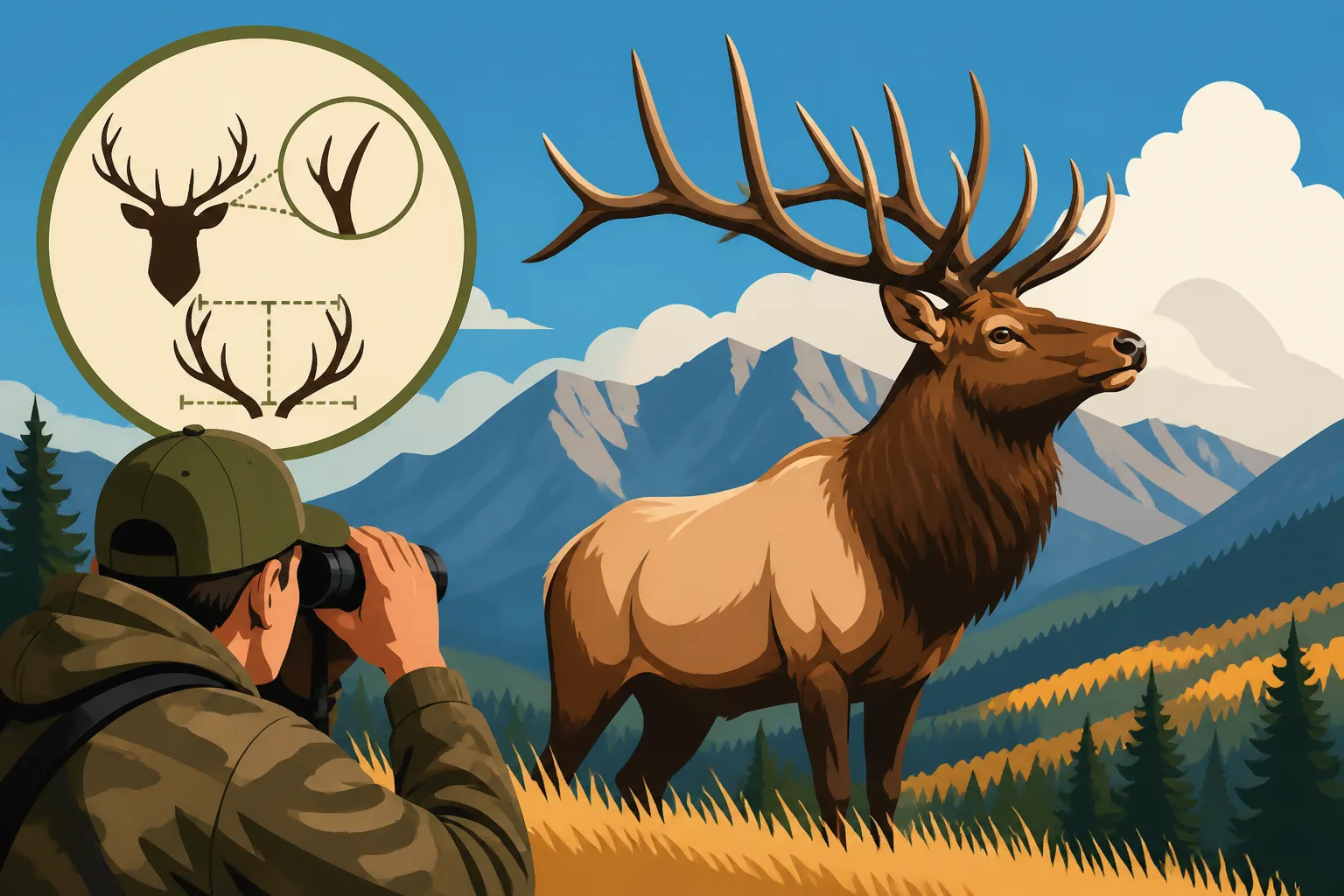
- Number of Points: This is straightforward – count them! This is critical for meeting Colorado's antler point restrictions. Can you clearly see four or five points on one side, or are they hiding in the timber? Are the brow tines long enough? Many units in Colorado use a 4-point minimum on one side, for instance.
- Tine Length: Long tines add a lot to a bull's aesthetic appeal and score. Imagine measuring them against the length of the bull's ear or even the length of its face. Are the G-series tines (G1-G6) tall and prominent, or are they stubby? Many trophy bulls are defined by their long, graceful tines. A bull with short, stubby points, even if numerous, won't score as highly as one with fewer, longer tines. Some bulls will have incredible G2s and G3s (the second and third points up from the base), making them truly stand out.
Spread and Overall Symmetry
Antler spread refers to the widest point of the rack, usually measured between the outside of the main beams. A wide-spread bull looks magnificent, often giving the illusion of a larger animal. To estimate spread, compare it to the width of the bull's body. Does the antler spread extend well beyond its ears? Does it seem as wide as its shoulders? A "30-inch" bull typically means its outside spread is 30 inches, a benchmark that looks fantastic. A bull with main beams that extend beyond its ears often has a good spread.
Symmetry is also a major factor for overall appeal and can be important if you're chasing a Boone & Crockett or similar record book entry, which penalizes for asymmetry. Look at both sides of the rack. Do they match up in length, mass, and tine configuration? Few wild bulls are perfectly symmetrical, but a generally balanced rack is more visually appealing. Sometimes, one side might be a complete different story, or a bull might be a "club" on one side due to injury. These are things to quickly assess. While perfect symmetry is rare, a generally balanced look usually indicates a healthy, desirable animal.
| Antler Characteristic | Young Bull (1.5-3.5 years) | Mid-Age Bull (4.5-6.5 years) | Mature Bull (7.5+ years) |
|---|---|---|---|
| Main Beam Length | Shorter, often not past ears | Extends past ears, good length | Well past ears, long & sweeping |
| Main Beam Mass | Slender, "pencil-like" | Good mass, consistent | Heavy, thick, deep burrs |
| Tine Length | Shorter, sometimes stubby | Good length, distinct | Long, sharp, prominent |
| Number of Points | Often spikes, 3×3, 4×4 | 5×5, sometimes 6×6 | 6×6 or better, complex |
| Spread | Narrow | Moderate | Wide, beyond ear tips |
| Overall Symmetry | Varies | Generally balanced | Can be very symmetrical |
| Body Build | Lanky, thin neck | Robust, thickening neck | Massive, barrel-chested, thick neck |
Practical Strategies for Field Judging in Colorado's Terrain
Colorado’s diverse landscapes – from dense timber to open alpine basins – present unique challenges and opportunities for field judging. Having a solid strategy and the right gear can make all the difference.
Optics and Observation Techniques
Quality optics are not a luxury; they are an absolute necessity for ethical and successful elk hunting in Colorado. You need binoculars, a spotting scope, and a rangefinder. Companies like GoHunt often emphasize the importance of high-quality gear for successful hunts, and for good reason.
- Binoculars: Use 10×42 or 12×50 binoculars for initial spotting and closer inspection. When a bull appears, immediately get your binoculars on him. Look for points, mass, and overall shape.
- Spotting Scope: For distant animals, a spotting scope (20-60x or higher) is invaluable. This is where you can truly pick apart a bull's rack, counting points precisely, evaluating tine length, and assessing mass. Set it up on a stable tripod for clear viewing. It’s hard to judge antler length when you can barely see the animal, so give yourself every advantage.
- Rangefinder: Always range the animal. Distance can play tricks on your eyes, making an animal seem larger or smaller than it is. Knowing the exact distance helps calibrate your visual assessment.
- Grid Searching: When glassing, don’t just randomly scan. Grid search an area slowly and thoroughly. Once you spot an animal, don't immediately focus on the antlers. Take a breath, observe its behavior, and then systematically go through your judging criteria: body, then main beams, then tines, then spread. This systematic approach helps minimize emotional bias. Many successful hunters utilize e-scouting tools like those from GoHunt to identify potential glassing knobs and areas where elk might be found, making on-the-ground glassing more efficient. You can learn more about this by checking out How to Use Optics for Colorado Big Game.
Using Environmental Cues and Comparisons
It's tough to judge an animal in a vacuum. You need points of reference.
- Known Measurements: Try to compare antler features to known body parts. An elk's ear, for example, is typically about 8-10 inches long. If a brow tine is significantly longer than an ear, that's a good indicator of length. The length of its head can also be a good benchmark for estimating tine length or beam mass.
- Comparing to Other Elk: If the bull is with other elk, use them as a comparison. Is he the biggest body in the herd? Do his antlers dwarf the other bulls? This is particularly helpful when judging younger bulls for legality.
- Vegetation: If the bull is standing near a tree, a shrub, or a rock, use it as a makeshift ruler. While not precise, it can give you a rough idea of size relative to something familiar. Just be careful, as environmental features can also play tricks. A bull in heavy timber might look smaller, while one silhouetted on a ridge might appear enormous. This is especially true when hunting How to Hunt Elk in the Dark Timber.
- Topography: Be mindful of the terrain. A bull standing downhill from you will often appear larger, while one standing uphill might look smaller. Similarly, an animal in a deep canyon might be harder to judge accurately due to the distorted perspective. Understanding How to Judge Distance in the Mountains is a skill worth practicing.
Practice Makes Perfect Off-Season Prep
Field judging is a skill, and like any skill, it improves with practice. Don't wait until opening day with a bull in your crosshairs to start learning.
- Study Photos and Videos: Spend time looking at photos and videos of elk. Use online resources like those from GoHunt or other hunting forums. Practice counting points, estimating mass, and identifying body characteristics. Challenge yourself: "Is this a 4-point legal bull? What's its estimated score?"
- Observe Live Animals: If you have access to areas where you can observe elk (or even deer) in the off-season, take your binoculars and practice. Watch them for extended periods, assessing their age and antler growth without the pressure of a hunt. This trains your eye to pick up subtle details.
- Realistic Scenarios: Imagine yourself in different hunting scenarios. A bull at 300 yards in thick timber versus 100 yards in an open meadow. How would you approach judging each? What challenges would you face? This mental rehearsal can prepare you for the real thing. It's not just about looking at antlers; it's about understanding Colorado Elk Behavior During the Rut and other seasons to anticipate where and how you might encounter them. Building confidence in your field judging abilities before the season even begins is invaluable.
Disclaimer
Please note that hunting regulations, seasons, and unit boundaries are subject to change. Always consult the official Colorado Parks and Wildlife (CPW) regulations and maps for the most current and accurate information before planning or engaging in any hunting activity. This guide is for informational purposes only and should not be considered a substitute for official sources.