Rocky Mountain Hunting Guide
Hunting in Colorado's majestic Rocky Mountains is an experience unlike any other, offering breathtaking vistas and the challenge of pursuing big game in some of the most rugged terrain in North America. However, the sheer scale and unforgiving nature of these mountains can quickly overwhelm even seasoned hunters, making success feel out of reach. This comprehensive guide is designed to break down the unique obstacles and equip you with the knowledge and strategies needed to plan and execute a successful hunt in the Colorado Rockies, helping you navigate everything from the high-altitude challenges to crucial gear choices.
The Unique Challenges of Hunting the Colorado Rocky Mountains
The Rocky Mountains are beautiful, but they don't give up their secrets, or their game, easily. Hunters face a formidable combination of environmental factors and inherent difficulties that require careful planning and a robust skillset. It's not just about finding an animal; it's about enduring the conditions and being prepared for anything.
Extreme Terrain and Elevation
When people talk about hunting the Rockies, they’re often picturing those iconic, snow-capped peaks and deep, timbered valleys. That imagery isn't just for postcards; it's your hunting reality. You're going to be dealing with steep inclines, treacherous descents, thick stands of dark timber, and wide-open alpine basins. Elevations can range from 7,000 feet in the foothills to well over 12,000 feet in prime elk and deer country. This dramatically impacts your physical performance, often leading to shortness of breath, fatigue, and even altitude sickness if you're not properly prepared. Animals are also adapted to this vertical world, often using elevation to escape pressure or find feed, meaning you'll need to learn how to hunt elk at high elevation yourself.
Furthermore, the ground underfoot is rarely flat or forgiving. Expect loose scree slopes, boulder fields, downed timber, and dense brush. A simple mile on a map can translate to hours of strenuous travel across this kind of terrain. This isn't a stroll through a flat woodlot; it's a constant physical test that demands strong legs, lungs, and an unyielding will.
Unpredictable Mountain Weather
If there's one thing you can count on in the Colorado Rockies, it's that the weather will be unpredictable. You can start your morning with crisp, clear skies and by noon be caught in a torrential downpour, a sudden hailstorm, or even an unexpected early season snow. Temperatures can swing wildly too, from warm, sunny afternoons to freezing nights. These rapid changes aren't just uncomfortable; they can be dangerous, leading to hypothermia if you're not dressed in appropriate layers or if your gear isn't waterproof.
Hunters often arrive expecting consistent weather for their specific season, only to find themselves battling conditions that feel more like a different time of year. For instance, an archery hunt in September might bring 70-degree days in the sun, only to be followed by a cold front dropping temperatures into the 20s with several inches of snow. Understanding how to handle cold-weather gear for Colorado is paramount, as is the ability to adapt your plans on the fly. These weather shifts also influence animal behavior, pushing game to different elevations or into thicker cover, making scouting and real-time adaptation critical.
Sparse Game and Vast Country
Unlike some other states or regions where game populations might be concentrated, hunting the Colorado Rockies often means covering immense tracts of land to find animals. While Colorado boasts a healthy elk population, for example, they aren't necessarily evenly distributed. You might hike for miles through prime-looking habitat without seeing a single track, only to stumble into a honey hole of animals when you least expect it. The sheer vastness of the public land, particularly in National Forests and Wilderness Areas, means that animals have ample space to roam, making them harder to pinpoint.
Hunter pressure, especially in easily accessible areas, can also push game into deeper, more remote country. This means you often have to go further and work harder to find undisturbed animals. The challenge isn't just the physical act of traversing the mountains, but also the mental fortitude required to keep pushing, keep glassing, and keep believing you'll find what you're looking for, even when the miles pile up without a sighting. This is where strategic e-scouting and understanding animal behavior truly shine.
Strategic Approaches for Rocky Mountain Hunters
Successfully hunting in Colorado's Rocky Mountains demands more than just grit; it requires a well-thought-out strategy, meticulous preparation, and the right techniques adapted for high-country game. You can't just wander out there and hope for the best.
Mastering E-Scouting and Topographic Maps
Before you ever set foot on the mountain, your hunt begins from your living room. E-scouting, or electronic scouting, is an absolute game-changer for Rocky Mountain hunting. Tools like onX Hunt and GoHunt allow you to pour over satellite imagery and topographic maps, identifying potential bedding areas, feeding zones, water sources, natural travel corridors, and escape routes. You can mark waypoints for saddle crossings, benches, wallows, and even potential glassing knobs. This virtual reconnaissance saves you countless hours of unproductive hiking once you're on the ground.
When you're looking at those detailed maps, pay close attention to subtle terrain features that might concentrate elk or deer. North-facing slopes often hold timber and moisture, providing cooler bedding during early seasons. South-facing slopes get more sun, melting snow faster and offering early season forage. Look for benches or flat spots on steep hillsides, as these are natural resting spots for animals. Identifying these key areas before your boots hit the dirt gives you a massive advantage, allowing you to prioritize your efforts and maximize your time in productive country. It's truly a critical step for how to E-Scout before a Colorado Hunt.
Physical Conditioning and Acclimation
Let's be blunt: if you're not in shape, the Rocky Mountains will break you. The combination of high elevation and rugged terrain is brutal, and many hunts end prematurely due to physical exhaustion or injury. A dedicated fitness plan is non-negotiable. Focus on cardiovascular endurance – think hiking with a weighted pack, stair climbing, or trail running. Strength training for your legs, core, and back is equally vital, as you'll be carrying heavy loads over uneven ground. Check out a Colorado Elk Hunt Fitness Plan for detailed guidance.
Beyond general fitness, acclimation to altitude is crucial for anyone coming from lower elevations. Arriving a few days early, if possible, and spending time at a moderate elevation (around 6,000-8,000 feet) can significantly reduce the effects of altitude sickness. Even if you can't arrive early, maintaining hydration, avoiding alcohol, and taking it slow on the first day or two can help your body adjust. Remember, even peak physical fitness doesn't completely negate the effects of thin air, but it makes them manageable. Altitude Training for Colorado Hunting can make a huge difference in your hunt's enjoyment and success.
Effective Glassing and Silent Movement
In the vastness of the Rockies, your optics are your best friends. Glassing – systematically scanning terrain with binoculars and spotting scopes – is often far more effective than simply walking. Find a high vantage point, settle in, and meticulously pick apart every hillside, timber edge, and open park with your binoculars. Take your time, sometimes spending an hour or more in one spot, letting your eyes relax and search for unnatural shapes or movements. Good glassing techniques are central to finding game in these large landscapes. For more on this, check out our guide on how to glass big Colorado basins.
Once you’ve spotted an animal, or decided on an area to investigate, silent movement becomes paramount. The dense timber and rocky terrain can make stealth challenging, but it's essential. Walk slowly, deliberately placing each foot to avoid snapping branches or dislodging rocks. Utilize natural cover, stay in the shadows, and use the wind and thermals to your advantage. Colorado thermals in elk country often rise during the day and fall at night; understanding these air currents can help you approach game undetected. A good pair of boots that are quiet and offer excellent traction, combined with patient, calculated steps, can make all the difference in closing the distance. For more specific tactics, learn how to move quietly through Colorado timber.
| Rocky Mountain Hunting Challenges | Strategic Solutions | Essential Gear |
|---|---|---|
| Extreme Terrain & High Elevation | E-scouting, Physical Prep, Acclimation | Sturdy Boots, Trekking Poles, Lightweight Pack |
| Unpredictable Weather | Layered Clothing, Waterproof Outerwear | Quality Rain Gear, Insulated Layers, Warm Hat |
| Vast Country & Sparse Game | Intentional Glassing, Patience, Silent Stalking | High-Quality Binoculars, Spotting Scope, Rangefinder |
| Navigating Public Lands | onX Hunt, CPW Resources, GPS | GPS Device, onX Hunt App, Printed Maps |
Navigating Access and Regulations in the Rockies
Understanding where you can hunt and the rules that govern it is just as important as knowing how to hunt. Colorado's system can seem daunting at first, but with the right resources, you can confidently navigate the public lands.
Understanding GMUs and Public Land Boundaries
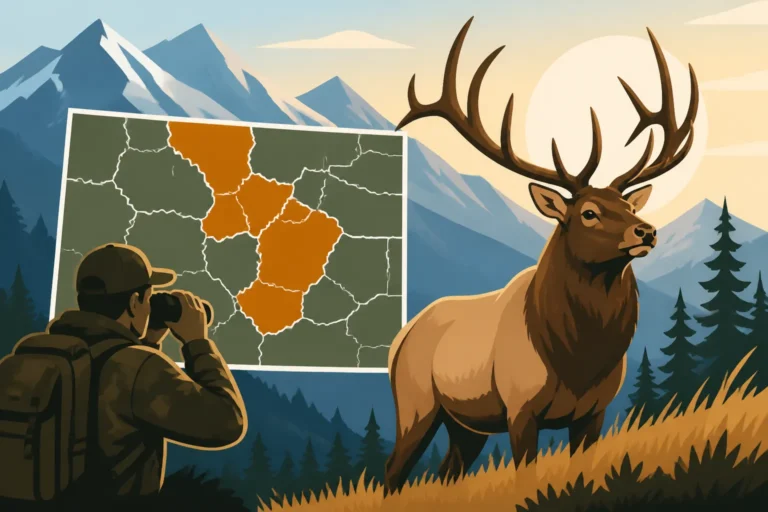
Colorado is divided into numerous Game Management Units (GMUs), each with its own specific regulations regarding species, seasons, and tag types. Before you even apply for a tag or head into the field, you need to understand the GMU boundaries and the specific rules for the unit you plan to hunt. These boundaries are often based on natural features like rivers and mountain ranges or sometimes man-made features like roads, making them crucial to identify accurately. You'll find detailed explanations in our guide on Colorado Hunting Units (GMUs) Explained.
The vast majority of hunting in the Rockies takes place on public lands, primarily National Forests and Bureau of Land Management (BLM) property. However, public and private land ownership can be a complex patchwork. This is where tools like onX Hunt become indispensable. Its GPS capabilities and detailed land ownership maps show you exactly where you are in relation to public and private boundaries, preventing accidental trespassing. Always double-check your position, especially in areas where public and private parcels are intertwined. Don't forget to study the Colorado Public Land Hunting Guide for general principles.
Utilizing Colorado Parks and Wildlife Resources
Colorado Parks and Wildlife (CPW) is your primary resource for all things hunting in the state. Their website is a treasure trove of information, offering detailed maps, regulation brochures, draw statistics, and season dates. Before your hunt, download or print the relevant big game brochure for the current year, as regulations can change annually. Pay close attention to season dates, legal methods of take, and any specific restrictions for your chosen GMU, such as antler point restrictions for elk.
The CPW also provides valuable data on game populations, harvest statistics, and even historical weather patterns, which can inform your unit selection and hunting strategy. They host seminars and provide educational materials that are particularly useful for those new to hunting Colorado. Understanding how to use the Colorado Hunting Atlas explained on their site is another key piece of the puzzle, providing information on public land access and species distributions. Don't hesitate to call a local CPW office with specific questions; the game wardens and wildlife biologists often have invaluable, localized knowledge.
Essential Gear for a Successful Rocky Mountain Hunt
Your gear is your lifeline in the Rocky Mountains. The right equipment can make the difference between a successful, safe, and enjoyable hunt and a miserable, potentially dangerous ordeal. Every item in your pack should serve a purpose and be able to withstand the rigors of the backcountry.
Layered Clothing Systems and Footwear
The golden rule for mountain hunting attire is layering. Forget bulky, single-purpose garments. Instead, build a system that allows you to add or subtract clothing as temperatures and activity levels fluctuate. Start with a moisture-wicking base layer (merino wool or synthetic, never cotton) to pull sweat away from your body. Add an insulating mid-layer for warmth, such as a fleece or puffy jacket. Your outer layer should be waterproof and windproof to protect against rain, snow, and blustery conditions. Look for durable, quiet fabrics in natural earth tones or camo patterns. Learn more about how to layer for a Colorado Elk Hunt to optimize your comfort.
Your boots are arguably the most critical piece of gear. They need to be comfortable, provide excellent ankle support, be waterproof, and have aggressive traction for steep, uneven terrain. Break them in well before your hunt – don't show up with brand new boots! Pair them with quality merino wool socks to prevent blisters and manage moisture. Many hunters prefer a stiff-soled boot for stability on sidehills and rocky ascents. Investing in the best boots for Colorado elk hunting will save your feet and your hunt.
Optics and Navigation Tools
High-quality optics are not a luxury; they are a necessity for hunting the vast landscapes of the Rockies. A good pair of 10x binoculars is essential for general glassing and spotting game at a distance. For more detailed scrutiny of distant hillsides, a spotting scope (typically 15-45x or 20-60x) mounted on a lightweight tripod will reveal details you'd otherwise miss. Don't forget a rangefinder, especially if you plan to shoot at longer distances, as judging distance in the mountains can be incredibly deceptive. Our guide on the best optics for Colorado big game provides more detail.
For navigation, a reliable GPS device or a smartphone with a robust mapping app like onX Hunt is crucial. These tools allow you to pinpoint your exact location, track your movements, mark important waypoints, and navigate complex terrain. Always carry a backup, whether it's a second GPS device, a power bank for your phone, or a traditional paper map and compass. Knowing how to use all these tools, especially the map and compass, is a vital wilderness skill that could save your life if electronics fail.
Packing Out Your Harvest
While the thrill of the hunt often focuses on finding and taking an animal, the real work begins after the shot. If you're successful, you'll need to pack out hundreds of pounds of meat, hide, and antlers from potentially remote and rugged locations. A robust, comfortable hunting backpack with an external frame or a strong internal frame designed for heavy loads is indispensable. Ensure it has good compression straps and a comfortable hip belt to distribute weight effectively. Consider models from KUIU, Mystery Ranch, or EXO Mtn Gear for their proven performance in backcountry hunting.
You'll also need game bags to protect the meat from dirt, flies, and debris, and a sharp knife or two for field dressing and quartering the animal. Many hunters also carry a lightweight saw for bone-in cuts. Planning your pack-out strategy beforehand, including how to quarter an elk in the field and the routes you'll use, is just as important as planning the hunt itself. If you're hunting solo, packing out an elk can require multiple trips, testing every ounce of your physical and mental resolve. Don't underestimate this part of the hunt.
Disclaimer
Hunting is an inherently dangerous activity. Always prioritize safety, adhere to all Colorado Parks and Wildlife regulations, and respect private property. The information provided in this guide is for informational purposes only and should not be considered a substitute for professional guidance or official regulations. Conditions in the mountains can change rapidly, and personal responsibility is paramount.