Colorado Plains Rifle Elk Season Explained
For many, the image of Colorado elk hunting instantly conjures up visions of steep, timbered mountains, lung-busting climbs, and crisp alpine air. But what if I told you there’s an entirely different, often overlooked opportunity that can offer an incredible experience without the vertical challenge? The Colorado Plains Rifle Elk Season is a unique beast, often misunderstood and underutilized by hunters, leaving many unsure about its rules and potential. This guide is here to unravel all the mysteries of hunting elk on Colorado's vast plains, offering a comprehensive look at what makes this season distinct and how to approach it successfully.
Understanding the Colorado Plains Rifle Elk Season
The Colorado Plains Rifle Elk Season stands in stark contrast to the more famous mountain hunts, offering a unique set of challenges and rewards. Instead of dense timber and rugged peaks, you're looking at vast expanses of rolling grasslands, agricultural fields, and critical riparian corridors along river bottoms. This landscape dictates a completely different approach to finding and harvesting elk, making it a compelling option for those seeking a unique experience or a hunt with different physical demands.
This season typically focuses on specific Game Management Units (GMUs) predominantly situated in eastern Colorado, where the terrain flattens out and human settlement patterns mean a higher percentage of private land. The elk in these areas are often residents, accustomed to human activity, agriculture, and the more subtle cover provided by draws, creek beds, and cottonwood groves. If you’ve ever felt daunted by the idea of an intense backcountry hunt, the plains season might just be the accessible alternative you’ve been searching for.
The Unique Landscape of Plains Elk Hunting
Hunting elk on the plains is an experience unto itself, a world away from the high country. Forget the thin air and vertical ascent; here, your biggest challenges might be spotting a ghosting bull in a sea of wheat stubble or closing the distance across miles of open ground. The topography is characterized by gentle slopes, broad valleys, and the occasional abrupt break in terrain, like a river canyon or a deep wash.
Elk on the plains are masters of using minimal cover. They'll bed down in a small CRP (Conservation Reserve Program) field, a shallow depression, or tucked away in the thick brush along a winding creek. These riparian zones, often dominated by cottonwood trees and dense undergrowth, become critical arteries for plains elk, providing both bedding cover and travel routes. Agricultural fields provide abundant food sources, from corn and alfalfa to winter wheat, drawing elk out of their daytime sanctuaries, often at dawn and dusk. Understanding how these animals utilize the subtle nuances of this landscape is key to success, demanding patience, exceptional glassing skills, and a keen eye for finding hidden game in seemingly flat country.
Key Regulations and Season Structure
The regulations for the Colorado Plains Rifle Elk Season are distinct and require careful attention, as they often differ significantly from mountain unit regulations. Most plains elk tags are obtained through the Colorado Parks and Wildlife (CPW) draw system, meaning you'll need to apply well in advance. While some limited over-the-counter (OTC) options for antlerless elk might exist in specific plains units, these are rare for rifle seasons and can change annually. Always consult the most current CPW Big Game Brochure for precise dates and hunt codes.
The season dates for plains rifle elk generally fall in the late autumn and early winter, extending well past the traditional mountain rifle seasons. This timing can offer advantages, as colder weather often pushes elk to seek out food sources in agricultural areas, and the absence of leaves on deciduous trees in river bottoms can make spotting easier. One significant difference in many plains units is the absence of antler point restrictions. This means that a legal bull is often defined simply by having one antler at least five inches long, offering a broader range of harvest opportunities compared to the 4-point or brow tine restrictions prevalent in many mountain units. This aspect alone can make a plains bull tag highly attractive to hunters.
Drawing a Plains Elk Tag and Accessing Land
Securing a plains elk tag and then gaining access to huntable land are often the two biggest hurdles for aspiring plains elk hunters. Unlike the vast swaths of public land in Colorado's mountains, the plains are predominantly private, making landowner relations and strategic application essential components of your hunt planning. Without a solid understanding of the draw system and respectful engagement with private landowners, a plains elk hunt can quickly become a frustrating endeavor.
This is where meticulous research and planning really pay off. Resources like the GoHunt platform can become invaluable, offering detailed information on draw odds, unit statistics, and public/private land boundaries. They can help you sift through the myriad of hunt codes and regulations to pinpoint the units that align with your hunting goals and point accumulation.
Navigating the Colorado Draw System for Plains Elk
Applying for a plains elk tag through the Colorado draw system requires strategic thinking. Unlike the high preference point requirements for trophy mountain units, many plains units, especially for antlerless or either-sex tags, might require fewer or even zero preference points. This makes them a more accessible option for hunters new to the Colorado draw or those with fewer points built up. When you're ready to apply, you'll need to navigate the CPW website, using specific hunt codes that designate the GMU, species, sex, and weapon type.
It's absolutely critical to study the Colorado Parks and Wildlife (CPW) Big Game Brochure for the current year. This document is your bible, detailing season dates, hunt codes, and all pertinent regulations. Pay close attention to the drawing odds for your chosen units and hunt codes. A tool like GoHunt can help you analyze past draw statistics, giving you a better understanding of your chances. For some of the more sought-after plains bull tags, even on the plains, preference points can still be a factor, so understanding how Colorado preference points work is key to long-term success in the draw. Building preference points strategically, even for plains hunts, ensures you're ready when a desirable tag becomes available. For a deeper dive into how the entire system operates, check out our comprehensive guide on the Colorado Draw System and Preference Points.
Public Land Access and Landowner Relations
The reality of plains elk hunting is that public land is often scarce and highly fragmented compared to the vast national forests and wilderness areas of the mountains. You might encounter small parcels of Bureau of Land Management (BLM) land or State Trust Lands, but these are often isolated and can be difficult to access without crossing private property. This makes the question of "where to hunt" fundamentally different on the plains.
The overwhelming majority of prime plains elk habitat lies on private ranchland and agricultural properties. Therefore, obtaining landowner permission is often not just helpful, but absolutely essential for a successful and ethical hunt. Building rapport with landowners, making polite inquiries well in advance of the season, and respecting their property and operations are paramount. Some hunters find success by offering to help with chores or provide compensation for access. Another avenue is exploring Colorado Ranching for Wildlife Explained programs, which partner private landowners with CPW to offer limited, high-quality hunting opportunities, though these tags are also typically part of the draw or acquired through significant financial investment. For a broader understanding of finding places to hunt, consider reviewing our Colorado Public Land Hunting Guide.
Tactics and Gear for Plains Rifle Elk
Hunting elk on the Colorado plains demands a distinct set of tactics and gear compared to what you'd typically pack for a mountain expedition. The open, often vast terrain means long-range glassing skills are paramount, and the ability to execute precise, ethical shots at extended distances is often a requirement. You won't be navigating dense dark timber or scaling jagged peaks, but the elements can be just as formidable, with biting winds and rapidly changing temperatures.
Your approach to the hunt will shift dramatically. Gone are many of the close-quarters calling scenarios or ambush setups that define mountain hunting. Instead, it becomes a game of observation, patience, and often, a strategic spot-and-stalk across open ground, relying on the subtle folds in the landscape for cover.
Effective Hunting Strategies on the Plains
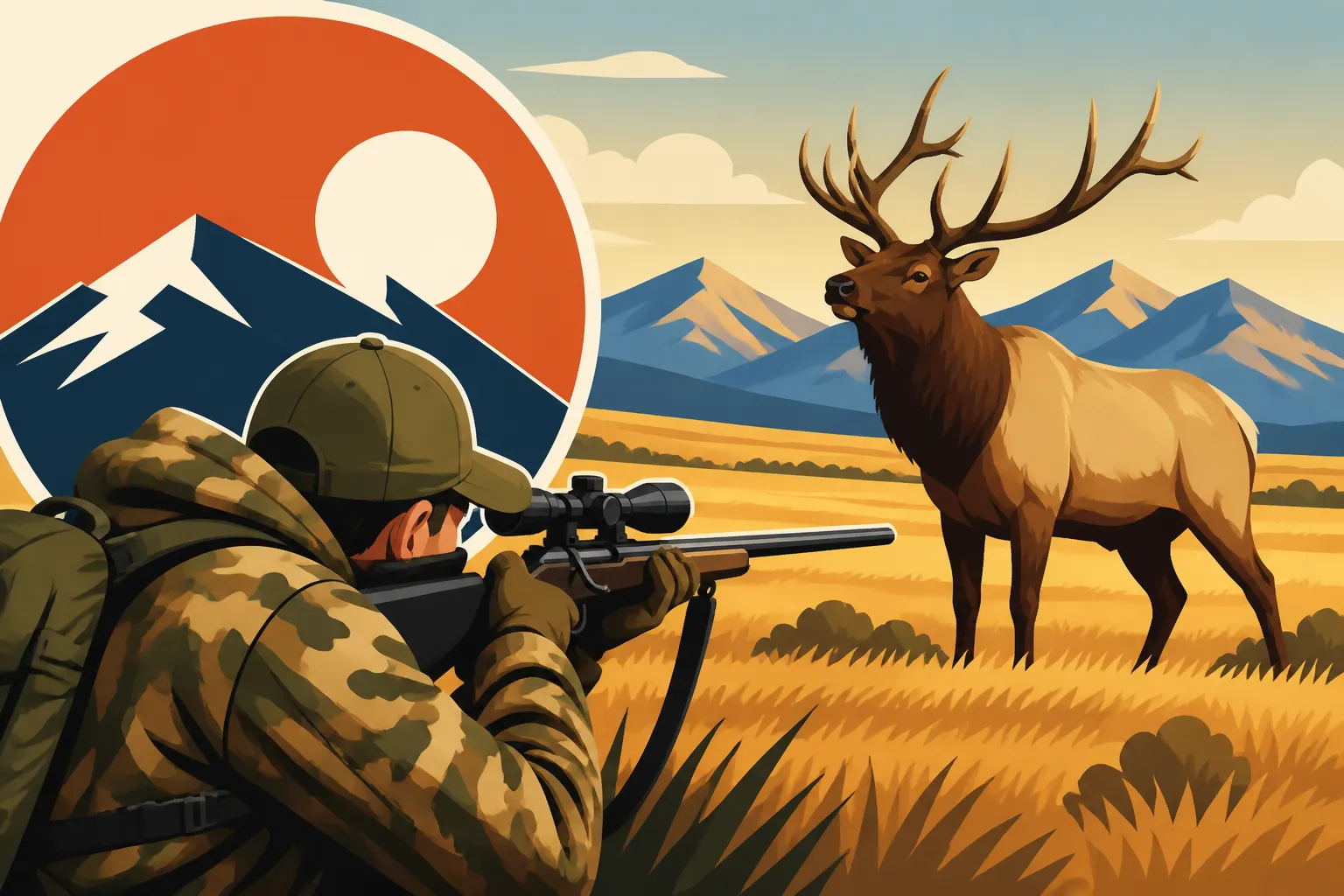
On the plains, your eyes and your optics are your primary hunting tools. Glassing is paramount. Instead of picking apart small pockets of timber, you’ll be systematically scanning vast fields, distant draws, and winding river bottoms for any sign of movement or the tell-tale shape of an elk. A high-quality spotting scope is almost a necessity for identifying elk at extreme distances and judging their size without spooking them. Learn to glass big Colorado basins and open country effectively, spending hours behind your glass, letting the landscape reveal its secrets slowly.
Once elk are spotted, the challenge shifts to the stalk. With limited cover, you'll need to use every rise, depression, and natural fold in the terrain to your advantage. Wind direction is even more critical here than in the mountains, as there's less topography to break or channel it predictably. A crosswind or headwind is your best friend. Be prepared for long, slow crawls and extreme patience. These elk are often very skittish due to their exposure and familiarity with human activity. While calling isn't as prevalent as in the rut-crazed mountains, soft cow calls or chirps can sometimes be effective for calming nervous animals or drawing in a curious bull if you can get close enough. This style of hunting closely mirrors the intense focus required for Spot-and-Stalk Hunting in Colorado.
Essential Gear Considerations for the Plains Hunter
Your gear list for a plains elk hunt will reflect the unique demands of the environment.
| Gear Category | Mountain Elk Hunting (Contrast) | Plains Rifle Elk Hunting (Focus) |
|---|---|---|
| Terrain | Steep, rocky, thick timber, high elevation | Open, rolling, agricultural, riparian zones |
| Physical Demands | Very high (climbing, heavy pack outs) | Moderate (walking long distances, less vertical) |
| Visibility | Often limited, short-range shots | Very high, long-range shots common |
| Optics | Good binoculars, rangefinder | Premium high-magnification binoculars, spotting scope, rangefinder (e.g., Swarovski, Leica) |
| Rifle/Caliber | Versatile, good for timber or open | Flat-shooting, accurate at long range (e.g., .270 Win, 7mm Rem Mag, .300 Win Mag) |
| Clothing | Layering for exertion/rest, moisture-wicking | Layering for cold/wind, windproof outer, insulating for static glassing |
| Footwear | Sturdy mountaineering boots | Comfortable, waterproof hiking boots |
| Primary Skill | Calling, tracking, endurance | Glassing, long-range shooting, stalking |
| Access | Public land, backcountry access | Primarily private land, landowner permission |
Optics: This is where you don't want to skimp. You'll spend hours behind glass, so investing in top-tier binoculars (10x-15x) and a powerful spotting scope (20-60x) is critical. A reliable rangefinder capable of accurately measuring long distances is non-negotiable. For detailed recommendations, see our guide on Best Optics for Colorado Big Game.
Rifle and Caliber: Given the likelihood of longer shots, a rifle chambered in a flat-shooting caliber is highly recommended. Think .270 Winchester, 7mm Remington Magnum, .300 Winchester Magnum, or even the newer 6.5 PRC or 7mm PRC. Accuracy is paramount, so practice shooting from various field positions out to 400-600 yards, or whatever your ethical maximum range is. Consult our guide on Best Rifle Calibers for Colorado Elk for more insights.
Clothing: While you might not be busting brush through deep snow, the plains can be brutally cold and windy, especially later in the season. Layering is essential, with a strong emphasis on windproof and insulating outer layers. Merino wool base layers and a quality puffy jacket are your friends.
Mapping and Navigation: A robust GPS mapping app like OnX Hunt is invaluable. It clearly delineates public and private land boundaries, allowing you to stay legal and avoid trespassing. The detail provided by such platforms, including those offered by GoHunt, is essential for planning your approach and understanding land ownership.
Expectations and Ethical Considerations
A plains rifle elk hunt can be an incredibly rewarding experience, offering a distinct challenge and often providing opportunities for impressive animals. However, it's crucial to approach it with realistic expectations and a deep commitment to ethical hunting practices, especially given the prevalence of private land and agricultural operations. This isn't a "gimme" hunt, but rather one that tests different skill sets and requires a high level of respect for both the game and the landowners who provide access.
Understanding the nuances of the plains environment and the behavior of the elk that call it home will set you up for success. Moreover, upholding the highest ethical standards will help ensure these unique hunting opportunities remain available for future generations.
Realistic Expectations and Challenges
While plains elk hunting can be physically less demanding than mountain hunting, don't mistake that for easy. The challenges are simply different. One of the biggest hurdles is often gaining legal access, as discussed earlier. Even with access, plains elk are notorious for being wary and difficult to approach. Their survival in open country depends on their keen senses and ability to disappear into surprisingly minimal cover. You might spend days glassing, only to have a herd vanish into a small draw or sprint across a field before you can get within range.
Success rates for plains rifle elk can vary wildly depending on the unit, tag type, and individual hunter effort and preparation. Don't expect a shot at every elk you see; many will be out of range, on private land where you lack permission, or simply too alert to allow a stalk. Patience is a virtue, and the ability to adapt to changing conditions—like a sudden change in wind or elk shifting feeding patterns—is crucial. For those just starting their elk hunting journey, understanding what's involved in Colorado Elk Hunting for Beginners is a great place to begin, even if your focus is on the plains. And if you're venturing onto any public land in these areas, be prepared for increased pressure, as even small parcels can attract many hunters, much like trying to find elk when they go quiet on public land pressure.
Ethical Hunting and Respect for the Landscape
Ethical conduct is paramount in all hunting, but it takes on a particularly significant role on the plains. Since so much hunting occurs on or adjacent to private property, always, always confirm your location and boundaries. Utilize your mapping apps rigorously. Never cross a fence or boundary without explicit permission. Respect for private property extends to not disturbing livestock, closing gates, and avoiding damage to crops or infrastructure. Building a positive relationship with local landowners is not only good for your hunt but also for the reputation of all hunters.
When it comes to the harvest, be prepared for potentially long retrieval distances across fields or difficult terrain. Cold weather during late seasons can be a blessing for meat care, but always have a plan for how you will quarter an elk in the field and get the meat out, especially if you're hunting solo or far from a vehicle. Knowing how to pack out an elk in Colorado, even across flat terrain, is crucial. Ensure you have the necessary game bags and coolers ready. Finally, practice impeccable "Leave No Trace" principles. Pack out all your trash, spent casings, and leave the land better than you found it. This goes a long way in maintaining positive public perception and securing future hunting opportunities.
Disclaimer
Please remember that hunting regulations, season dates, and unit boundaries are subject to change annually by Colorado Parks and Wildlife (CPW). Always consult the most current official CPW Big Game Brochure for the specific year you intend to hunt before making any plans or purchasing licenses. This guide offers general information and recommendations, but official CPW resources should always be your primary source of truth for all regulations and legal requirements.