Best Colorado Backcountry Elk Basins
Finding those truly hidden gems for elk in Colorado, the basins that hold unpressured animals and offer a genuine backcountry experience, can feel like searching for a needle in a haystack. With so much public land and so many hunters, it’s easy to get frustrated navigating dense timber and steep slopes only to find tracks of other hunters. This guide is dedicated to helping you unlock the secrets of Colorado's best backcountry elk basins, detailing why they're so productive, where to find them, and how to successfully hunt them, helping you avoid those crowded areas and find the solitude and success you're dreaming of.
The Allure of Colorado's Backcountry Elk Basins
There’s something truly special about dropping into a high-alpine basin, knowing that beyond the trailhead, it’s just you, the mountains, and the elk. These aren't just pretty places; they're vital elk habitat, offering a unique blend of solitude and resources that make them irresistible to big game, especially when hunting pressure builds in more accessible areas.
Why Basins Are Elk Magnets
Elk are creatures of comfort and security, much like us, and high-country basins provide both in spades. Think of a basin as a giant, natural fortress. They typically feature a sheltered, often bowl-shaped depression at high elevations, usually above 10,000 feet, surrounded by steep ridges or peaks. Inside this natural amphitheater, you’ll often find a mosaic of open parks, dense stands of timber (especially north-facing slopes with dark timber), willow bottoms, and critical water sources like alpine lakes, perennial streams, or wallows. This diverse terrain provides everything an elk needs: nutritious forage in the meadows and willow patches, thermal cover and security in the timber, and a constant supply of fresh water. During the heat of the day, elk can bed down in cool, dark timber, then emerge in the morning and evening to feed in the lush grasses.
What really makes these basins shine, however, is their remoteness. Many of the most productive basins are miles from the nearest road, requiring a significant physical effort to reach. This natural barrier discourages most hunters, especially those unwilling or unable to commit to a multi-day pack-in hunt. As a result, elk learn that these basins are safe havens, particularly during rifle seasons when lower, more accessible areas are swarming with orange vests. This creates a fascinating dynamic where elk will intentionally retreat to these high, rugged sanctuaries, making them prime targets for the adventurous hunter willing to put in the work. You might even find them to be crucial "refuge areas" when pressure mounts.
The Drawbacks and Realities of Basin Hunting
While the allure is strong, let’s be realistic: hunting Colorado's backcountry basins isn't a walk in the park. The first, and often most significant, hurdle is the sheer physical demand. You're often dealing with extreme elevations, sometimes well above 11,000 or even 12,000 feet, which means thinner air and a greater strain on your cardiovascular system. If you haven't put in the time to physically prepare for Colorado elk hunting, these basins will quickly expose any weaknesses. The terrain itself is another challenge – steep climbs, rocky scree fields, thick timber blowdowns, and long distances are the norm. Navigation can also be tricky without modern tools like the onX Hunt app, which allows you to download offline maps and pinpoint your exact location even without cell service.
Then there’s the logistics. A basin hunt almost always requires packing in all your gear for multiple days, often utilizing a spike camp or a full backcountry setup. This means carrying a heavy pack with shelter, food, water filters, cooking gear, and all your hunting essentials. Weather in the high country is notoriously unpredictable; a sunny morning can quickly turn into an afternoon thunderstorm, hail, or even an early-season snowstorm. You need to be prepared for anything, from scorching sun to freezing rain, sometimes within the same day. Finally, if you're lucky enough to harvest an elk, the hardest work begins: quartering the animal and then packing out an elk in Colorado, often over many miles of rugged terrain and multiple trips. It’s a monumental task that requires physical strength, mental fortitude, and a well-thought-out plan.
Top Contenders for Best Backcountry Elk Basins
Colorado is vast, and its mountain ranges offer an incredible array of backcountry opportunities. While specific named basins might change year to year based on snowpack, forage, and pressure, certain regions consistently produce due to their expansive wilderness and ideal habitat.
Northern Colorado's High Country Gems
When you look at the northern reaches of Colorado, areas like the Rawah Wilderness and parts of the Mount Zirkel Wilderness stand out. These regions are characterized by towering peaks, numerous alpine lakes, and a mix of dark timber, open meadows, and willow-choked creek bottoms – classic elk country.
In the Rawah, for example, you'll find a labyrinth of high-elevation cirques and glacial valleys. Access can be challenging, often requiring long hikes from trailheads, but the reward can be significant. Elk here are accustomed to the solitude and will utilize the timbered slopes for bedding during the day, moving into the expansive, lush meadows in the evenings and mornings. The sheer vastness means you can often find unpressured pockets of animals, even if you’re not the only one back there. Similarly, the Mount Zirkel Wilderness, with its extensive spruce and fir forests and high-alpine parks, offers similar opportunities. The areas west of the Continental Divide here are particularly rugged and remote, making them ideal for hunters seeking a truly solitary experience. Always keep an eye on weather patterns here; early season snow can be a factor, pushing elk down, but also concentrating them.
Central and Western Colorado Wilderness Strongholds
Moving west and south, several wilderness areas are legendary for their elk populations and expansive backcountry basins.
The Flat Tops Wilderness is arguably the most famous. It's unique for its expansive, high-elevation plateaus interspersed with deep, timbered drainages and numerous "flattop" mountains. While some areas are more accessible, the interior of the Flat Tops contains countless basins and hidden pockets that require serious effort to reach. Elk density here is legendary, and while it sees its fair share of pressure, the sheer size and ruggedness allow elk to disappear into its folds. Finding success often means knowing how to hunt elk at high elevation and being prepared to navigate complex topography.
Further south, the West Elk Wilderness and the Maroon Bells-Snowmass Wilderness offer incredibly steep, rugged, and breathtaking terrain. These are not for the faint of heart, but they hold some truly magnificent elk. The basins in these areas are often characterized by severe elevation changes, thick stands of aspens giving way to spruce-fir, and dramatic rock formations. Elk in these ranges are incredibly tough and adapt to the severe environment. Expect to find them utilizing north-facing slopes, dense timber, and remote cirques. These areas often require expert navigation and the ability to glass big Colorado basins effectively, as elk can be tiny specks against massive backdrops.
Then there are the San Juan Mountains, particularly within the Weminuche Wilderness and South San Juan Wilderness. This is some of the most remote and wildest country in Colorado, with numerous peaks soaring above 13,000 and 14,000 feet. The basins here are often massive, multi-tiered systems with a mix of timberline habitat, subalpine forests, and wide-open tundra. These areas are truly special, offering some of the most challenging yet rewarding elk hunting experiences. The sheer distance from roads means that once you’re in, you’re committed, and that’s exactly what separates the successful hunters from the rest. Consider researching specific GMUs like GMU 76 or GMU 78, known for their wilderness components.
Unpacking Specific Basins
While naming every specific basin would be impossible (and a bit of a secret-spill, honestly!), understanding the characteristics that define a prime basin can help you scout your own. Look for basins that are:
- Roadless and Remote: The further from a trailhead, the better. Often, this means looking for areas accessible only by long trails or those requiring significant elevation gain.
- Diverse Habitat: Basins that offer a mix of open forage (grasses, forbs, willows), dense thermal cover (spruce, fir, dark timber), and water are key. Elk need all three to thrive.
- Complex Topography: Multiple smaller drainages within a larger basin, saddles, benches, and steep escape routes provide elk with security and options to evade pressure.
- North-Facing Slopes: These typically hold snow longer, stay cooler in early season, and often grow denser, more mature timber, offering prime bedding cover. Learning how to hunt north-facing slopes for elk is a fundamental skill.
Example Scenario: Imagine a basin deep within the Flat Tops. You've hiked five miles in, crossing a series of rolling meadows. Ahead, the terrain steepens into a bowl-shaped amphitheater, ringed by craggy peaks. On the shaded north side, a thick stand of spruce-fir drops into a willow-choked stream bottom where a small alpine lake collects snowmelt. The southern slopes are more open, sun-drenched, with scattered aspens and pockets of pine. This is textbook elk country. You’d expect elk to be feeding in the willow bottom or open parks at dawn and dusk, then retreating to the cool, dark timber on the north slope to bed during the day. This is where scouting with tools like GoHunt or onX Hunt can help you identify these features on a map before you ever set foot on the mountain.
Strategies for Tackling Colorado's Backcountry Basins
Success in these challenging environments isn't accidental. It's the culmination of meticulous planning, rigorous physical preparation, and astute on-the-ground tactics.
Essential E-Scouting and Pre-Season Planning
Before you even tie your boots, the hunt begins from your computer. E-scouting is absolutely critical for basin hunting. Start by identifying potential wilderness areas or large roadless tracts. Use online mapping tools like onX Hunt to analyze topography, identifying potential basins, travel corridors, bedding areas (dense timber on north-facing slopes), and feeding zones (open meadows, willow bottoms). Look for water sources, saddles, and benches that might serve as natural funnels. You can overlay different map layers, like satellite imagery and topographical maps, to get a comprehensive view.
Don't stop there. Research historical elk movement patterns for the specific Game Management Unit (GMU) you’re targeting. Pay attention to how weather, especially early snow, can influence migration. Websites like GoHunt provide a wealth of data on draw odds, success rates, and unit breakdowns that can inform your decisions. Once you've identified a promising basin, zoom in and virtually walk the terrain. Identify potential routes in and out, possible spike camp locations, and even areas that might be too steep or brushy to navigate efficiently. This detailed pre-planning will save you precious time and energy when you're on the ground, minimizing surprises and maximizing your hunting efficiency. Thinking about how to E-Scout Before a Colorado Hunt is a non-negotiable step.
Physical and Mental Preparation is Key
Let's be blunt: a Colorado backcountry elk hunt, especially into high-alpine basins, is not for the physically unprepared. The elevation alone is a significant factor. Most prime basins are well above 10,000 feet, where the air has significantly less oxygen. This can lead to altitude sickness if you're not acclimated. Months before your hunt, you should be on a serious fitness regimen. Focus on cardiovascular endurance (running, hiking, cycling) and strength training, particularly for your legs and core. Simulating the demands of hunting is ideal, so try hiking with a weighted pack on steep inclines. Many hunters pursue an altitude training for Colorado hunting plan to get ready.
Beyond the physical, mental toughness is paramount. You'll face discomfort, exhaustion, unpredictable weather, and potentially long stretches without seeing animals. There will be moments of doubt and frustration. The ability to push through these challenges, to remain positive, and to maintain focus is what separates those who succeed from those who pack it in early. Understand that setbacks are part of the journey and embrace the grind.
On-the-Ground Tactics for Basin Success
Once you’re in the basin, your tactics need to adapt to the environment. The first crucial step is to move slowly and deliberately. This isn't a race. You're trying to integrate yourself into the elk's world, not disrupt it. Pay close attention to the wind and thermals. In mountain basins, thermals typically rise in the morning and fall in the evening. Understanding how to use thermals in Colorado elk country is vital; your scent can carry for miles in these open environments.
Key Tactics:
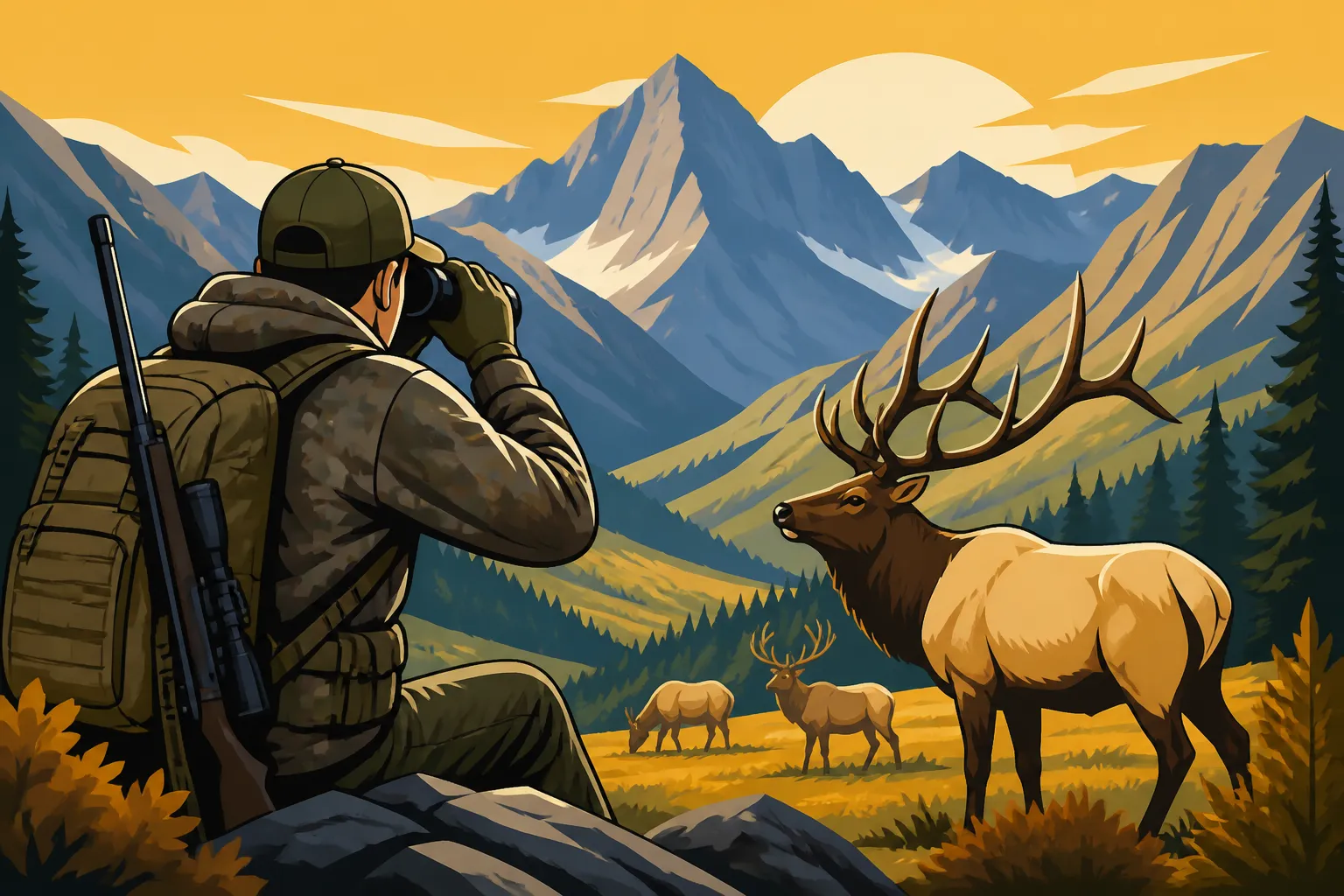
- Glassing: Basins often offer expansive views. Find a high vantage point, settle in, and meticulously glass every inch of the opposing slopes, timber edges, and meadows. Quality optics are invaluable here. Many experienced hunters will spend the first few hours of daylight and the last few hours of evening light glassing, letting their binoculars do the walking. Learning how to glass big Colorado basins is a skill that takes practice.
- Still-Hunting and Calling: Once you’ve identified a promising area or heard an elk, a slow, methodical still-hunt through timbered areas can be effective. If it's archery season or early rifle, calling can be very productive. Bulls will often bugle in the mornings and evenings, giving away their location. Knowing how to bugle-locate a Colorado bull or how to cow call Colorado elk can draw them in.
- Morning and Evening Movements: Elk will typically move from bedding areas (often dense timber on north slopes) to feeding areas (open parks, willow bottoms) at dawn and dusk. Set up ambush points along these travel corridors or position yourself to intercept them as they move.
- Mid-Day Strategy: Don't quit when the sun is high. Elk are often bedded in dense cover during the middle of the day. This is a perfect time for a quiet, slow stalk through prime bedding areas, or to target wallows or water holes where elk might come to drink. How to Hunt Elk Wallows in Colorado can be a very effective mid-day strategy.
Navigating the Unique Challenges of Basin Hunting
Even with the best planning and execution, backcountry basin hunting throws curveballs. Being prepared for these challenges is part of the experience.
Weather, Altitude, and Remote Logistics
I’ve mentioned it before, but the weather in Colorado’s high country is a beast of its own. Sunny and warm one minute, hail and snow the next. Always pack for all four seasons, even in early archery season. Layering is key, and having high-quality rain gear and insulation is non-negotiable. Freezing temperatures at night are common, even in August. Snow in September or October can drastically change elk behavior, pushing them lower or concentrating them in specific drainages. Learning how to hunt elk in the snow requires different strategies, focusing on tracks and migration routes.
Altitude sickness is another real threat. Symptoms can range from mild headaches and nausea to severe, life-threatening conditions. Acclimatize if possible by spending a day or two at moderate elevation before heading into the high country. Stay hydrated, eat well, and don't overexert yourself on the first day. Medications like Diamox can also help, but consult your doctor well in advance. Remote logistics also mean carrying a comprehensive first-aid kit, knowing how to purify water, and having a reliable communication device like a satellite messenger (Garmin InReach, Zoleo, or Spot X) for emergencies, as cell service will be nonexistent in many basins. This is why having a robust Colorado Backcountry Hunting Gear List is so important.
Handling Hunting Pressure in Seemingly Remote Areas
It’s easy to assume that because you're miles from the road, you’ll have a basin all to yourself. While the deep backcountry does thin the herd of hunters, popular basins, especially those with established trails, can still see significant pressure. This is particularly true during rifle seasons. Don't be surprised to find other camps or hear distant shots.
The key to success in these situations is to go deeper, higher, or steeper than others. Look for drainages or sub-basins that require even more effort to reach. Study your onX Hunt app for small, untrailed pockets of public land adjacent to the main basin. Elk will often retreat to these impenetrable-looking areas when pressure is on. Hunting midday, when most hunters are back in camp, can also be productive. Understanding how to find elk refuge areas and adapt your tactics when you encounter other hunters is crucial. Often, elk will move into the darkest, thickest timber during the day to escape human activity, only to emerge at dawn and dusk.
Packing Out Your Hard-Earned Elk
Let's not sugarcoat it: packing out an elk from a backcountry basin is an epic undertaking. If you're fortunate enough to drop a bull or cow several miles from the trailhead, be prepared for one of the most physically demanding experiences of your life. The average bull elk can weigh over 700 pounds live, translating to hundreds of pounds of meat, hide, and antlers.
The first step is proper field dressing and quartering. You'll need a sharp knife, game bags, and a clear understanding of how to quarter an elk in the field. Breaking the animal down into manageable pieces is essential for multiple pack loads. From there, it's about strategy. Most hunters will make multiple trips, packing out one quarter at a time. This is where your physical preparation truly pays off. A good internal frame backpack, like those from Kifaru, Mystery Ranch, or EXO Mountain Gear, is critical for comfortably carrying heavy loads over uneven terrain. Keep the meat cool and clean, especially if warm weather is a concern. If you're hunting solo, learning how to pack out elk meat solo is a vital skill and requires even more careful planning and physical conditioning.
Even with the challenges, the feeling of packing out an elk from a remote Colorado basin is unmatched. It's a testament to your dedication, resilience, and the wild spirit of the mountains.
Colorado Backcountry Basin Hunting Gear Essentials
| Item Category | Essential Items | Notes |
|---|---|---|
| Navigation | GPS Unit or Smartphone with onX Hunt app |
Download offline maps for your GMU. Essential for staying found and navigating complex terrain. |
| Topographical Maps (paper) and Compass | Backup to electronic devices. Know how to use them. | |
| Shelter & Sleep | Lightweight Tent or Bivy Sack | Suitable for high-altitude, unpredictable weather. |
| Sleeping Bag (0-20°F rated) | Even in early archery, nights can be freezing. | |
| Sleeping Pad | Crucial for insulation from the cold ground. | |
| Clothing | Layering System (Base, Mid, Outer) | Moisture-wicking base layers, insulating mid-layers (fleece/puffy), waterproof/windproof outer shell. |
| Warm Hat, Gloves/Mittens | Even in September. | |
| Quality Hiking/Hunting Boots | Broken-in, waterproof, good ankle support. Arguably the most important piece of gear. | |
| Optics | Binoculars (10×42 or 12×50 recommended) | Essential for glassing vast basins. |
| Spotting Scope (20-60x or 15-45x) and Tripod | Highly recommended for detailed scouting and judging animals at long distances. | |
| Food & Water | High-Calorie, Lightweight Food (freeze-dried meals) | Enough for duration of hunt plus extra days for emergencies. |
| Water Filter/Purifier | Access to clean water is crucial. | |
| Water Bottles/Bladder | ||
| Safety & Survival | First-Aid Kit (comprehensive) | Blister care, pain relievers, emergency meds, trauma supplies. |
| Headlamp with extra batteries | ||
| Fire Starter (lighter, waterproof matches) | ||
| Emergency Blanket/Bivy | ||
| Satellite Messenger (InReach, Zoleo, Spot X) | For emergency communication where cell service doesn't exist. | |
| Hunting Specific | Hunting Pack (60-80+ liters) | Designed to carry heavy loads, an integral frame for packing meat. See a good guide on the Best Backpack for a Colorado Elk Hunt. |
| Game Bags | Lightweight, breathable bags for protecting meat. | |
| Sharp Knife & Sharpener | For field dressing and quartering. | |
| Trekking Poles | Reduce strain on knees, aid balance on steep terrain, especially with heavy loads. | |
| Weapon (Bow, Rifle, Muzzleloader) | Ensure it’s sighted in and you are proficient, considering how to shoot uphill and downhill at elk. | |
| Calls (Bugle, Cow Call) | If planning to call. | |
| Miscellaneous | Sunglasses & Sunscreen | High altitude UV is intense. |
| Lip Balm | ||
| Camp Towel/Wipes | For hygiene. |
Disclaimer
Hunting in Colorado's backcountry involves inherent risks, including but not limited to adverse weather conditions, dangerous wildlife encounters, difficult terrain, and the potential for serious injury or death. Always prioritize safety, understand and follow all Colorado Parks and Wildlife regulations, and ensure you have the necessary skills, physical fitness, and equipment for your chosen hunt. This guide is for informational purposes only and does not replace proper training, experience, or professional guidance.